StartUp Communities, Ecosystems

I participated in a WBZ radio breakfast panel yesterday on the Boston start-up community and recently delivered the presentation below at the Harvard Innovation Lab as part of an HBS Entrepreneurship Club Event.  It reflects a survey of the local start-up ecosystem that dissects what it takes to build a great ecosystem.


My friend Brad Feld talks about this topic in his new book on Startup Communities, as summarized in his fun Kauffman video "Sketchbook":

Software Is Eating Marketing

When I was a kid, "The Graduate" was a generation-defining hit movie, with Dustin Hoffman playing an aimless college graduate. In the middle of a graduation party, an older businessman takes the wayward Hoffman aside and delivers some wise advice: “plastics.” That should be the field his generation should focus on, the field that would shape the future.

Today’s advice for aspiring graduates is also a single word: “software.”  

In a sweeping Wall Street Journal article last summer, Netscape founder Marc Andreessen identifies the 21stcentury phenomenon of software eating the world. Software is disrupting industry after industry and transforming large swathes of the economy. When I was an entrepreneur in the 1990s, I would debate with my investors what sliver of the $70 billion U.S. software industry we could carve out. 

Today, as a venture capitalist, I meet with entrepreneurs who are trying to figure out what portion of the $70 trillion global economy they can dominate.

Within the $1 trillion marketing industry, the impact of software eating marketing has now reached the board room.  With the explosion of digital marketing, it is clear that technology is radically transforming the marketing function and the role of the marketing professional. 

The changes rippling through the marketing industry goes far beyond the simple mantra of “follow the eyeballs” to different screens.  Gartner analyst Laura McLellan predicts that by 2017, CMOs will spend more on IT than CIOs.  The repercussions of social, mobile, video, Big Data, CRM, cloud and other disruptive forces are impacting all aspects of business, but particularly marketing. 

As a result, marketing leaders and agencies now carry the burden of understanding technology’s impact on their business, the entire customer experience, and leading innovation within their enterprises, not simply following a course set by their IT department.                             

“Madison Avenue meets MIT” and “Revenge of the Nerds” are common themes in marketing circles as technologists are becoming the rock stars of customer engagement — employing algorithms and analytics along with artistic creativity to win market share. In much the way Apple disrupted the music and phone industries with smart industrial design and clever software that shielded users from complexity, technologists are building sophisticated systems with interfaces that are as simple for marketers and designers to manipulate as their iPhones.

MITX, the Massachusetts Interactive Technology Exchange (and an organization I serve on the board of) is putting on a killer conference on this topic called FutureM that kicks off on October 22nd.  FutureM will gather marketing and technology leaders to address these challenges head on, exposing marketers to today’s most innovative thought leaders and companies who are transforming marketing.

Hosted in Boston, at the nexus of the technology and advertising industry, FutureM is a weeklong extravaganza that will bring together marketing artists and marketing scientists, left brain and right brain thinkers alike, to debate the most pressing issues facing the industry. FutureM is fast becoming the equivalent of SXSW, the place to get inspired and see what’s next, but focused on digital marketing.  

If you think the last few years were disruptive, imagine how much the marketing industry will be transformed in the next three years!

(a version of this post originally appeared in Mediapost)

Back to School Blog – Fall 2012

(Note: this post is an open letter to the approximately 400,000 members of the Massachusetts-based student community. Many of the messages apply to students in other innovation hubs.)

Dear student,

Welcome (back)!  Now that you have unpacked the underwear, laid out the futon,
picked your courses and settled in a bit, I wanted to write to you about
something important.

Just as you were selected by your school amongst many applicants, we know that you chose to make the greater Boston community your home in selecting your school. For that, we
thank you.

But more than thanking you, on behalf of the Massachusetts Innovation Economy community, I wanted to make sure you understood something.  We want you.

We want you to learn, engage, show up,
contribute and – most important – stay when you graduate. One of our core values in this community is supporting innovation and young people.  We have a long history of fostering amazing student entrepreneurs, many of whom you know all about (like Zuckerberg and Facebook, or Houston and Dropbox) to some you may not know about (like the three Babson students who founded IdeaPaint or the two Harvard students who started IP TV pioneer Tivli).  And everyone in the community is fired up to support you, from civic leaders to business leaders and fellow entrepreneurs.

At 600,000 people, this city is small. Even with a larger metropolitan area of 4.5 million, there is a strong sense of intimacy and community here. This sense of intimacy contributes to why the innovation community here is so accessible.  As you are out and about, you will quickly learn that this is a very open and friendly town, particularly for students who hustle.

So here are a few tips for you as you think about exploring what the innovation community has to offer:

  • Attend an event.  Greenhorn Connect is the definitive listing of all the local events in the entrepreneurial community.  My firm, Flybridge Capital, created a scholarship program to support local students who want to attend events called Stay in MA.  Take advantage of the free passes on us and law firm Gunderson Dettmer and get out there!
  • Invite an entrepreneur to speak on campus.  I am amazed at how accessible and giving the entrepreneurial community is.  "Pay it forward" is the local motto and entrepreneurs are always telling me they love meeting with students and speaking on campus.  If you read about someone you think would be interesting, reach out.

There are a few standout examples of students who are making an impact in the local community that are worth highlighting as role models for their peers:

  • Cory Botolsky.  This Northeastern junior decided that not enough students were finding jobs at startups.  So, he created StartUp Summer and helped facilitate over 100 summer internships to help students get exposed to the local entrepreneurial community. 
  • Scott Crouch.  A Harvard senior, Crouch spent his summer shuttling back and forth between Springfield and Cambridge as he collaborated with the police department and state troopers to use social media and pattern recognition software to combat gang violence.  His work was featured in this Boston.com article and the New York Times.
  • Anna Palmer and Christine Rizk.  These two Harvard Law School graduates have launched a new company called Fashion Project that is helping non-profits make more money by providing a marketplace to sell high-end, donated goods more efficiently.  They are a part of the Techstars 2012 class.
  • Zach Ringer.  A Babson senior, Ringer has jumped into the entrepreneurial community with two feet.  He secured an internship with a hot mobile start-up, Crashlytics, by merely aggressively tweeting and engaging in the community.  He is always attending events at Mass Challenge and the Cambridge Innovation Center and is leading a number of entrepreneurial initiatives on the Babson campus.

What will you do this year to get engaged?  I urge you to make your presence felt beyond the classroom and frat
house. The local community you have chosen to be with wants you.

Have a great school
year!

Scaling is Hard, Case Study: athenahealth

There are many companies that are competing to be the “operating system” for small businesses. The theory is that with the advent of the cloud in the digital age, small businesses can leverage a suite of services from a technology vendor to manage all aspects of their work – from payments to record-keeping to marketing to customer communications.  Among those competing for this vision are PayPal/eBay, Square and Groupon, with each struggling to pull together pieces of the equation and, importantly, reach the small business in a cost-efficient manner at scale.

One company in Watertown, Massachusetts has been executing on this vision for over a decade with a winning approach for one vertical slice of the small business market: physicians.  Although this is not typically how athenahealth is described, it is one way to describe what they are doing that mainstream members of the technology community might understand.  I have found it pretty amazing that so few people in the tech community know their story or understand the scale and scope of what they have achieved.  That is why I’ve chosen athenahealth for the third in my series on scaling (following Akamai and TripAdvisor).

Founding Story:  A Pivot

Athenahealth version 1.0 was a complete failure.  The company was originally founded in 1997 by Jonathan Bush (1st cousin of George W.) and Todd Park, a pair of Booz Allen consultants, as a physician practice management company for obstetrics.  As they tried to execute on their original vision, the pair became incredibly frustrated with the difficulty of turning medical claims into cash.  Payers took months to reimburse their practice for patients’ medical claims.  Park began to write software to try to speed up the process, automating countless manual steps and creating a user interface that would be simple enough for doctors and medical clerks to use.

It turned out, the physician practices loved the software, but didn’t love the practice management services.  The doctors wanted to run their own practices, but use athena’s software to speed up billing.  Bush and Park remembered the advice one of their early angel investors had given them:

“Get close enough to your customer to understand what they really want.  And once you understand what they really want; once that opportunity comes knocking on the door; for crying out loud, answer the door.”

The founding pair realized that they needed to pivot into becoming a software company, and in late 1998, completely shifted their focus to delivering athenaNet, their Web-based medical billing platform, as a cloud-based software service for all doctors.  Scaling Lesson #1:  get close to customers early, really close, to help inform your pivots.  And when you do pivot, pivot hard.

Over time, the functionality athena delivered to doctors expanded, all with the vision of simplying the administrative burden on medical practices.  From collections and revenue lifecycle management (called Collector) to clincial documentation and electronic medical records (Clinicals) as well as patient communication (Communicator) – athena now provides a full suite of cloud-based automation software for doctors.  In effect, they have become the Salesforce.com of the health care vertical.  Scaling lesson #2:  Once you find product-market fit with a customer segment, scale up by offering other products that solve other hard problems to that customer segment.

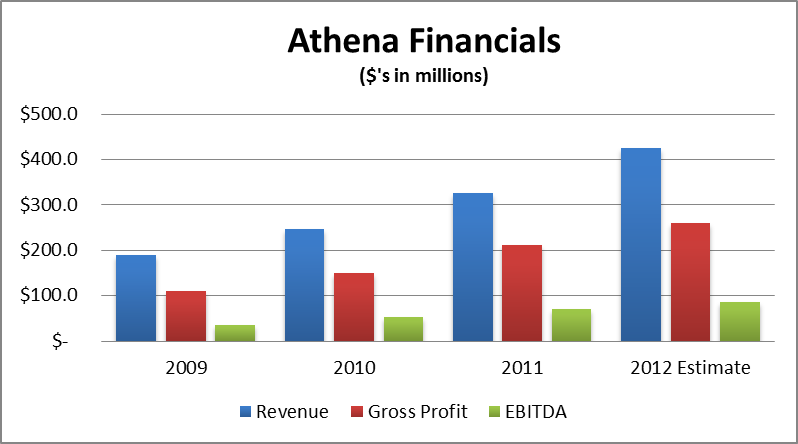
Athena’s financial performance has steadily grown alongside their product footprint and physician penetration.  In 2012, analysts estimate they will do $425 million in revenue and $85 million in EBITDA.  The company’s market capitalizaiton is $3.2 billion.  See chart below:

Athena Financials

The reach the organization has achieved is impressive, but still only a fraction of the market opportunity.  Below you can see the number of doctors in the athenahealth network – which is over 25,000.  There are nearly 1 million physicians in the US.

Athena Table

Athenahealth’s Culture

For the 15 years since inception, CEO and cofounder Bush has run athenahealth end-to-end.  A remarkable entrepreneurial story, similar to TripAdvisor and Akamai, where the founder (or near-founder in the case of Akamai’s Paul Sagan) lead the business over many years.  Cofounder Todd Park, who is now the Chief Technology Officer for the United States, joked in an interview that medical billing is hardly “sexy”, but that by emphasizing the “doing well by doing good” aspects of their vision, athenahealth was able to create a powerful, mission-driven culture.  Bush and Park both emphasize culture in all aspects of the business.  Scaling Lessong #3:  A mission-driven culture (as opposed to green-driven or fear-driven) endures, particularly when the mission connects to a greater social good.

But athenahealth’s culture is more than just a bunch of do-gooders.  Their performance management system is very sophisticated.  One former executive described to me how transparent the organization is with respect to goals and metrics and how well-designed their Balanced Scorecard is for each individual and department.  The company shares that Balanced Scorecard on each quarterly earnings call as well.  As a result, everyone in the organization has a clear view of what the priorities are.  The scorecard includes five major components:  stability, operational performance, client satisfaction, financial performance and growth.  Scaling Lesson #4:  performance management systems and communications systems need to mature and be implemented as the company grows to maintain clarity and transparency.

Visionary CEO

As anyone who has met him can tell you, Jonathan Bush is a unique founder/CEO.  He is open, transparent and (at times painfully) authentic.   I love that his candor and humor haven’t changed, even as he has matured into the CEO of a multi-billion dollar market cap company.  Read the recent Q2 earnings call transcript, and you’ll get a clear sense of what I mean.  During the Q&A, when he’s talking off script, you’ll see a few funny quotes:

Well, one of the great lessons that we all learned in The Princess Bride is never get involved in a land war in Cleveland. [in reference to a slow roll-out at a hospital]

Life, Anthony. It’s a contract for life. All of our contacts are for life. They can all leave whenever they want, but hopefully, we don’t get boring. We keep changing our outfits, and they stay forever. We cut our hair short, we let it grow long. We have contracts for life. [when asked how long the term of a particular large deal was]


Jonathan’s humor stands out, but his willingness to put himself “out there” and be so authentic and direct is not unusual for many founders.  The athenahealth lesson is about passion, endurance and perserverance.  Much like Akamai and TripAdvisor.  Those appear to be the consistent attributes for scaling companies.

Dave McClure Misses An Additional VC Trend…Outside Silicon Valley

There is alot I like about Dave McClure's post on VC industry trends. It captures many of the trends of that are transforming the venture capital industry, particularly the bifurcation of "mega VC" and "micro VC" funds. But I think he's missing one important trend that is happening outside of Silicon Valley.

For those of us who practice the VC craft outside of Silicon Valley, it is clear that the mega VC strategy just doesn't work. VC can't successfully deploy $1 billion unless they are investors in mega hits like Facebook, LinkedIn, Twitter and the like that have the potential to generate > $10 billion exits. Nearly all of the mega hits have been Silicon Valley based. Most of the recent big successful exits outside Silicon Valley (e.g., Buddy Media, Demandware, Endeca, Millenial Media) have been in the $500 million – $1 billion range. If you have a $1 billion fund and need to generate 3x to be successful, that's $3 billion in returns. If you own an average of 15-20% per company, that's $15-20 billion in exits. You can't get there $500 million at a time.

The micro VC strategy also is particularly well-suited for Silicon Valley. The successful micro VCs get into the mega-successes early, and also benefit from the high number of quick flips. Some micro VCs are attempting to make this model work outside Silicon Valley (e.g., Founder Collective, Lerer Ventures, NextView), and are seeing early promise, but the results of that strategy is still too early to call.

What is working outside Silicon Valley is small, focused, lifecycle funds. $150-300 million in size, funds like Union Square (NYC), Foundry (Colorado), Spark (Boston) are among those that have generated the best returns for their LPs this decade. These funds, who are neither mega VCs nor micro VCs. They are in the middle. Outside Silicon Valley, being in the middle can work well because you can get in early with small dollars, like a seed fund does, but get fully behind your winners and own 15-20% for $8-12 million. When the $500 million exit is available, you take it and the fund is small enough that it has a big impact. When you have an opportunity to attempt a mega exit and it is time to raise a mega round of financing, you simply go to the mega fund.

A number of companies in our portfolio have followed this strategy. In our first round of financing, we invested $1 million in Open English, an English language learning platform. Over a few years, we kept investing as the company grew. Once the company achieved real scale, mega fund Insight came in and invested $43 million. Similarly, 10gen was at a very early stage when we and Union Square invested. As the company grew and achieved scale, it came time for a mega round. NEA led a $40 million round last quarter.

At Flybridge, we are trying to execute on that middle strategy outside Silicon Valley – a small, focused fund that will invest early and work hard alongside companies for their full lifecycle to generate solid exits sometimes and, hopefully, one or two mega exits.

So far, this strategy is working for us and others. Whether it works in Silicon Valley, I can't say.

Scaling is Hard, Case Study: TripAdvisor

“TripAdvisor is to travel reviews what Kleenex is to tissues.”


– Henry Harteveldt, Forrester


TripAdvisor may be one of the most fascinating companies I know and so I was excited to dig into their business model as part of my series on scaling.  This is a company that took $4 million of invested capital to build a company now worth over $4 billion.

As I mentioned in my post last week, scaling is hard.  Really hard.  As we have seen with the recent speed bumps at highfliers like Groupon and Zynga, taking “lean startups” from foundation to creating sustainable, scalable, profitable business models is a very rare and special task.  That’s why I embarked on this series:  to highlight a few companies outside of the Google/Amazon/Facebook pantheon that have built large, sustainable, profitable business models at scale.

Last week, I wrote about Akamai, a company with strong network effects that successfully transitioned from a single product to build a platform that garners over a billion dollars in revenue and is now a core part of the Internet’s fabric.  TripAdvisor is more of a classic consumer Internet success story, but with even more powerful network effects and an amazing business model.  Magical, really.

TripAdvisor’s History:  Two Big Pivots

Founded in 2000 by Stephen Kaufer and Langley Steinert, Boston-based TripAdvisor is a travel website that provides reviews and other information for consumers about travel destinations around the world.  The company is now pervasive – with 65 million unique visitors each month scouring the site for reviews of hotels, restaurants and sites around the globe.  I remember last year settling into the booth of a café deep in the rainforest in Costa Rica and looking up to see a placard on the table begging for a positive TripAdvisor review.

Chatting with CEO and cofounder Kaufer this week, I was reminded of the fact that the company started with a very different business model in mind.  I first met Steve when he was VP of Engineering at Centerline software, a software development tools startup, and I was a junior in college.  He was a fellow Harvard computer science graduate and I was looking for a summer job in software development and found him through an alumni directory.  In founding TripAdvisor, Kaufer wanted to take his hard core engineering skills and apply them to vertical search in travel.  That is, build a massive database of travel information that provided a white label search engine for travel sites like Expedia and Travelocity.  Big Data meets travel…in 2000.

Kaufer described to me with some chagrin what happened – after a year and a half, he had no clients and no revenue and was running out of money.  Then, 9/11 hit and the travel industry was decimated.  Kaufer began to despair that his fledging start-up would go under.  Fortunately, on the side, the company had built up TripAdvisor.com as a demo site to show the prospective clients what a vertical search engine could do.  When he saw TripAdvisor.com start to pick up traffic, he decided to pursue an online advertising based business model with banner ads.  “Going B2C was daunting and not in our core DNA,” Kaufer remarked.  But testing hypotheses was very much in the company's DNA, as well as evaluating data to learn and adjust.  TripAdvisor, in effect, was a model lean start-up with an engineering-driven, product-focused founder.

After a few weeks of watching no click throughs, Kaufer executed his second pivot:  a cost per click model (now known as CPC).  Every time a consumer clicked on a hotel to book a room, TripAdvisor would charge the hotel something.  Suddenly, everything began to (literally) click.  Three months into launching the new model, TripAdvisor was earning $70k per month and achieved breakeven.  The company has grown profitably ever since. Kaufer originally hired editors to comb the Web for great travel articles and link to them, and then allowed users to post their own reviews on the site as a whim.  When the company saw that user reviews were getting all the traffic, they adjusted to focus on user reviews, such that fresh, authentic content was always available and didn’t cost the company any money to produce.

TripAdvisor And Expedia:  From $4 million invested to $4 billion in value 

With these adjustments, TripAdvisor grew rapidly and successfully.  The company agreed to be acquired by Expedia/IAC in 2004 for $210 million in cash, a huge win for all, particularly given their amazing capital efficiency:  they had only raised $4 million in venture capital.  Under Expedia, TripAdvisor continued to flourish and grow – they would feature Expedia’s ads on their site and reap the revenue benefit when users clicked on those ads.  Expedia grew to account for roughly one third of the company’s revenues.  In December 2011, Expedia felt it wasn’t getting full economic credit for TripAdvisor buried within its financials and so spun TripAdvisor out as an independent company, where it now trades on the NASDAQ with a $4.8 billion market capitalization as of this writing. 

Scaling Lesson 1:  Focus On Finding A Great Business Model

After some searching, TripAdvisor found a magical business model, representing social media and user-generated content at its best.  Content is free and supplied by consumers who write reviews voluntarily.  These consumers allow this content and their own engagement to be monetized without asking for anything in return.  Customer acquisition is driven mainly through natural search (the art of Search Engine Optimization, or SEO, was practically invented by TripAdvisor) thanks to the huge volume of great content (as Kaufer pointed out to me:  “if a review comes on in Thai of a Bangkok hotel, suddenly it’s a better product”), long history and brilliant manipulation of Google’s search algorithm.  Advertisers are brought to the site and driven mainly through self-service channels, so there is no need for a large sales force or account management team.  As a result, gross margins are very high at 98% (not a typo!) and EBITDA margins are 47%.  Think about that.  For every dollar of revenue, the company is able to drop nearly half to the bottom line.  I’m not sure the Mafia could do better.  In the hyper-competitive world of technology and consumer Internet, it is hard to find a company that is pound for pound as profitable as TripAdvisor.

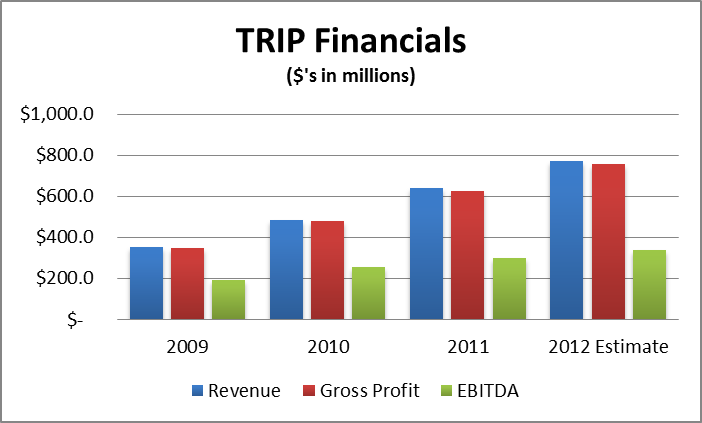
TripAdvisor is a classic example of a network effect business and a reminder of how financially attractive network effect businesses can become at scale.  There are three sides to the network:  the consumer, the venue and the advertiser.  The network becomes more valuable as it grows to each party – with more consumers providing more interesting content, more venues providing more access to vacation options and more advertisers offering deals and convenient bookings.  This virtuous cycle has fueled its growth nicely and allowed the company to drive very efficient value.  The chart below shows their financial performance over the last few years, with forecasted 2012 revenue of $767M and EBITDA of $339M.  At its current 20-25% revenue growth rate, TripAdvisor will join Akamai in the billion dollar revenue club in 2014.  The $4.8B market cap is 6x revenue and 13x EBITDA, so not insane multiples on a comparable basis.

TRIP Financials

As a side bar, I thought it would be interesting to compare TripAdvisor’s Unit Economics with those of Yelp and foursquare.  I took a few of the relevant metrics – unique visitors, revenue and market capitalization – and calculated a few ratios to demonstrate how good a job TripAdvisors does at monetizing their users.  Here's unique visitors, with an estimate for foursquare based on some of their reported numbers:

Monthly Unique Visitors (2)

As the chart below shows, TripAdvisor consistently achieves $12 annual revenue per user (ARPU) as compared to $1 for Yelp and unknown for foursquare. 

ARPU (2)

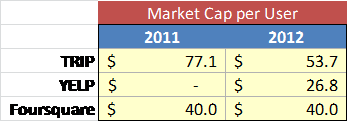
Yet on a market capitalization side, despite having a 12x advantage in monetization, the company is valued only 2x per user by Wall Street than Yelp and a mere 25% higher than foursquare, based on its most recent private financing round (reported to be somewhere north of $400 million pre-money).  Amazing. 
Market Cap per User

Scaling Lesson 2:  Maintain a Sense of Urgency

Kaufer’s description of the TripAdvisor culture and development process makes it clear that he has been able to maintain a strong sense of urgency, even at scale.  “No matter how large we are, I always want to maintain a startup mentality,” said Kaufer.  "We have a once a week release cycle that we have religiously maintained for years…even with hundreds of developers working on a shared code base.  If my team tells me they want to launch a new feature in two months, I ask them what prevents them from doing it in two weeks.  Culturally, I’m happy to play the ‘crazy CEO who doesn’t get how hard it is to build and release stuff’ in order to push.”  I know many CEOs who don’t have the same comfort pushing their engineering teams.  I wonder if Kaufer’s ability is here is in part grounded in the fact that he himself was a vice president of engineering and feels comfortable challenging his product team with authority. 

Scaling Lesson 3:  Maintain a Product Focused Culture

Kaufer described to me that with his engineering roots, the company has always had a test and learn culture and a product-focused culture.  “I enjoy focusing on building a great product,” he commented simply.  “I can maintain that focus as we grow because I have a fantastic executive team who enjoys doing things that I don’t enjoy doing.”  The company’s vice president of engineering posted a terrific blog about how the engineering culture has scaled and shared something with respect to the role of engineers that I thought particularly interesting:  “We do not have ‘architects’ – at TripAdvisor, if you design something, your code it, and if you code it you test it. Engineers who do not like to go outside their comfort zone, or who feel certain work is "beneath" them will simply get in the way.”  In other words, there is a certain style of developer required to fit into the TripAdvisor culture – someone who is focused on building great products end-to-end, just like the CEO is.

Scaling Lesson 4:  Create Entrepreneurial Pockets

Kaufer described his technique for building entrepreneurial centers while scaling.  “Any time you want to expand, you have the question – do you build it into the mother ship or acquire companies and keep things separate?  I prefer to keep it separate and give it some CEO love.  Whether its an internally built effort or something you incubate through an acquisition (we’ve acquired over a dozen companies), keep it separate operationally.  Staff the team separately, give it attention but don’t let it get bogged down with the mother ship.”  For example, one of the company’s divisions, FlipKey, is hiring engineers, just like other divisions within the company.  He tells them to just go out and find the best engineers they can find and hire them without bogging them down in a centralized recruiting process that would clash with other divisions’ hiring.

Comparing TripAdvisor with Akamai

There are a few similarities to the TripAdvisor story as there are with the Akamai case study but some differences.  TripAdvisor founder Stephen Kaufer is the classic technical founder who has grown with the company to be the end-to-end leader.  Kaufer told me he always thought he’d be tapped out and replaced around 100 employees.  With 1,300 employees and 12 years after its founding, he remains CEO of the company.  Although Akamai’s founders were engineers, they hired Paul Sagan and George Conrades to run the company very early on.  Sagan was thus almost like a cofounder and, similarly, has been with the company for 12 years.  There is something powerful about that enduring focus – a leader who continues to grind away at driving improvements, results and managing scale over a long period of time.  Neither leader was ever "exit" focused, but rather focused on building a great business that can endure.

TripAdvisor’s Future

TripAdvisor may have a magical business model, but consumer travel remains a very competitive market.  Google’s $700M acquisition of Cambridge-based ITA and more recent acquisition of travel content leader, Frommer, is an indicator that others are in pursuit of TripAdvisor’s core business and juicy profit margins.

That said, whatever the future may bring, the lessons from TripAdvisor’s successful twelve year journey to scale are enduring.

Thanks to Stephen Kaufer for his help with this profile as well as Zach Ringer for his assistance with the research and analytics.  For more on TripAdvisor’s business and strategic choices, see the Harvard Business School case written about the company.

Scaling is Hard, Case Study: Akamai

I have been thinking lately about how hard it is to scale start-ups.  The Lean Start-Up movement, as exemplified in Eric Ries' book The Lean Start-Up, has appropriately focused a great deal of attention on the hard decisions and techniques required to create a company from nothing.  But once the company has honed in on a strong value proposition and found initial product-market fit, what is the best approach to scaling it?  And what lessons can be applied to the early decisions you make as a start-up?  After all, scaling is hard.  Really hard.

To help shine some light on this topic, I’ve decided to do a series of blog posts of case studies of companies founded in the last 10-15 years that have made the transition from finding initial product-market fit to building a large, scalable, platform company.  Facebook and Google would be obvious choices for this, but so much has been written about each of them and they represent such special business models, I worried that it would be both hard for entrepreneurs to relate and hard for me to develop new insights.  So instead, I am picking a few companies with less well known stories that may resonate with today’s entrepreneurs.  The first one I’ll focus on is Akamai.

Akamai:  The Present

Many people know Akamai as the purveyor of the Internet’s backbone.  Incorporated in 1998 in Cambridge, Massachusetts, the company’s network of over 100,000 globally distributed servers provides an infrastructure layer that accelerates the distribution and delivery of content, media and applications.  With over $1 billion in revenue, 2000 employees and a market capitalization of over $6 billion, Akamai has become a role model for scalable start-ups.  The chart below shows the company’s strong financial performance from 2009 to the present.  In 2012, analysts forecast the company will achieve nearly $1.5 billion in revenue, over $1 billion in gross profit and $500 million in EBITDA.  I can't think of many companies founded in the same era outside of Google and Facebook with similar financial performance.  How did Akamai do it?


Akamai Financials (2009-Present)

Founding Akamai

Interestingly, the company’s founding vision was not a lean idea, but rather a big idea:  to accelerate and manage Internet traffic on a global, highly scalable, highly distributed scale.  Technical founders Tom Leighton and Danny Lewin built the original prototype at their lab at MIT starting in late 1996 before raising capital, so in a sense Akamai’s Minimum Viable Product (MVP) was a prototype with the basic architecture and traffic mapping in place that validated algorithms for the founders and investors alike.  So the first interesting scaling take-away for me of the Akamai story is:  they pursued a very big idea, but utilized lean principles in the sense of hypothesis-testing and avoiding waste.  Later joined by Jonathan Seelig, an MIT Sloan MBA student, the Akamai team raised an $8 million Series A based on the lab prototype in order to commercialize the product.  They didn’t raise their Series B until they proved some of the initial hypotheses around market adoption and were ready to scale the sales efforts, as described below.

Scaling Akamai – Part 1:  A Little Fat

The company quickly realized that its initial commercial product was in huge demand – they had reached product-market fit nirvana.  The first year of revenue (1999) was $4 million – a remarkable achievement.  But the second year (2000) was simply astounding:  nearly $90 million!  Despite the Internet bubble bursting, the company was able to generate over $160 million in revenue in 2001.  Akamai found itself truly inside the tornado.  They raised a Akamai’s Series B of $20 million shortly after the Series A to fuel the growth.

Co-founder Seelig told me that they realized that they had gotten to that rare point where “the opportunity presented itself to go big” at the same time as the capital markets provided capital at a good valuation to support going big.  Seelig described the frenzy inside the company to hire like mad (they had over 1000 employees by the end of 2000), to scale all aspects of the operations and team (experienced operators Paul Sagan and George Conrades were quickly hired to lead the company) and to address the initial product's warts.  Seelig shared with me that these warts were in all the functional areas you don’t think to focus on building for scale in the early days – such as reporting, billing and administration.  This presents the second interesting scaling take-away of the Akamai story:  when you achieve product-market fit, it’s ok to have some waste in order to grow fast.  If you find yourself in that privileged position, don’t be cautious.  Go after it aggressively, even if it means risking making hiring and operating mistakes and wasting capital – so long as this capital is relatively cheap, as it was for Akamai in the midst of the Internet bubble.  Look at the (quite ugly) P&L for Akamai in 1999 and 2000 – costly mistakes were made, but ultimately enabled the company to scale as rapidly as it did:

($'s in millions)      
  1999 2000 2001
Revenue $4.0 $89.8 $163.2
Gross Profit $(60) $(886) $(2,436)
EBITDA $(56) $(899) $(2,414)
 
Market Cap $23,184 $3,165 $536
Head Count 464 1,300 841


Looking at the numbers, it's obvious that 2001 was a dramatic year – the company had to cut back head count significantly as the market capitlalization plummeted from the highs of the IPO.  Even more tragically, the company's founder, Danny Lewin, was killed on one of the 9/11 airplanes.  The leadersihp team had to rally to overcome these two difficult blows and make difficult financial choices to recover.  Akamai learned a scaling lesson that I've seen play out in typically less dramatic fashion, but nonetheless difficult:  scaling is never a linear path. There are always set backs and speed bumps along the way to growth and greatness. 
 

Scaling Akamai – Part 2:  From Product to Platform

As the company’s first product offering – content acceleration – hit the tornado in 1999, they began working on transforming the company from a one-product success to a platform.  Seelig told me that the founding vision always was that Akamai would build a global distribution platform, but the first application was static content from websites.  In effect, this was the company’s MVP to prove out the core infrastructure.  But once this first application took off, they began developing the suite of additional applications that form today’s behemoth – streaming media, dynamic page assembly, whole site assembly, e-commerce distribution, etc.    Here the company was challenged to prove it could repeat its success with its first product.  Systems were put in place and professional managers with experience in building mission-critical products were hired.  This effort leads to the fourth interesting scaling take-away:  Just because your first product is successful, it doesn’t mean you’re a product genius.  Product geniuses are those that build rigorous product development processes that allow multiple successful products to be developed and marketed.  This is the magic of what Akamai and other multi-product companies achieve as they scale.  Without a repeatable product development process, they are doomed to be one-hit wonders. 

Akamai Going Forward

There are a lot of challenges ahead for Akamai.  The company faces competitive pressure that some analysts think will challenge their margins going forward and the stock has slumped recently from a high market capitalization of $8 billion to a “mere” $6 billion.  CEO Paul Sagan has announced he is retiring after 13 years at the helm and the board will need to select a new leader for the company’s next phase.  Whether Akamai turns into an even bigger platform company success story or not is still to be determined in the coming years, but there is no question that the company represents an amazing case study for students of the start-up game focused on scaling.

Special thanks to Jonathan Seelig for his insights and Zach Ringer for his assistance with the research and analytics behind this blog post. For more on Akamai’s founding story and business model, see the Harvard Business School case written about the company.
Why Hasn’t NYC Produced More IPOs (While Boston Has)?

Over a year and a half ago, I did a two-part blog post on the East Coast IPO malaise – one focused on Boston (Massachusetts more broadly), another focused on New York.  In these two posts, I expressed optimism that there was a strong pipeline of companies that would result in public offerings if the macroeconomic environment was stable enough.  And in assessing the two markets, my conclusion was that the New York market had a stronger pipeline of pre-IPO companies that would be attractive to the public markets than Boston.

On the heels of the successful Kayak IPO, I thought I would do a retrospective look back.  In doing so, I realize I was dead wrong.  In the last 18 months, Boston has produced far more IPOs than New York, and the remaining pipeline in Boston seems to be quite strong (see Boston Business Journal's IPO Watch), arguably stronger than New York for the next 6-12 month window.

There have been eleven Boston-based technology IPOs since my blog post, including:  Brightcove ($430M market cap), Carbonite ($240M), Demandware ($740M), EXA ($130M), Kayak ($1.2B), Merrimack Pharma ($730M), Synageva Biopharma ($1.2B), Tesaro ($360M), TripAdvisor ($6.0B), Verastem ($210M) and Zipcar ($730M).  A few of Boston-based the companies that I highlighted as potential IPO candidates in 2011-2012 have chosen to sell instead, including Endeca ($1.1B, Oracle), Kiva ($775M, Amazon) and ITA ($700M, Google).

Meanwhile, not a single New York technology IPO has taken place.  Maybe I'm mistaken, but in reviewing the data, I couldn't find a single one.  There was one big exit from my list of NY IPO candidates – Buddy Media ($700M, Salesforce.com) – but no others.

11-0 in IPOs and 3-1 in big M&A in favor of Boston?  What’s going on here?  Is this a law of small numbers or a fundamental issue?

I’m not sure of the answer, but a few theories have surfaced as I talk to others:

  • The IPO culture hasn’t fully permeated NYC?  There are only very few public technology companies based in NYC:  I count AOL as the only one with > $1 billion market capitalization, whereas Boston has 30-35 innovation economy companies with greater than > $1 billion market capitalization.  Perhaps Boston CEOs, CFOs and boards feel more pressure to go public sooner and/or are comfortable with the IPO process because they community has done it so many times.  Honestly, this theory doesn’t totally resonate with me as NYC is the heart of Wall Street – all the relevant bankers, accountants and advisors are there.  If any technology hub can build a strong middle market public company ecosystem, it should be NYC.
  • NYC’s tech sectors are out of favor with public markets?  This theory suggests that the sectors that NY is particularly strong in – consumer, advertising technology, media – are out of favor for some reason.  Perhaps the poor performance of the Facebook IPO soured Wall Street on the consumer sector and advertising-based business models?  But then why have consumer plays like Boston-based Kayak, TripAdvisor and Zipcar done so well?  As for the adtech sector, why did DC-based Millenial Media, a mobile advertising network, have such a strong public offering if the sector is out of favor?  Again, I’m not sure this theory holds water.
  • NYC companies are more sizzle than steak?  This theory is that because NYC companies are so heavily covered in the mainstream media, they are perceived to be ahead of where they really are in terms of actual business progress.  E-commerce companies like Etsy, Gilt Group and Rent the Runway get a lot of ink compared to, say, Boston-based Wayfair and RueLaLa.  But if you objectively examined their financials in terms of actual revenue scale and profitability, who is really closer to being ready to file their S-1?  This theory resonates somewhat with me.  For example, there is no TechCrunch reporter in Boston, but a number in New York and Business Insider is a strong local publication that does a nice job cheerleading for the local sector.

My firm, Flybridge Capital, operates with both offices and portfolio companies in both cities.  We are seeing amazing things going on in the NYC start-up ecosystem and are investing heavily there in 2012.  My summary view is that the outperformance is due to a more vibrant seed and Series A environment in 2003-2006, which is when many of these companies were started.  Given how strong the seed and Series A environment has been in NYC for the last few years, the results should even out over time.

Unfortunately, I can’t say the same for my Red Sox this year…

Big Idea vs. Lean Idea

“Seems niche.  How many people want to tell everyone randomly what they’re doing and how many really want to look at it?” 

– My entry for Twitter, as recorded in early 2007.

This entry in my "deal flow" journal records my first, inauspicious impressions of Twitter when I initially heard about it.  Today, It is obvious that I totally missed the power of the service, which I now adore and admire.  But what is less obvious to me, and therefore I assume many others, is how to distinguish between a Big Idea that simply starts small — consistent with Lean Startup methodology — as compared to a Small Idea that will always remain a Small Idea.

This question has been on my mind because recently, when I talk to entrepreneurs, I’m seeing too many Small Ideas.  In the last few weeks, I’ve spent time at Techstars, MassChallenge and ER Roundtable.  I love the passion the entrepreneurs are exhibiting in all of the venues and the education they’re getting by being a part of these programs.  And I love that the toolkit for startups is getting sharper and that techniques like the Lean Start Up methodology and terms like "hypothesis testing" and "MVP" are becoming common place.  To be clear, I am a lean startup acolyte.  The class I teach at Harvard Business School, Launching Technology Ventures, dedicates a large portion of time applying the lean methodlogy that Eric Riess so ably outlines in his book to start-ups. 

Yet, I fear that the success of the Lean Start Up movement risks leading entrepreneurs to pursue Lean Ideas rather than Big Ideas.  I'd like to see that trend reversed, by pushing entrepreneurs to distinguish more carefully the differences between Lean Ideas and Lean Start Ups.

First, a few definitions.  Lean Start Up methodology teaches that young companies should view the start-up as a laboratory for experiments, where a minimum viable product (MVP) is created to test the most critical initial hypotheses in order to inform the direction of the company, and whether the value proposition will be compelling enough to build a compelling product, and therefore compelling company.  A “lean idea” is a concept that is small, niche, incremental.  It might be better served as a feature in someone else's product.  Or a point solution in someone else's product suite.  But it is not substantial enough to form the core of an entire company, never mind start-up nirvana, which is to become a platform on top of which other companies seek to build (see chart below, which should have "Platform" as the rightmost point of nirvana for the inventor). 

Today, Facebook is a platform.  The Facebook API set is one of the hottest areas of development on the Web and some even equate Facebook with an operating system, in hushed tones of awe that previously were reserved for Microsoft (oh, how the mighty have fallen…).  But the initial service that was formed and launched in the Harvard dorm room, coded up in a few weeks, was simply a minimum viable product that allowed students to look each other up.

So as an entrepreneur, never mind an investor, how do you know whether you are working on a lean idea will never be anything more than a feature, or a Lean Idea that will evolve into a Big Idea over time, just as Facebook and Twitter did?  I don't have a definitive point of view here, but a few rules of thumb have begun to take shape in my mind:

  1. Don't Settle For Anything Less Than "The Wow".  Declaring something a Big Idea, or a Big Vision, is a lofty moniker.  Set the bar high when you consider whether your idea really is as massive, disruptive and game-changing as you think it is.  When you bounce the Big Idea off your friends and colleagues, do they nod politely and use words like "interesting", "cool", "neat" as opposed to widening their eyes and declaring, simply, "wow".  When I first heard about Square (also a Jack Dorsey production), I thought "wow".  Turning every mobile device into a payment acceptance platform – that's game changing.  Look for the wow.  Don't settle for anything less.
  2. Swim in the Ocean, Not a Pool.  If your company is operating in a massive, massive market area, with plenty of interesting adjacent markets, then you know you are pursuing something that could be really big.  DataXu, a Flybridge portfolio company, initially started focused solely on bringing real-time bidding and machine learning techniques to display advertising, at the time a $10 billion market – large, but not wow, particularly because the solution only worked if the advertising inventory was available to bid on through one of the exchanges.  So let's call that market pool-sized – or perhaps even lake-sized, but not ocean-sized.  The ocean-sized market was the bigger vision that CEO Mike Baker had – that all advertising (display, video, mobile, social) would be addressable through real-time, digital techniques.  And that a system could be built that was so fast, that thousands of data points could be poured in to inform the decision as to which ad to put in front of the consumer in real-time.  That was the wow that is driving that company to be as successful as it is today.
  3. Great Teams Find the Wow.  For decades, VCs have debated whether to focus on great teams or huge markets.  Will great teams operating in a small market outperform mediocre teams operating in a huge market?  Although there are case studies that cut both ways, to transform a Lean Idea into a Big Vision, I would submit you need a great team.  Benchmark's Andy Rachleff's bias, as reported in a Marc Andreessen post, is that the #1 company-killer is a lack of market.  Therefore, he concludes, in the debate between team vs. market, markets rule.  That said, I would submit that in order to transform a Lean Idea into a Big Idea, you need both.  A great team will find a way to expand that initial MVP into a huge market opportunity.

Company-building is never neat and linear.  Did Mark Zuckerburg or Jack Dorsey imagine at the point of creation that Facebook and Twitter could become veritable movements (that most transcendent state for a service – where it is beyond a platform but instead a cultural institution)?  Probably not.  Sometimes a Big Idea grows organically out of a Lean Idea.  But often, that combination of big vision, big market and great team can be seen in the DNA of any idea that morphs into a Big Idea that leads to a Big Platform.

So, when you are formulating your own start-up idea, make sure to distinguish between a Big Vision that begins with a Lean Implementation, and a Lean Implementation that is a reflection of a Lean Idea.  As Jordan Cooper recently wrote in his provocative blog post "Rise Strange Thinkers…We Need You", we need more Big Visions, as strange and outlandish as they may initially sound, to drive this ecosystem forward.  Just because you want to embrace the Lean methodology, doesn't mean you should settle for a Lean Idea.

We Still Don’t “Get” China


I confess to being proud of my family and so when someone in the clan writes a book, I read it with great pleasure.  My brother-in-law, William Landay, recently released his third book, the crime thriller Defending Jacob, to great critical reviews and it has become a NY Times Bestseller.  And my uncle Ezra Vogel recently released a towering biography of Deng Xiaoping, which beat out Kissinger's book on China for the prestigious Gelber Prize, which is awarded to the best book on foreign affairs each year.

So when my cousin, Tom Doctoroff, released his second book on China, What Chinese Want, I was excited to read it.  Somewhat to the chagrin of the rest of the family, Tom left America for China 20 years ago to be an executive for advertising agency JWT (one of the WPP holding companies).  He quickly rose to become CEO of Asia for JWT and from that perch has witnessed the cultural transformation and consumerisation of the country.

What is amazing about Tom's book is that it is a cultural and sociological analysis of Chinese society disguised as a book about advertising and marketing.  Tom's observations range from wonky brand analysis (e.g., in his assessment of how Starbucks has become a sensational success in tea-obsessed China) to sweeping cultural and political insights.  For example, in reviewing China's halting efforts to instill more creativity in their schools in the hopes of creating a more innovative society he states:  

"Put simply, the Chinese are great at application but lousy at innovation…The Chinese are defensive and protective, are culturally and institutionally averse to ideas that buck convention."

I also enjoyed his observations about China's relationship with the United States.  "The Chinese do not want to beat the US," he writes as if trying to assure policymakers and the broader American society at large, "They want to stand beside it, proudly."  This attitude is rooted in the Chinese adherence to Confucian principles of harmony and the principle of being "ambitious, yet cautious to the core".  His explanation of China's fascination with president Obama was also telling, observing that Obama's "underdog status became a font of admiration," and that by reshaping the US political power structure as an outsider he "achieved what a sometimes-insecure China aspires for itself".

Tom's observations on Chinese culture, board room behavior, international affairs and consumerism are that rare insider's view provided by an able reporter who is steeped in American culture and values.  If you want to learn about the motivations and mores behind the next great global force, read this book.