Hacking Immigration – The Global EIR Coalition

Our immigration reform system is broken. That isn't new news.

There is now a fix for high-skilled, immigration entrepreneurs that can be implemented TODAY with no legislation required. That is new news. And it has the potential to break through the political logjam.

Only 85,000 H1-B visas are normally issued each year to immigration entrepreneurs and high-skilled technology workers. This year, there were 233,000 applicants. Countless others don't bother applying and simply leave the country after collecting their MBAs and PhDs because the odds are so stacked against them.

With the Global EIR program, pioneered by Massachusetts and Colorado, a model has been developed for companies to partner with universities to allow entrepreneurs to become exempt from the stifling H1-B visa cap. Yesterday, the Massachusetts state legislature reaffirmed their support for the program, which was originally proposed by former Governor Deval Patrick and now has been endorsed by Governor Charlie Baker.

Today, my friend Brad Feld and I are announcing the Global EIR Coalition, a scrappy startup non-profit that will work across the country to help other states implement the program as well. We are going to "open source" our learnings from Massachusetts and Colorado in the coming months. Our hope is that by publishing the program's playbook, we can encourage other states to implement the program as well. Massachusetts and Colorado have been pioneers in such areas as health care reform, gay marriage and the legalization of marijuana. It is natural that these two states would lead the way in this important area as well. You can read Brad's post here.

If you're interested in joining the cause, let us know. We know of many states that are working on this. The formula is simple: pull together leaders from the business sector, a university and (ideally but not necessarily required) the local government. Add a good immigration lawyer into the mix and contact us. We'll help show you the way.

Related articles

Colorado adopts Massachusetts program to help retain foreign talent
Venture capitalists open-source new visa approach for foreign-born founders

The Search for Product-Market Fit

 I participated on a panel at the First Growth Venture Network yesterday on product-market fit and customer acquisition.  Lowenstein's Ed Zimmerman, our host, asked me to cram a semester's worth of content (related to my HBS class) in 10 minutes and below are the slides I pulled together:


Advice to Grads: Join A Winning Startup

Around this time of year, many students are focused on finding a job in Startup Land and building their careers. If you have your own idea and no one can talk you out of it, that's awesome. But for most undergraduates and graduate students, they have no idea how to get plugged in to the startup community.  I gave some advice in my post, Seeking a Job in Startup Land, but I didn't give specific pointers to companies who I think are emerging winners and thus good places to begin your startup career.

For many years, I have been keeping an updated list of interesting, scaling start ups (private or recently public) to share with the students in my HBS class to point them in the direction of good, fast growing companies worth exploring.  I recently learned that Andy Rachleff at Stanford does the same, although it is lighter on East Coast companies.  Now that graduation season is coming, I thought I would "open source" and share my current list, organized by geography.  Note that this is my own imperfect point of view with imperfect data (full disclosure: Flybridge portfolio companies are hyperlinked).  Feedback welcome! 

Boston:

  • Private: Acquia, Actifio, AdAgility, Affirmed Networks, Airbo, Anaqua, Applause, BevSpot, Bit9, BitSight, Cloudlock, DataXu, Digital Lumens, Draft Kings, Drifft, Drizly, Dyn, Ellevation, Evertrue, Fiksu, Globoforce, HourlyNerd, Iora Health, Jana, Jibo, Kyruus, Localytics, Nasuni, OpenBay, Panorama Education, PeerTransfer, Promoboxx, Rapid7, RunKeeper, Savingstar, Sonos, Thinking Phones, Valore Books, Veracode, VMTurbo, Zerto
  • Public: Akamai, Care.com, Demandware, EMC, EnerNOC, Hubspot, iRobot, Kayak/Priceline, Trip Advisor, Wayfair
NYC
  • Private: 1st Dibs, Alfred, Appnexus, BetterCloud, Betterment, Birchbox, Bloomberg, Blue Apron, BuzzFeed, Carnival Mobile, CB Insights, ClassPass, Codecademy, Contently, DataDog, DataMinr, Etsy, Fan Duel, General Assembly, Gilt, Handy, Harry's, Integral Ad Science, Jet.com, Kickstarter, Knewton, LearnVest, Manicube, MediaMath, MongoDB, Newscred, Oscar Health, Outbrain, Payoneer, Quirky, Rent the Runway, Sailthru, Shapeways, Spotify, Sprinklr, Stack Exchange, tracx, Vaultive, Warby Parker, WeWork, Yext, ZocDoc
  • Public: OnDeck, Shutterstock
SF/SValley
  • Private:  Airbnb, Atlassian/HipChat, Automattic, Beepi, BloomReach, Cloudera, Cloudflare, Coinbase, Coupa, Coursera, CreditKarma, DoorDash, DoubleDutch, Dropbox, Eventbrite, Evernote, Fitbit, Flipboard, FundBox, GitHub, GlassDoor, HomeJoy, Houzz, IFTTT, Instacart, Jasper Technologies, Jawbone, JustFab, Lyft, Monetate, Nextdoor, Okta, One Kings Lane, Optimizely, Palantir, Pinterest, Plastiq, Quora, Rubicon Project, Shazam, Slack, Slice, SpaceX, Square, StitchFix, Stripe, Survey Monkey, Thumbtack, Turn, Twilio, Uber, Wanelo, WealthFront, Zenefits, Zumper
  • Public: Box, FireEye, Horton Works, Lending Club, LinkedIn, New Relic, Palo Alto Networks, ServiceNow, Splunk, Tableau, Twitter, Workday, Yelp, Zendesk
Israeli (often with HQ in the US – either BOS, NY or SF)
  • Private:  BillGuard, Fiverr, Forter, Freightos, Hola, IronSource, Kaltura, Kaminario, Magisto, ObserveIT, Outbrain, Riskified, SundaySky, Taboola, tracx, Wochit, Wibbitz
  • Public: CyberArk, Mobileye
Other
  • London:  Bla bla car, CityMapper, Duedil, FarFetch, Funding Circle, GoCardless, King, Purple Bricks, Shazam, TransferWise, Vouched For
  • LA: Cornerstone on Demand, OpenX, Rubicon Project, SnapChat, TrueCar, Zefr, ZestFinance
  • SEA:  Avalara, Julep, Juno, Koru, Peach, Porch, Pro, Refin, Zulilly.
  • CO: LogRhythm, Rally, Sympoz, Webroot
  • UT:  AtTask, Domo, Health Catalyst, Hirevue, Inside Sales, Instructure, Plurasight, Qualtrics
  • CHI:  AvantCredit, BucketFeet, Fooda, Narrative Sciences, Raise, SpotHero,  SproutSocial
  • DC: 2U, Cvent, Opower, Optoro, Sonatype, Vox Media, WeddingWire
  • Other: Kabbage (ATL), Open English (MIA), Yik Yak (ATL)

Founder Leadership Models

There are a number of founder leadership models that can work well as a startup evolves. I have lived a few as an entrepreneur and worked with many as a board member. Getting the founder model right is critical because the founder is the soul of a company. If you can navigate a leadership model that keeps the founder involved and engaged in the business as it scales, it meaningfully improves your odds that startup magic will happen.

Putting aside the complexities of multiple founders (as I talked about in my post, The Other Founder), the founder leadership model tends to fall into a few buckets:

  • Ellison Model – Named after Oracle's Larry Ellison, who did this for over 50 years in one of the most amazing executive and entrepreneurial runs in history, this model is where the founder runs the show from end to end with no #2. Founders who pull this off are able to hire strong functional managers, weave them into an operating team and grow as leaders with the help of these strong managers. Steve Kaufer of TripAdvisor is 15 years into running on this model and going strong.
  • Zuckerberg Model – Named after Facebook's Mark Zuckerberg, this model is where the founder hires a #2 early on so (e.g., Sheryl Sandberg) that they can focus on one aspect of the business (e.g., product), while letting the #2 run most of the day-to-day operations.  You sometimes hear board members talking to each other in short hand about this model when they say, "we need our Sheryl".
  • Schmidt Model – Named after Google's Eric Schmidt, this model is where the board hires a professional CEO early on to provide company leadership to build the company around the founder's early vision (e.g., Sergei Brin and Larry Page).  Schmidt joined Google initially as chairman and then 6 months later as CEO.  That is VC playbook 101:  get the CEO-in-waiting on the board, let the founders and them get acquainted, and then see if you can make a match.  But even with the new CEO in place, the founders should remain deeply involved and lead major initiatives (e.g., the founder becomes CTO). And, in a few rare cases, founders return to run the company after the CEO retires, now that they have had time to grow as leaders (e.g., Akamai – where founder Tom Leighton succeeded operational CEO Paul Sagan, and of course Google, where Page succeeded Schmidt).

I have implemented each of these models in my portfolio.  The right model varies based on the circumstances, obviously, and most importantly based on the makeup of the founder and what they are good at and what they love to do.  Good founders realize early on that there is a Start Up Law of Comparative Advantage and that they need to quickly figure out what they are uniquely awesome at and hire the right complimentary team around them.

I find the old school model of shoving the founder aside happens only in rare situations.  More typically, early investors focus on employing one of these three models to keep the founder(s) close to the business and put the right team in place around them to allow the company to successfully evolve and grow.

Why Metrics Get Worse With Scale

Conventional wisdom suggests that the most important metrics for a startup – such as unit economics, cost of acquisition, lifetime value, churn rates – typically get better with time. I hear this asserted frequently by entrepreneurs who confidently project their businesses with increasingly improving metrics as they scale into the future.

The topic of scaling startups is one that I enjoy thinking, living and writing about (most recently, Scaling the Chasm).  In the class I teach at Harvard Business School, the first module of the course is dedicated to examining startups when they are pre-product market and struggling to find product-market fit while the second module is dedicated to what the challenges of scale post product-market fit.

One of the themes I explore in the class is the tough reality that many metrics can actually get worse over time for a startup. Take growth rate as a simple one.  The law of large numbers suggests it is easier to double in size when you are doing $1 million in revenue as compared to when you are doing $10 million, never mind $100 million. Thus, more mature companies naturally have slower growth rates than younger ones. Here are a few other key metrics that are hard to scale:

Customer acquisition. Most of the marketing techniques that look good in the early days cannot be scaled 10x, never mind 100x. For example, PR doesn’t scale. It seems like such an amazingly efficient source of customers, yet ask any marketing communications or PR professional to acquire 10x the number of customers that they did last year and they’ll look at you as if you have 10 heads.  Search engine marketing (SEM) and app store optimization (ASO) exploit arbitrage opportunities in keywords and placement, but those arbitrage opportunities are effective only for a moment in time and for a certain level of spend. When you spend more, you risk losing that edge. Similarly, if you try to scale email too much, you quickly risk fatiguing your list and spending money acquiring less valuable customers when compared to your core segment.

Customer acquisition is like drilling for oil.  A particularly successful tactic allows you to find a gusher, which you can take advantage of for a while, but eventually the well dries out and you have to find another well.  One of my CEOs pointed out to me at a board meeting last week:

“Our average customer acquisition cost (CAC) is irrelevant for the future. It is the marginal CAC that matters the most – that is, what does it cost to acquire the next incremental set of customers?”

Word of mouth, referrals, virality – these are all amazingly powerful customer acquisition techniques that hold the promise of scale, but they require you to have a great product, not just a great marketing plan, and a product that is elegantly design for virality.

Churn rates are another metric that can get harder with scale. When you expand your market, the next market segment may not be as perfect a “bullseye” market fit as the early segments and early customers. Even as the product matures, the customers that are recently acquired that represent newer segments can be less dedicated. A new battle for product-market fit must be waged – something that never ends – particularly as you expand into new customer segments and verticals.

Monetization can get harder with scale as well. Monetizing the initial user base – who is your most dedicated and often organically acquired – is easier than the more marginal users who you are spending incrementally more money to acquire from indirect channels that may not produce as loyal customers as the initial channels. Even a company as amazing and well run as TripAdvisor (who I once claimed had a better business model than anyone outside the mob) has seen average revenue per user (ARPU) decline over the years, from $14.10 in 2009 to $11.80 in 2012. During that period of time, their monthly uniques grew over 2.5x, from 25m to 65m. More recently, with the shift to mobile and the growth in emerging markets, this ARPU decline has become even more dramatic as mobile visitors and international visitors monetize at a lower rate than their earlier segments of online, US visitors.

The trick to keeping your metrics steady during growth, if not improving over time, is to find a series of techniques and keep improving on them as you go.  That’s why so many great entrepreneurs obsess over the details of landing page wording, button placement and color on a page, creative copy, etc. They know that being able to scale 10x from where they are has no silver bullet, but rather a series of tactics that need to be executed against. And they recognize that often times, as you are scaling 10x and 100x, your metrics may erode on the margin.

If your core metrics only erode 10-20% while you are scaling fast, like TripAdvisor’s ARPU, you are in pretty good shape. If they erode 50-75%, you are in deep trouble. Just remember, don’t project to investors that every metric is going to get better over time. Otherwise, you will be dismissed as naïve, out of touch, overly optimistic, insane or all of the above. Never a good combination.

Scaling the Chasm

One of my favorite business books of all time is Crossing the Chasm by Geoffrey Moore. It is a classic. My boss and mentor from Open Market, Gary Eichhorn, made the entire management team read it in the 1990s to hammer home its important lessons as we stumbled through the chasm on our way to scaling from zero to nearly $100 million in revenue in a few years.

I have been thinking about the challenges of crossing the chasm – that is, taking a cutting-edge product and selling it successfully to the mainstream, not just early adopters who are more tolerant of less complete solutions – and the challenges of scaling in general as many of my portfolio companies are dealing with these issues.  A few years ago, I wrote a few case studies on how some big players achieved scale – like Akamai, TripAdvisor and athenahealth - to help crystalize my thinking on the topic, but I thought it might be appropriate to write a more general blog post on the challenges that companies face at different points in the scaling process.  

Scaling up is becoming a hot topic lately, from non-profit Endeavor and the World Economic Forum focusing attention on the importance of scaling up companies in the Global Scale Up Declaration to The Economist pointing out that Israel's miraculous start up economy is seeking to transition from "Start Up" to "Scale Up".  I coined 2014 as the Year of Results, where the lofty promises would finally translate into real, tangible outcomes (and it was for us).  2015 may be the year of the Scale Up.

Dealing with scale up challenges is particularly important to me because of our firm's investment strategy.  We pride ourselves on being lifecycle investors, which means we invest very early on (typically at the seed or Series A stage) and then stick with a company through exit.  Some VCs prefer investing at the earliest stages and then cycle off the board of directors.  Others prefer to come in at the later stages, post product-market fit, and not have to deal with the risk and roller coaster of the early stages.  Gluttons for punishment, we prefer to start early, take the risk and stick around through the end.  As a result, I get to work with companies both during the search for product market fit and after they hit product market fit, and race headlong into the chasm.

For quick context, I sit on the board of eleven Flybridge portfolio companies and am an observer on two.  Each of us typically makes one or two new investments per year (I made one new investment in 2014).  With that rhythm, if things are going according to plan, I should have a spread of companies across a wide range of scaling stages, as measured by annual revenue.

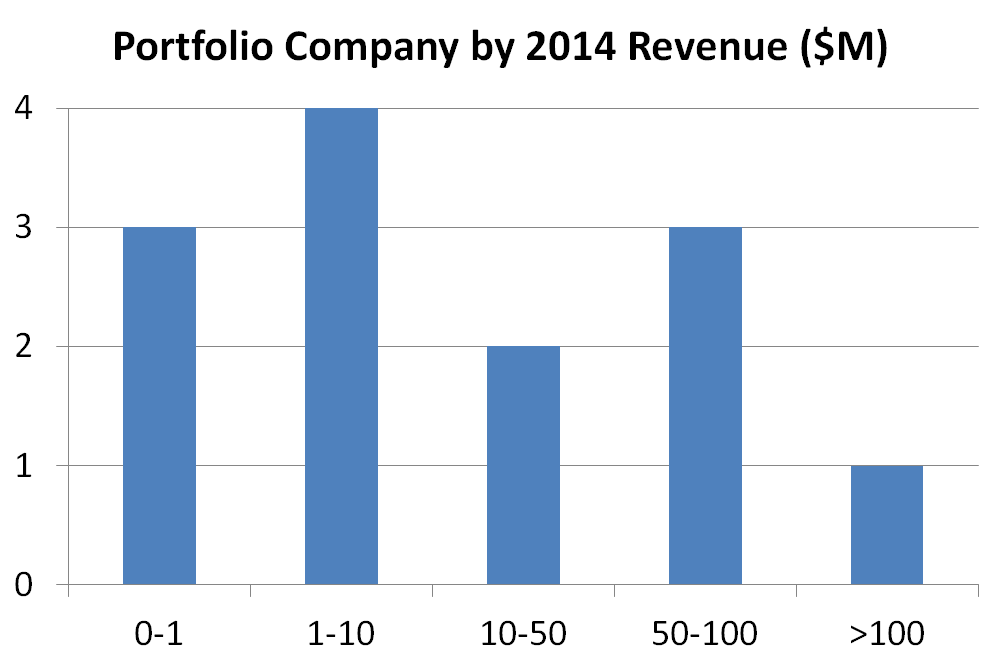
If I plot my portfolio companies across a few broad revenue buckets, looking at 2014 figures, below is a chart.  They spread fairly evenly, although slightly more in the earlier stages as few companies achieve the kind of success that $> 50m in revenue entails.

PortCo Revenue

At each stage, there are different problems.  Here are the patterns of issues I typically see at each stage – maybe you will recognize a few of them in your own companies:

$0-1 million

  • People:  founder-run and trying to recruit amazing technical talent (the product development team is a huge priority at this stage) and integrate a few senior managers to help prepare the company for scale – which leads to cultural clashes and communication challenges. Also, the founders' roles' start to evolve (see:  "The Other Founder") as functional areas and responsibilities become more precisely defined.
  • Product:  the product is buggy and incomplete – really more of a feature than a complete product – but it is past MVP.  Customers are using it and deriving value and now the challenge is how to complete it – fast, before running out of money. 
  • Business Model:  running a lot of experiments – pricing, packaging, value proposition. Always testing and trying to run fast tests to put up some strong metrics before running out of money (did I mention we're running out of money?).
  • Financing:  holy crap – we are running out of money in 6 months! Have we acheived enough value-creating milestones to raise an up round? who will lead it (insiders vs. outsiders) and on what terms?

$1-10 million

  • People:  things are going well – everyone gets excited when the cash register rings after a few big sales. The first version of the go to market team is hired (i.e., first sales person, first marketing professional).  The founders are getting restless because they have been diluted, have less responsibility and realize that the company isn't going to reach $1 billion in 3 years. Also, that first VP you hired was great from 0-1 and good from 1-10, but you're afraid she can't scale to the next level.
  • Product:  the product is better – A LOT better – but now we have technical debt thanks to our success. Anyone up for a rewrite? How much do we invest in a rearchitecture versus adding new features.
  • Business Model:  Time to get some channel and business partners on board, because adding revenue by adding sales and marketing dollars is going to be expensive – no matter what the early LTV vs. CAC data shows.  The focus now is building a repeatable, scalable sales machine
  • Financing:  The "hopes and dreams" financing stage is over. Nothing ruins a good story like numbers and now we have numbers so we better have them look good enough to support a strong expansion round. And why does it look so easy to raise $20m on $100m pre for companies at an earlier stage than I am every time I read TechCrunch, as my board reminds me every month (and can I stop having monthly board meetings already)? Do we take a little venture debt to get us to give us some cushion as we progress to the next valuation inflection point.

$10-50 million

  • People:  The functional management team is running out of steam – do we need to roll up a few things and perhaps hire a COO? The board has too many investors on it (how did that happen?!) – can we add an outside director of two?  Most critically, is the CEO scaling or is time to replace them as well (ideally not).
  • Product:  Now that we have a robust product and paid down our technical debt, we seem to have lost our ability to run experiments – how do we maintain that mission-critical quality for all these customers while remaining as nimble as we were when we were a startup? Also, customers are pushing us to provide a solution, not just a product, and so suddenly we need services and partners to round out our offering.
  • Business Model:  Now that we are at a reasonable scale, why are our gross margins so low and what can we do to fix it?  Is it time to be profitable or should we continue to prioritize growth and invest ahead of revenue?  Should we pursue adjacent M&A or tuck in acquisitions to expand our market footprint?
  • Financing:  Is our market big enough to support another round (which puts the exit bar even higher)? Is it time to consider an exit? Would an IPO be possible in the future if we can continue growing 50-100% per year?

$50-100 million

  • People:  Should we have a business unit structure or retain the functional structure?  Do we have an IPO management team in place? Is the CEO still a single point of failure or can she delegate effectively in the event of a road show? Board committees start to really matter.
  • Product:  With a robust product and complimentary solution in place, let's open this sucker up – let's build as many APIs as we can and evolve this thing into a platform. Time to enlist some 3rd party developers!
  • Business Model:  If we're not profitable at this point, we better be growing > 50%/year. How profitable should we be? Are we seeing erosion in our LTV vs. CAC math or is it continuing to scale nicely? Where should our first international office be and how much should we invest?
  • Financing:  Do we have the metrics to support a growth or mezzanine round?  Let's expand our debt capacity and put in place a working capital line and receivables facility.

>$100 million

  • People:  The A team is in place at the top and now we have to focus on solidifying the next level and providing them with great training, career paths, growth and additional stock options (in the form of refresh grants) as they are all getting approached by pesky recruiters.
  • Product:  We are in the midst of a feature war with competitors – how much do we invest in new product innovation versus continue to harden and prepare for scale. How can the product be changed to lower the cost of delivery for us and cost of ownership for our customers?
  • Business Model:  Services revenue and services partners become more important. Investing more heavily in international.
  • Financing:  Why haven't you filed the S-1 already?!

One of the things I've learned from my two decades in startup land is that it doesn't get any easier as you scale – the problems just evolve, but there are still problems.  And opportunities.  But I guess that is what makes the startup game so fun.

The Outsiders

One of my favorite childhood books was SE Hinton's The Outsiders.  For whatever reason, I always related to this tough group of teenagers who felt like societal outcasts just because they were born on the wrong side of town.

I was reminded of the book the other day when attending the Unconference.  The Unconference is a Boston-based technology conference put on by the MassTLC that has no agenda.  Instead, the agenda is created dynamically the day of the conference by the attendees.  Sessions are created on the fly, led by whoever wants to lead a session.

At many conferences, there is a sense of "insiders" and "outsiders".  Insiders have attended the conference in past years, speak on panels, walk around with great confidence and poise because they "know everyone" and are sought after during the course of the conference.  They are the popular kids at the conference.  Outsiders come to the conference knowing no one else, are often lingering awkwardly on the periphery during networking time and struggle to gracefully secure air time with the very people they came to the conference to meet.

The Uncoference tries to break this paradigm with a more dynamic sesssion format alongside structured one on one sessions between well-known insiders with eager outsiders.  I try to sign up for these one on ones every year, which are essentially an extension of the offce hours concept that many VCs (including Flybridge) have been championing as a way to provide more accessibility and transparency between insiders and outsiders.  A few years ago, I was matched with a very tall, eager entrepreneur who shared with me his passion for private coaches for sports.  His name was Jordan Fliegel and, although his 6 foot 7 inches frame stood out amongst the crowd of nerds and middle aged investors, he was an anonymous outsider that day.

Since then, Jordan's company, CoachUp, has secured venture capital funding from a local big name firm (General Catalyst) and grown into a local success story.  In a few short years, Jordan has become the definition of an insider – he's now one of the best known figures at any conference and has even started an angel fund, Bridge Boys, with one of his childhood friends.

A few years ago, I met a student during office hours at HBS, who was embarking on a new company.  He was new to Boston, having grown up in Iowa, attended Brown and then worked in Chicago.  I was with him at a lunch at a conference and, sensing his discomfort as an outsider, started to introduce him around – endorsing him with the insiders around me, like reporter Scott Kirsner and serial entrepreneur Walt Doyle.  Before long, Brent Grinna (CEO/founder of EverTrue), blossomed into one of the local innovation community's strongest leaders and insiders, sought after as a mentor by others for his success with the company (backed by big time, insider firm Bain Capital) and within the community.  Brent reminded me of this story with this recent tweet.

Francis Ford Coppola turned SE Hinton's book into a move, released in 1983.  The movie starred a slew of young Hollywood outsiders – a remarkable number of whom became the ultimate Hollywood insiders, including Tom Cruise, Rob Lowe, Patrick Swayze, Emilio Estevez and Ralph Macchio.  That's the magic of a dyanmic, entrepreneurial environment – today's outsiders can become tomorrow's insiders.  That's why immigrants, students and other outsiders are such valuable members of the entrepreneurial ecosystem – and why we should be doing everything we can to encourage and support them.

Entrepreneurs Are Crazy

Becoming an entrepreneur is illogical.  If you were to calculate the expected value (i.e., the probability-weighted average of all possible outcomes) of being an entrepreneur as compared to living the safe life of a traditional executive, it wouldn't even be close.  On a purely rational, probablistic basis, the math for entrepreneurship doesn't add up.

Despite this, entrepreneurship is on the rise.  For those of us who live in that world, we know that entrepreneurship is about passion more than rational thinking.  It inspires those who are crazy enough to believe that they can change beat the odds and succeed in changing the world, or at least their little corner of it.

That's why I love Linda Rottenberg's new book, Crazy is a Compliment.  First, I should admit a bias.  I deeply admire Linda and her non-profit organization dedicated to global entrepreneurship, Endeavor.  We first met in college when we volunteered together in an inner-city high school in Roxbury.  Although I don't get to see her as often as I would like, I've had such respect for Endeavor that I decided to donate the proceeds from my book to it.  Thus, I was positively inclined when I cracked open the binder.

But I still loved it.  It gives entrepreneurs a roadmap, plenty of fun war stories and (in typical Linda fashion) a very human angle.  For example, perhaps the most powerful part of the book is when she shares how her husband's bone cancer diagnosis forced her to be more vulnerable at work and let go of her perfectionist zeal.  She even dedicates a section of the book – "Go Home" – to addressing the importance of trying to "Go Big AND Go Home", i.e., pursue an ambitious career with passion AND at the same time live a balanced life (charmingly, she writes this section directly to her daughters – as if the reader is a bystander in the dialog).

Here were a few of my other favorite sections/lessons:

  • Esta chica esta loca.  As an entrepreneur, there are many times when you need to do crazy things.  In fact, if you're not doing a few things that conventional wisdow would refer to as crazy, you're not thinking big enough.
  • Fire your mother-in-law.  Sometimes, when you are growing and evolving the business, you have the courage to kill "sacred cows" (pun intended – but not all related to my mother-in-law, who is lovely)…
  • Flawsome.  Effective leaders are very human – flawed AND awesome at the same time.
  • Upside down mentoring.  I've written about Reverse Mentors and Linda's concept is similar – senior people should seek out junior ones to learn from them, not just mentor them.

The book is chock-full of funny, engaging stories and case studies as well – some familiar, but most unfamiliar and not your typical entrepreneur yarns (e.g., I never knew the story behind Maidenform Brands).  

If you're looking for a good read this fall, I highly recommend it.

After Ringing the IPO Bell

Last week's successful IPO of e-commerce giant Wayfair (market cap $3B) and this week's impending IPO of Hubspot (if it prices in the range, market cap $600m) has many in the Boston tech community celebrating.  They are not alone.  2013 was the best year for IPOs since the tech bubble of the 90s and 2014 looks to wrap up even stronger this quarter.

I was an executive at a hot IPO company during the last big tech boom (NASDAQ: OMKT) and, like many who lived through that cycle, I gleaned a few important lessons. After the IPO party is over (and we had a great IPO party) and the euphoria wears off, you actually have to run a company and live up to the big expectations that you have just publicly set. Your venture capital investors and many early employees head for the door and you are left holding the bag. Here are a few things I learned after my 16 quarters as an executive post-IPO:

1) The Mission Continues.  On average, it takes 8-10 years for a start-up to go public. After a lot of ups and downs, twists and turns, it feels like a massive victory (aka "Mission Accomplished", as George Bush famously declared regarding Iraq in 2003). By that time, your team will be exhausted. Naturally, a huge let-down ensues, particularly after the first hiccup – and there will always be a hiccup:  a missed quarter, a departing executive or major customer, something. Recruiters and venture capitalists salivate over picking off executives at recently public companies with the siren song of "don't you want to do that again?". If the stock price flags, all the better. Executive teams need to focus their staff post-IPO on a new mission. Be clear that the end goal was never an IPO – that is merely a financing event, a means to an end.  The end goal is industry transformation, customer satisfaction, etc. Find that new mission – and make sure you get your team behind it. Give them more stock options, more incentives and more inspiration to go at it hard for another 8-10 years.

2) Don't Let The Turkeys Get You Down.  When Ronald Reagan left office, he provided a final note with words of wisdom for incoming president Geroge HW Bush:  "Don't let the turkeys get you down." And, believe me, when you're a newly public company executive, there are a lot of turkeys out there. Not only is there a risk that your company mood ebbs and flows with the daily stock price (your stock is down 10% thanks to Vladimir Putin – deal with it), but you are suddenly publicly castigated for every move. Investing an extra $1m in R&D in order to accelerate your game-changing new product? Pre-IPO, your board would have applauded. Post-IPO, you will get hammered. And if any insiders dare to divest of their shares, even in programmed trading batches, it will kill you. I remember delivering a (compelling, I thought) company presentation at a Goldman Sachs conference and, afterwards, the first question was, "Mr Bussgang. If your company is so great and the future so bright, why is your CEO selling stock?" Many Wall Street analysts are total turkeys. They build their reputation by tearing yours down. Be tenacious and true to your strategy and prepare your team to ignore the noise. Gail Goodman is one of the most tenacious, skilled public company CEOs I know. Many analysts hammered Constant Contact shortly after the IPO, complaining about churn rates and missing the social marketing window. The stock waxed and waned and Gail just kept executing. A few years later, the stock has nearly tripled these last two years and the market cap is near $1 billion. Watch her public presentations over the years and you'll see Gail kept telling the same story – making small improvements every quarter and showing the turkeys the value of the business. Care.com CEO Sheila Marcelo is in the midst of a similar situation. Her stock is down 3x from its post-IPO high with a market cap of a paltry $250 million. I'm rooting for her to prove the turkeys wrong, just like Gail did, but it requires a tremendous amount of patience and tenacity.

3) Wall Street Is Annoying…But Sometimes Right.  OK, I know this sounds like a contradiction to point 2, but it's the unfortunate truth. Wall Street analysts and hedge fund managers can be annoying, short-term minded turkeys, but they're smart and often right. Carl Ichan's recent battle with eBay/PayPal is a great example. The trick is to ignore the noise, but don't walk around with an arrogant attitude that you are always right and the critics are always wrong because they just "don't get it." Make sure you listen carefully to the smart Wall Street analysts and incorporate their feedback where appropriate. Make sure you have board members who make you a little uncomfortable because they hold you accountable. The cozy days of the VC-led board where everyone is trying to blow smoke and get you to help them with their next fund is over. Wall Street doesn't care about a long-term relationship. They demand results. And sometimes their cool, analytical distance can be very valuable. It can be painful and distracting, but sometimes very enlightening and helpful.

Ben Horowitz's book, the Hard Thing About Hard Things, is one of my favorite business books of the year. The best parts, in my opinion, describe Ben's struggles as a public company CEO trying to refocus and motivate his team, make hard pivots and hard decisions, while dealing with internal and external challenges. His case study is precious, because in my experience it plays out again and again and Ben's candor and authenticity allow us to peer into the raw emotions and feelings of riding through those ups and downs. Executives of these newly public companies should take heed. Linger on the champagne for a moment, but then quickly clean up and get everyone focused on what's next.

After the IPO bell has rung is when the hard work really begins.