The Bubble Begins

Sports Illustrated has a well-known reputation for its “cover story jinx”.  History shows that those that appear on the cover of the magazine are doomed to lose the upcoming big game or suffer a terrible injury.  Red Sox fans famously remember that only days after Nomar Garciaparra cover appeared on the March 5, 2001 issue, it was announced that he had a split tendon in his right wrist and a sure-fire Hall of Fame career was derailed.

I wonder if this Sunday’s NY Times cover story in the business section heralds the same “jinx” for the world of Web 2.0.  “Alive and Well in Silicon Alley” raves about the twenty-something founders of the slews of NYC media .coms that are back in vogue – developing cool new media content sites and luring advertisers and consumers.  The article reports that 14 new start-ups are now housed at the NY Software Industry Association’s headquarters.  I would hazard a guess that all of them are pursuing the attention of consumers and advertisers as opposed to enterprise IT companies.

Silicon Valley appears to be smoking the same exhaust that Silicon Alley is smoking.  One of the top-tier Silicon Valley funds emailed us and the CEO of a new media start-up in our portfolio a recent overture:  “we will invest any amount at any price to get into this deal”.  Nice for our portfolio, but scary for our industry.

Another harbinger of doom:  I was speaking to a CEO friend of mine who is searching for her next gig.  She asked me what areas I was looking at.  I listed a range of things, but when I touched on new media/consumer infrastructure/e-commerce she exclaimed dismissively, “Oh all my VC friends are saying that – everyone I talk to is becoming a consumer investor!”.  Uh oh.

Put it all together, my friends, and I humbly submit that we have now hit the consumer bubble I feared a year ago (see May 2005 post:  “Is a Consumer VC Bubble Coming?”.)

And if this observation is accurate, what should VCs and entrepreneurs do about it?  On the one hand, avoiding bubbles like the plague is an obvious investment strategy.

On the other hand, a lot of money gets made in bubbles, particularly if you get in them early.  My former company, Open Market, had its IPO in May 1996 in what was clearly a bubble-like event, with a $1.2 billion market capitalization despite $1.8 million in most recent annual revenue.  That said, a retrospective look at the IPO run-ups after Open Market in 1996 suggest an investor that stopped investing at the first sign of the bubble would have missed on enormous wealth-creating companies.

I guess the smart money isn’t afraid to investment in bubbles, but simply knows when to get out of them before they deflate.  We’ll see over the next few years where the smart money is.
Syndication Science

VCs and entrepreneurs both seem to really struggle on a deal by deal basis with the question whether to syndicate or not syndicate a deal.  As an entrepreneur, I had my own biases (always syndicate – it’s obvious, I used to think, ignorant of all the nuances).  But now entering my fourth year on the other side of the table, I’ve come to see both sides of the argument.  Since I’m going through this issue on a particular deal right now, I thought it might be worth sharing a few perspectives.

From the entrepreneur’s perspective, often the more help and the more money around the table the better.  One VC has one set of networks for recruiting and business development assistance.  Two VCs have two sets of networks, usually with modest overlap.  And having two sets of deep pockets to tap when things are going good, bad or sideways can be very helpful.  Frankly, I also never liked the idea of being beholden to one VC.  As an entrepreneur, I figured having two or more VCs allowed for more diverse opinions and, in the end, more control to do as you saw fit even if you were in disagreement with one VC, who could be isolated as an “outlier”.  Of course, more VCs tends to mean more dilution.  A single VC should be happy at 30% ownership and, when pushed, will go down to the 20s.  Two VCs typically clamor for 20-25% each, sometimes more in very early-stage companies, and have to be pushed hard to go below 20%.  That said, I drank the kool-aid based on the three start-ups I worked for that having the right partners around the table would drive the right positive outcome more than a few extra points of ownership.  Many entrepreneurs will point out that there is extra overhead in managing two firms.  Although that is true, experienced entrepreneurs seem to not mind.  Manaing three or four VCs on the other hand…

From the VC’s perspective, though, I’ve come to appreciate that there are more nuances involved.  First, it’s important to point out that there is an elitist caste system in the VC world.  Upper crust, top tier VCs rarely partner with those they view to be beneath them.  The flip side is that lower-tier VCs love to partner with upper crust VCs to help enhance their brand image.  One way to sniff this out is when a VC tells you about the deals they’re in, check to see whether they name-drop the co-investors before raving about the entrepreneurs and the business model!

On the other hand, greed (gasp) is a huge driver in the VC world.  Once you like a project and decide to invest in it, your partners look at you and ask:  “if we like it and are going to put all this work into it, why share it?  Let’s own 30% and forget about the other firm.  Besides, what incremental value are they really going to add?"

Then there is the dynamic of structuring the syndicate and how things are divided up.  Many VCs are religious about splitting everything evenly to preserve harmony.  Others take a more aggressive approach and take what they can get, squeezing out co-investors as much as possible to take an unequal share.  Entrepreneurs are trypically pretty bemused by the whole dance.  After working so hard to get a few firms to pay attention to their big idea, they are quite gleeful when the tables are turned and the VCs suddenly act like alley cats clawing over cap table scraps.

However the dance plays out, entrepreneurs should remember that ultimately, they are far more in the driver seat than they appreciate.  And so when it’s time to pick partners, choose carefully, because you are going to be stuck with those partners for a long, long time.

Sour Grapes, Wolves and Sheep

Harvard Business School is having a private equity conference for students this upcoming weekend and, regrettably, is featuring Howard Andersen and his ridiculous sour grapes about the VC business.  Because of this, I feel obliged to blog on this topic.

Simply put, Howard Andersen’s article is bunk.

The venture capital business is hardly for the faint of heart and, unlike the brief period in the mid- to late-90s, is admittedly not an easy business where even the dumb and lucky can make tons of money.  That said, there is still plenty of money to be made and breakthrough innovations to support.

Howard’s comment that the “technology supply is bloated” is absurd.  This is an extraordinarily short-sighted view.  In the next decade, many predict that someone will fund a company that will cure cancer, if it doesn’t exist today.  With the modernization of China and India, we have 2 billion additional consumers entering into the wired world.  The venture-backed company, Google, is transforming the trillion dollar consumer marketing industry and print world. The global proliferation of mobile phones has generated a whole new platform of innovation beyond the PC.  Anyone in the midst of a healthy flow of deals across technology and biotech will tell you that the pace of innovation continues to quicken, not grind to a halt.

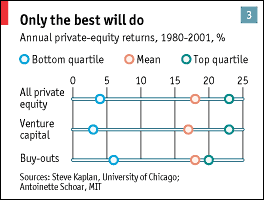
And the description of poor average returns in the business is a simplistic analysis that misses the “dispersion effect” in venture capital returns.  VC fund returns are one of the most widely varied by fund manager of any asset class.  The top quartile VCs account for the majority of the returns.  Even during a period of 0% average returns, top quartile VCs make their investors lots of money.  The chart below from The Economist is the best I’ve seen on this topic.  Howard is right that if you’re a middling-performing VC, you will not serve your investors well.  But the top quartile returns are far better than the S&P and well-deserving of the risk and liquidity premium.  This was a big driver behind the recently reported fantastic growth of the Stanford Endowment, who gained 23% last year thanks to its participation in top-tier Silicon Valley funds.

Economist_graph_1

My advice for business school students thinking about the VC business would be similar to what my finance professor, Andre Perold, gave me when I was graduating business school.  Andre (who sits on the board of Vanguard and teaches capital markets at HBS) taught me that in every market, there are two types of animals:  wolves and sheep.  The wolves are faster, smarter and have all the innate weapons to take advantage of the sheep, buying low and selling high.  If you find yourself in market where you don’t know if you’re a wolf or not, then by definition you are a sheep and are about to see a nasty finish.  The trick for students who want to become VCs is to recognize that although they are initially sheep, if they hang out with a few wolves, learn from them over a number of years, they can grow into becoming wolves themselves.  If they don’t, then they will leave the business frustrated and disgruntled rather than stuffed to the gills with its spoils.

“The Grass Is Always Greener”…aka The Circle of Envy

I have lately observed a strange dynamic in the start-up/private equity community that a buyout friend of mine coined:  “the circle of envy”.  It harkens to the old saying, “the grass is always greener on the other side” (a very capitalistic and classically “American” saying, which actually has its origins in Erasmus’ 16th century Latin writings, admiring the fertile look of a neighbor’s corn!).  It goes something like this:

Entrepreneurs are recently famous for sulkily observing that the VCs have the cushiest of lives.  Unlike entrepreneurs who live and die by quarterly and annual milestones, VCs get paid generous management fees whether they seem to actually perform or not.  In the mind of many entrepreneurs, VCs don’t work all that hard, parachute into board meetings without having done their homework, make a few trite, unhelpful comments and then leave.  In short, entrepreneurs are envious of the VC way of life, which seems to have lots of financial upside and none of the quality of life downside.

VCs are recently famous for grousing about how much money their private equity cousins are making.  A VC struggles to invest $5-10 million at a time while their private equity cousins pour hundreds of millions of dollars, and recently even billions, into a single deal.  Since the fee income portion of compensation is a function of assets under management, the more you manage, the more you make.  The other compensation component is the carried interest, and VCs are green with envy when they see buyout guys use cheap leverage to make money while retaining large stakes in their firms.  In short, VCs see the outrageous financial lifestyles of the private equity hitters, flying around in their private jets and think:  “if only I could be like them – they’ve really got the model figured out”.

Private equity executives are recently famous for expressing their envy for hedge funds.  Unlike private equity and VC firms, who only get paid on the gains when a portfolio company is liquidated, hedge funds take their carried interest off the table every year.  And when a private equity or VC firm gets hot, it has to wait three or four years in between fund cycles to raise new, larger funds.  Those lucky hedge fund executives can sweep big money in at a moment’s notice, raising their fee income with a snap.  Further, complain private equity folks, the hedge fund executives rarely travel to chase around high-stakes auctions and have none of the responsibility or liability that “owning” companies and controlling boards represents.  They just seem to coast along, accumulate more and more capital, and live it up.

And hedge fund executives?  The top of the heap?  Hardly.  I often hear them discuss with envy the life of the entrepreneur – cycling through exciting new start-ups every 5-6 years and then taking long sabbaticals in-between gigs.  Meanwhile, the hedge fund executive is chained to every international market every minute of the day for fear they miss spotting the latest currency or interest rate fluctuation.  Entrepreneurs actually create things of value and leave a mark on society, rather than simply financial engineering.  And that nonsense about money flowing in so fast being such a great thing?  Remember, it can flow out just as fast.  And, besides, the hedge fund business as a whole has little barriers to entry and struggle to find true proprietary elements of the busines, resulting in too much money chasing too few good investment opportunities.  Those entrepreneurs who can come up with original ideas, build proprietary technology and products, and then sell them out get all the glory, reap all the rewards and then unplug.  Now that’s the life.

The result of all this hand-wringing?  Perhaps the Chinese proverb is the truest:  “think about the misfortune of others to be satisfied with your own lot”.  Of course, relative to others in this world, each of these executives is as lucky as lucky can be!

Harvard Business School VC Conference

I had the privilege of spending the day today back at Harvard Business School at a venture capital conference organized by the burgeoning entrepreneurship department.  Professor Bill Sahlman (who has easily trained more VCs than any other professor) organized a spectacular affair with 60-70 VCs from around the world, although with a heavy Boston weighting.  In addition to the riff raff such as myself, there were numerous luminaries there, including Arthur Rock (who wrote the business plan for Intel), Peter Brooke (Advent founder), Henry McCance (longtime head of Greylock), Jim Breyer (Accel), Rick Burnes (founder of Charles River Ventures) and others.  And the speakers outshone the audience!

A few interesting perspectives shared today:

  • Larry Summers, Harvard’s President, emphasized the transformational impact that technological innovations in life sciences will have on our economy and lives, and the important role of the VC industry in taking projects out of the lab and enabling widespread distribution.  Summers has embarked on a massively ambitious Allston construction project which, when completed, will serve as a haven for inter-disciplinary scientific discovery.  Boston today, like Florence in medievel times, has the opportunity to be the most advanced community for the discovery and incubation of scientific breakthroughs and Harvard seems determined to truly lead that effort.
  • Bob Langer, George Whitesides and Doug Melton added to this perspective with case studies of their own labs at MIT and Harvard and the incredible "innovation productivity" that they have achieved.  Some common patterns they highlighted:  pursuing high risk, big ideas; encouraging external and internal collaboration; stressing interdisciplinary approaches to problem-solving; and strong relationships with VCs and industry to reduce friction and improve throughput in the "from lab to market" process.  They cautioned, though, that typical VC time horizons (4-6 years) may be too short for early stage research commercialization time horizons (6-10 years).
  • Clay Christiansen talked about the power of disruptive approaches (both low-end disruption and new market disruption) and the benefit to VCs of finding and investing behind disruptive opportunities rather than incremental ones.  A good lesson for those in the industry that jump on the "me too" funding bandwagon.
  • Michael Porter highlighted the important role of strategy for the VC funds and their portfolio companies – the need to be unique at something, not "the best", and to make hard strategic trade-offs when building the value chain that delivers the unique product/service.  Good boards and CEOs, he noted wisely, need to be willing to say "no" frequently and with conviction.
  • Jay Light, Andre Perold, Mohamed El-Erian and Jeremy Grantham discussed asset allocation and the capital markets.  They observed that pundits who believe a New Era is upon us are always wrong (as Jeremy quipped after analyzing 27 asset price different bubbles over the last 100 years:  "If it were a football match, it would be Reversal to the Mean: 27, New Era:  0".  They were quite bearish on US equities (predicting only 3-5% real return across a broad range of asset classes) and, like many others, lamented the dearth of untapped investment opportunities and the "stable disequilibrium" that the scary US current account deficit represents.  Makes you want to sit on cash!
  • Felda Hardymon and Josh Lerner talked about the internationalization of private equity, warning against "tourist VCs" in China and India as well as reminding everyone that historical fund performance is best for small, focused firms with lots of experience — not newcomers parachuting in with large funds and overly general strategies.

Overall, a very thought-provoking event.  Bill Sahlman wraps it up tomorrow, where he will undoubtedly tell us the VC business is a crappy one (newsflash) and that we should all be pursuing new jobs as timber executives at hedge funds.

2006 BostonVCBlog Predictions

As 2005 comes to a close, a few 2006 predictions are on my mind…

1) The year of creative exits.

With the advent of Sarbanes-Oxley, the IPO bar is still too high for most VC-backed start-ups. If the company doesn’t have more than $100m revenue, four quarters of profitability and 8-10 years of operational maturity and history, it’s an unlikely candidate.  Besides, value-maximizing CEOs and VCs are not keen to pursue a financing event that’s not really an exit, given strict lock-up and public disclosure issues.  Thus, M&A has been the VC-backed exit path of choice.  Yet many companies are not necessarily appealing for M&A targets.  Therefore, 2006 will see more creative exit scenarios.  Will VCs take a page from their private equity cousins and begin to use leverage to recapitalize companies and achieve their return?  Will we see more aggressive redemption terms and board skirmishes to return excess cash?  Will we see private equity firms and hedge funds come into VC-backed companies that have gained some revenue traction to buy out the early-stage VCs?  Already, signs are emerging that these creative exits will be attempted by the impatient VCs sitting on 6-8 year old portfolio companies from the bubble days.  More will follow.

2) Traditional media, newspapers and magazines aren’t dead…yet.

Many have been predicting the demise of traditional publishing since the start of the Internet. The rise of Google has caused these calls to rise in volume. And yet, many of these companies just keep on ticking – and some are innovating into the online world through aggressive acquisitions (e.g., NY Times and About.com) and business transformations (e.g., IDG’s transformation from a mainly traditional print businesses only to a media conglomerate of online, research and investments). But despite rumors of their demise, many of these traditional media properties will retain great value – as subscribers, brands and advertisers all prove to be stickier than most think. After all, scientists believe it took decades, not years, for the dinosaurs to disappear from Earth.

3) Capital gap continues.

VCs continue to raise big funds, private equity firms continue to raise even bigger funds, and start-ups continue to fret about minimizing dilution.  Thus, there remains a "capital gap" for the early, early-stage entrepreneur that only wants $1-4 million, but can’t find a strong market for that small a "nibble" in the private equity world.  As a result, many entrepreneurs will push harder to hold their breath and self-fund in the earliest stages.  And smaller VCs (some old, some new) will continue to flourish in focusing on this higher risk, higher upside class of opportunities.

4) Blogging continues.  Even from VCs.

‘Nuff said.

Moneyball, Theo and VCs

I confess that I am a devout Red Sox fan.  The habit started in 1975 when I sat on my father’s lap and watched one of the greatest World Series of all time against the Big Red Machine (my second favorite team at the time).  The great tragedies of 1975, 1978, 1986 and 2003 are forever burned in my memory – as well as the great triumph of 2004.  Even my chosen blog photo is a bow to the Red Sox – a picture of me sitting in manager Terry Francona’s office at my beloved Fenway Park.

Therefore, I am a sucker for baseball-VC comparisons.  I have refrained from writing too much about my beloved Red Sox, but the departure of Theo and the recent blockbuster trade to acquire Josh Beckett, a pitcher recently heralded as the second coming of Roger Clemens, have awoken me from my self-imposed restraint.

The first comparison of note is applying the Moneyball theory to venture capital.  Written by Michael Lewis in 2003, Moneyball provides an inside look into how Oakland A’s General Manager Billy Beane constructs winning baseball teams with a constrained budget.  One of Beane’s secrets is to stay away from over-priced, super-stars.  Having put a number of strong years under their belt, a player on the “back nine” of their career may have the ability to earn a high price in the market, but may not be able to recreate the performance numbers going forward that would justify their inflated value.

One veteran VC friend of mine commented to me when Moneyball came out that he felt the same way about entrepreneurs.  VC firms like to brag about their habit of backing superstar, repeat entrepreneurs.  But my friend observed that the problem with superstar, repeat entrepreneurs is that they know they’re superstars.  Therefore, they command a high premium in cash, equity and deal price.  A typical series A of $4-6 million on a $4-6 million pre-money valuation might suddenly become $8-10 million on $10-15 million pre-money valuation if a superstar, repeat entrepreneur is at the helm.  Will the performance justify the inflated price?  Manny Ramirez has had a terrific five seasons in Boston, but the team keeps trying to unload his contract because they’ve concluded his great numbers simply aren’t worth the astronomically high price they pay for him.

Like top baseball scouts, VCs are better off looking for the lesser-known players who have superstar potential.  It’s easy to get into the hot deals with proven entrepreneurs if you “pay up”.  But who among us can spot the next David Ortiz, a player that languished for six years with the Twins, was signed for a relative pittance by the Red Sox, and has emerged as the game’s premier superstar, receiving the most votes for any player for the 2005 All-Star team?  At age 25, recently acquired Sox pitcher Josh Beckett could be the next Roger Clemens in terms of prospective performance – but he certainly won’t be paid anywhere near Roger’s $18 million 2005 salary.

If you subscribe to the Moneyball theory of VCs, you would be better off backing the young, hungry entrepreneurs who have something to prove – and are willing to make the financial and personal sacrifices to achieve a “win”, than the proven superstar entrepreneurs who command premiums.

Another interesting VC insight from baseball struck me a few weeks ago with the news of General Manager Theo Epstein’s departure.  The wunderkind general manager decided it was time to spread his wings and break out on his own.  Despite the great mentorship he received from CEO Larry Lucchino, Theo decided his own interests were no longer aligned with the rest of his “partnership”.  Sound familiar?  How many stories have we been reading about the young guys in VC firms breaking out on their own (with my own firm reflecting this general characterization), never mind other private equity shops and hedge funds?  No longer satisfied with the status quo of marching to someone else’s beat, young talented executives are often compelled to make their own way in the world and build their own legacies.  Although I am saddened by Theo’s departure, I acknowledge that this is simply the way of the world, and know that my own industry sees this behavior quite frequently as well.

There are many other amusing analogies – VCs combing the landscape like a good scout looking for undervalued opportunities/players, VCs behaving much like the most callous GMs when they treat entrepreneurs like pawns in a chess game – that are worth further exploration.  But I will now return to more business-like analogies rather than allow my blog posts to further reflect my Red Sox obsession!

The Inside Out – Outside In Dance

When an entrepreneur has taken VC money in a first round of financing, there is almost always a second round.  Rare is the company that is able to develop a strong, sustainable cash flow positive business with a single round of financing.  When that bridge is crossed, the age-old debate begins within the boardroom:  do we do an inside round and save everyone (especially management) time and hassle or do we go outside and get someone else to price and lead the round?


Frankly, this “inside-out outside-in” dance was always a mystery to me as an entrepreneur.  And now that I’ve been a VC for nearly 3 years, I find myself still confused by it all.


If the VCs around the table love the company, why would they want anyone else to invest in it?  Why not keep investing and continue to (one of my favorite phrases) “put more money to work” (whenever I hear this oft-spoken phrase, I imagine a bunch of George Washington dollar bills slaving away in the salt mines and a VC foreman barking:  “Get me more dollar bills!  I need to put more money to work!”)?


So VCs only push entrepreneurs to go raise money from outsiders because they don’t love the company and don’t want to invest?  But if all VCs do this, then all VCs know this.  Therefore, when a VC receives “the call” from a VC buddy (sotto voice:  “I’m only exposing this to a few folks, it’s moving fast, but I wanted to get you exposed to it because you have such unique value-add and we have such a unique relationship”), the savvy VC buddy gets very suspicious.   A VC friend of mine refers to this as the “VC buddy pass”, and warned me when I got into the business to run for the hills when it comes your way.


And then there’s the famous bait and switch technique – the VC board member loves the company, but their partners are more skeptical and insist on outside validation.  So, the VC pushes management to spend an inordinate amount of time trying to attract interest from new investors, and then once the outside term sheet is put on the table, the insiders decide that they actually do want to invest and keep the round to themselves and shut out (and annoy) the outsider, particularly now that the price has been set.  This is known as the “rock fetch” (VC to entrepreneur:  “go find me a rock.”  Entrepreneur comes back panting hard with a rock in hand.  VC responds:  “No…I don’t like that rock, go fetch me another one.”)


As I said, I find it all pretty confusing.  That said, I have learned that there are mitigating circumstances.  Specifically:

  • Capacity.  There are times when the company’s capital needs are beyond the capacity of the existing syndicate.  Raising $10-15 million of fresh capital can be hard for the two original VCs, particularly if their fund sizes and average capital per firm constrain their ability to split the check while reserving adequate dry powder for another round.
  • True Value-Add.  All cynicism aside (or most of it, at least), there are times when a new, outside investor adds unique value.  This so-called strategic money can come in the form of an institutional VC, a corporate VC or a business partner with an interest in putting a few George Washingtons to work.
  • Market Validation.  As I mentioned in my VC accountability blog, an individual VC partner is accountable to their LPs and fellow partners.  If they continue to support a company on the inside without seeking outside market validation, there is a risk of eroding the natural checks and balances behind cutting off bad businesses and not allowing good money to be poured in after bad.  In my experience, this can lead to a very frustrating outcome for entrepreneurs.

My suggestion:  entrepreneurs should be proactive and have a frank discussion about the next round right after closing the first round.  Something like: “If I hit these milestones, will you continue to support the company?  If so, what is the stepped up price that we will deserve?  20%?  30%?  What if we exceed the milestones?”

Ultimately, the inside-outside dance can be an area of great and unnecessary tension and time-wasting between the VC and the entrepreneur.  As with most things, direct, open communication can mitigate the potential negativity that can result in the dance ending poorly when the music stops.


Accountability, Thy Name is VC?

The Jewish holidays are an interesting time of reflection and soul-searching.  One of the concepts I found myself mulling over this holiday season was the notion of accountability.  One of the most critical elements of Yom Kippur is to stand before G-d and be accountable for your actions of the past year.  Webster has a pretty simple definition for this word:  “having to answer for what was done”.  With the holidays behind us, I was thinking about the nature of VC accountability, a concept that can be subtle to understand, but critical for entrepreneurs to get their arms around.

For entrepreneurs, it’s really simple.  Every month, quarter and year, an operating executive is held accountable for results.  The VP of sales is accountable for revenue.  The VP of engineering is accountable for shipping products on time.  The VP of marketing is accountable for prioritizing sales and engineering resources, generating leads and providing superior positioning to the competition.   And the CEO is accountable for everything – revenue, expense and cash position – all as compared to the board-approved plan of record.  The consequences:  a nice bonus on the one extreme and preparing your resume on the other.

What about the VC?  What is the VC accountable for?  If posed that question, many entrepreneurs would smirk, roll their eyes and crack that VCs seem to be highly unaccountable creatures.  But that is a misguided view.  VCs are, in fact, highly accountable in two ways, and I would suggest a third as well.

First, VCs have to answer for their actions over a multi-year period to achieve what they are paid to achieve – make money.  Over some (typically long) period, how much money did they invest as compared to how much they returned?  The Limited Partner (“LP”, the VC’s investor) cares primarily about results.  After all, they, in turn, are accountable to their investment committees to make money, and so that accountability flows right to the VC.  Although the operating executive has a shorter time fuse, the VC is no less answerable for their performance and that performance is extremely measurable.

Second, VCs have to answer to their partners.  In a VC partnership, each VC is investing the money of their peers as well as theirs, and affecting the overall results of the fund.  And so while an LP may not hold a VC accountable for periods shorter than 6-10 years (the period after which fund performance is well-known), VCs are accountable to their partner every week at the partners meeting.  For 4-6 hours, the partners pour over their strategies for deploying the capital, high-priority projects and individual portfolios.  Every week, each individual VC must stand and deliver and demonstrate in front of their partners that they are on track to fulfill their obligation to their LPs to make money.

The third source of accountability is the one that is most often neglected – accountability to the portfolio company.  Some VCs take this very seriously.  When I was an entrepreneur, one of my VC investors shocked me when he said: “I’m simply a service provider – I work for you”.  It was a refreshing attitude that I’ve always taken to heart – good VCs are those that answer to the entrepreneurs.  What did they deliver in terms of value-add that month, quarter, year to their portfolio company?  I would recommend entrepreneurs not be shy about holding their VCs accountable.  Just as the board of directors evaluates the CEO/entrepreneur every year for their performance against results, the CEO/entrepreneur should have the license to evaluate their VCs for their performance.  Who did they help recruit?  What business development introductions did they make?  Were they proactive in giving critical strategic advice?  Were they available and responsive when needed for emergency issues?

No harm in a little extra accountability for VCs, don’t you think?

The Rebirth of Enterprise IT

Today’s post is brought to you by a guest blogger:  Chip Hazard, my partner at IDG Ventures.  By way of background, Chip’s been a VC specializing in enterprise IT for twelve years and has a great perspective as someone who has seen the good times, bad times and everything in between.

[Chip Hazard]

Many pundits, from Larry Ellison to…uh…Jeff Bussgang, have pontificated on the maturation, consolidation and eventual death of the enterprise software business – at least for companies whose names are not IBM, Microsoft, Oracle, SAP or Symantec.  The general thesis goes something like the following: 1) corporate IT departments are looking to reduce, not increase their number of vendors and are therefore not inclined to work with start-ups; 2) customers no longer are pursuing best of breed strategies but instead want integrated suites; 3) the sales and marketing costs of large enterprise software solutions are extremely high and drive a need for significant investments that are beyond the capabilities of many early stage companies; 4) the overall rate of growth of the software industry as a whole has slowed and there are few areas for innovation.  Common analogies used by these pundits include the maturation and consolidation of the automobile and railroad industries in the early to mid 1900s.  Pretty depressing stuff.

So where does that leave a talented entrepreneur (or VC for that matter) with deep experience in this now passé field?  While challenging, if you look at some recent successes (deliberately selected from outside our portfolio), themes and strategies emerge that entrepreneurs can adopt to drive the creation of successful companies.

These are discussed below:

  • Innovate to drive efficiency.  For many times over the last decade, enterprise software companies positioned themselves as automating certain functional departments of corporations.  First it was manufacturing, then financials, supply chain, sales, marketing etc.  If this is your view of the enterprise software environment, then by and large Larry Ellison is right – there is little room for new categories and innovation.  That said, if you spend time with you average CIO, you will hear a different story.  In today’s “post-bubble” environment the average CIO has seen their staff and capital budgets cut back, but the demands on their organizations from business executives have continued to increase as companies seek to have a more flexible and cost-effective IT organization to support their business plans.  Compounding this challenge of doing more with less is the sheer magnitude of the accumulated applications and technologies that have been deployed by enterprises over the last 20 years.  As a result, there remains a robust opportunity for focused vendors to drive innovative technology into enterprises to drive efficiency in IT operations.  The bar, however, is quite high.  If you can’t drive a 5 to 10 times reduction in key metrics, the status quo will prevail.  A recent success story is VMWare, which EMC acquired in early 2004 for $635 million, primarily due to the company’s success in enabling server consolidation, a primary method of driving efficiency in IT operations.  Other examples indicate there is a relatively healthy M&A market, as these innovative companies fill key product gaps for large acquirers, such as IBM, Microsoft, Oracle, HP and EMC, as well as mid-sized public companies such as BMC, Mercury, CA and Symantec.
  • Dominate a niche.  Start-ups are often caught in a quandary.  To raise money and hire the best people, they need to convince VCs, employees and other supporters of the company they are going after a billion dollar market.  To do so, however, they run the risk of going too broad, too quickly and losing the laser focused approach to solving problems that allows start-ups to win versus large, incumbent vendors.  A better strategy is to instead think about climbing a staircase.  You know you want to reach the next floor, but you don’t do that by trying to jump up 13 stairs all at once.  Ask yourself, “What can I uniquely do today for a customer that solves a real problem and also provides a link to doing more things for those customers in the future?”  Unica, a recently public $80 million in revenue marketing automation company in Boston is a good example of this.  When they first got going, they had the best data mining tools for marketing analysts on the planet.  Not a huge market, but one that valued innovation and provided a logical steppingstone to campaign management, lead generation, planning and the other marketing tools that the company sells today. 
  • Explore SaaS (software-as-a-service).  If the key barrier to success for early stage enterprise software companies is excessive sales and marketing costs, adopting a software as a service model may be the right approach.  This is more that just selling your software on a term or subscription, versus perpetual license, basis.  Instead SaaS is all about making it easy for customers to understand, try and ultimately gain value from your software.  In 5 minutes and for no money down, I can become a user of Salesforce.com and within the 30 day trial period I can qualify myself and decide if it is the right solution for me that I am willing to pay for.  Most importantly, I can potentially do this without consuming a single dollar of their sales and marketing spend.  None of the airplane trips, four-legged sales calls, custom demos, proofs of concept or lengthy contract negotiations that lead to the 6 to 12 month sales cycle that costs a traditional software firm 75% of their new license revenue in a given quarter.
  • Consider Open Source.  To us, Open-Source is not about free software, but rather products that have seen, or have the potential to see, widespread grassroots customer adoption.  A passionate end-user community has the benefit of driving a development cycle that quickly surfaces key product requirements and needed bug fixes. Further, the grassroots adoption of the product provides a ready installed base of early adopters who will promote the product across their enterprise, purchase professional services and acquire more feature rich versions of the product.  Like SaaS, this is a way to mitigate high sales and marketing costs.  RedHat’s version of Linux, Jboss’s version of the application server and SugarCRM are three of the best known examples, but other opportunities abound.
  • Go Vertical.  In today’s age of rapid development, componentized software and offshore resources, software code is relatively easy and cheap to write and is no longer the “barrier to entry” and source of competitive advantage it was ten or twenty years ago.  Instead what matters to customers, and potential acquirers, is the deep domain specific knowledge instantiated in that software.  For an early stage company to build this knowledge, they need to be incredibly focused in a given domain and make sure they have people on their team who understand a customer’s business better than the customer does themselves.  Profitlogic, another Boston area company that recently sold to Oracle, is a good example.  Profitlogic’s products were all about the retail industry, and in fact a particular part of the retail industry related to pricing optimization.  Their team knew more about the margins, operating metrics and best practices of this industry than their customers often did, and it showed up in how their software was architected, deployed and operated.  No wonder Oracle made the group a key part of their Retail industry vertical as an add-on to their Retek acquisition.

Enterprise Software entrepreneurship and investing is certainly not for the faint of heart, but when pursued with some combination of the strategies above, we believe interesting opportunities remain for innovative companies to make their mark in the world and have a positive impact. It is also worth noting, again contrary to the claims of many, that it is still possible to build these companies in a relatively capital efficient manner.  Sticking to the examples cited above, according to VentureSource, VMWare raised $26 million of venture capital, Unica $11 million, Red Hat $16 million, Jboss $10 million, and ProfitLogic $38 million.  Only Salesforce.com raised a lot of capital – $64 million – although almost 75% of that came in their last round when one would assume there was evidence the model was beginning to work. 

In the end, we believe the analogy to the automotive industry is flawed.  The manufacture and distribution of cars is fundamentally different from the software industry.  In auto industry, there are tremendous benefits of scale, the underlying platform (tires, chasis, internal combustion engine, frame and skin) has remained the same for decades and there is little room for small players to access end-users.  Software, on the other hand, is a digital good and an information business.  Innovation is limited only by the creativity of the author.  Small teams can be extraordinarily productive – often times more so than larger teams and organizations. The underlying platform and architecture has changed several times in the last 30 years and there is no physical product to distribute, thus end-users can be accessed much more directly.  Is there a benefit to the incumbency and distribution might of IBM, Oracle or EMC? Absolutely.  Does that mean there is no place for creativity, innovation and entrepreneurship in this industry?  Absolutely not.