Raising Your First Round of Financing

I gave a talk at Harvard Law School this week to a VC and Entrepreneurship class on raising your first round of financing.  It was good fun and forced me to rethink my usual presentation and add some practical elements.  You can view the presentation here:

My other SlideShare presentations are here.

Seeking A Job in Start-Up Land

My first time jumping into the start-up world was as a freshly minted Harvard MBA in 1995.  As my classmates were rushing off to high-paying, high-powered jobs on Wall Street, I joined a Series A start-up with 30 employees as a product manager, making $65,000 per year – lower than my pre-MBA salary at management consultancy The Boston Consulting Group.  Since then I've had a terrific ride, but I often think of that fateful decision when I get asked, repeatedly, by other freshly minted MBAs:  "How do I get a job in a start-up?"  Or, more generally, "How do I even begin to find and assess start-up job opportunities – I don't even know where to start?"

The start-up universe is a large one and can seem overwhelming and impenetrable to the uninitiated.  In order to narrow things down, I recommend following a simple, four-step heuristic.  Here's the advice I give:  

  • Pick a Domain.  First, figure out your passion in terms of domain.  Are you more of a B2C type or a B2B type?  What blogs are you reading?  What articles in Techcrunch or the Wall Street Journal capture your attention?  What companies are your dream companies to work for?  Answering these questions will help narrow down a set of domains that you are excited about.  It can be more than one, but it shouldn't be more than, say, three.
  • Pick a City.  Next, figure out where you want to live.  Again, there may be multiple options, but ideally one or two favorites.  Each start-up community has its own plusses and minuses, quirks and idiosyncracies.  I find that once young people choose a particular start-up community, they stay there.  It's a natural phenomenon – they build relationships over time that lead to one opportunity after the next.  Your co-workers in one start-up become your co-founders in another.  Thus, young professionals should be thoughtful about choosing a city early in their career because of this "settling in" phenomenon.
  • Pick a Stage.  Next, determine what stage company you prefer to work in.  Do you want a company that is still in the jungle phase (hacking through and trying to establish a path to success), the dirt road phase (established initial product-market fit and now trying to execute and scale in a relatively clear direction) or the highway phase (optimizing and scaling along a well-trod path)?  This decision should be made somewhat based on risk appetite and somewhat on personal makeup and preferences.  If you are a risk-taker and enjoy the challenges and roller-coaster ride, then the jungle phase is for you and you should bias towards seed funded or recently Series A funded companies that are pre-revenue.  If you are more conservative, want a good salary and prefer to pick a "safe" winner, then a highway phase company that is pre-IPO or recently IPO'ed is the right choice. 
  • Pick a Winner.  Now that you have your target domain, geography and stage, focus on picking out a few winners – the hot companies that everyone thinks has great momentum and potential.  After all, why would you want to work for anyone other than the absolute hottest company in a given category?  How does an outsider figure out who the winners are in a given domain, market and stage?  Ask a handful of insiders.  Find the top 3 VCs, angels, tech lawyers and headhunters in your target geographical market and ask them for the two or three hottest companies that match the domain and stage you are interested in.  Compile this list, pressure test it, and see what patterns you find.  The firms who get the most mentions with the most compelling underlying evidence will naturally rise to the top.

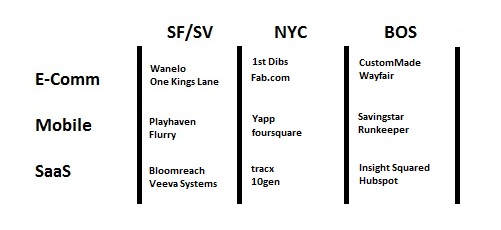
Below is a sample chart that I put together answering the question for someone interested in either e-commerce, mobile or SaaS companies in SF/SV, NYC or Boston.  The first company listed is an earlier stage company (either jungle or dirt road) and the second company is a later stage company (either dirt road or highway).  This list is illustrative – just to make the point – not in any way attempting to be comprehensive.

MBA blog 3-31-13
(full disclosure:  tracx, 10gen and Savingstar are Flybridge portfolio companies)

Once this heuristic is complete, you now have your target list.  The next step is to get warm introductions to the target.  This is easier than you would think.  LinkedIn is an incredibly powerful tool, as are the various alumni databases.  VCs are often happy to pass along your resume and background to their portfolio companies – after all, they are doing them a favor by sending them highly qualified talent.

In general, the start-up community is so incredibly generous with its time and has such a strong "pay it forward" culture, that with tenacity and time, you can get to almost anyone.   In fact, I recommended you aim high.  Use this heuristic to narrow down your search and then list out the 10 people that would be your absolute top choices to sit down for 30 minutes with face to face.  Then, go after those 10 people in any way you can (without stalking them or being a nudge!).  These networking meetings will help you establish valuable relationships, even if the job fit isn't there.

In short, be organized, focused and tenacious.  Aim high, seek out the incremental networking meetings and pick yourself out a winner.  Things may not work out, but at least you're putting yourself in a position for a little positive serendipity.

No Denying Deflation: Will It Eventually Kill Content?

In classic economics, deflation – a downward trend in prices – is a dangerous force that leads to recessions (see:  Japan, economic disaster – a case study).  In the world of the Internet, deflation viewed as a positive force, leading to massive consumer gains.  How can we reconcile these two competing beliefs?  And what impact will this deflationary pressure have on the production of high quality content?

I've been thinking a lot about deflation and its impact on the Internet economy since reading two articles in two different newspapers this last week.  The first was this article in The Economist about the music business.  The article contained a chart showing music industry revenues peaking in 1999 at $27 billion and dropping consistently as a result of the disruptive power of digital music and iPods/iPhones.  Industry revenue may have finally flattened out at $16.5 billion, but the bigger story is that over $10 billion of value has been taken out of the music business thanks to over a dozen years of digital disruption.  Artists are still producing a ton of music (I would guess music proliferation has grown during this period, although I haven't seen the data), yet the Internet has produced massive deflationary pressure.

The second article that I was struck by was in the Wall Street Journal, depicting the explosion of online video.  Titled, "Web Video:  Bigger and Less Profitable", the article reports on the rapid growth in online video views (39 billion in December), yet the fact that prices are dropping rapidly due to the oversupply of video inventory.  The CPM (cost per thousand views) that advertisers are paying has dropped from $17-25 in 2011 to $15-20 in 2012.  Advertisers and content producers are used to this trend.  Whenever a new advertising medium emerges, prices are high at first, and then steadily drop as inventory swells (I wrote about this in a post that provided a bearish analysis of Groupon back in 2010).  Every content business today faces this rapid drop in CPMs across every category, resulting in severe cost pressures.

So if the producers of music, video and other content are getting hammered on deflation, who is benefiting?  Consumers.  Consumers are getting access to music, video and other sources of content for less.  They're also getting subsidized by business advertisers through social networks and search.  McKinsey did a study a few years ago that sized the consumer surplus from the Internet at over 100 billion euros.  Interestingly, they concluded that in measuring this surplus, consumers have benefited 85% of the gains from the Internet as compared to 15% for producers.

Thus, while the business press is full of stories of disruptive gains in business transformation, the real story of the Web is the power of the consumer and the massive gain consumers are receiving.

Although I am thrilled with the consumer surplus, I struggle with where this logical chain is eventually leading us.  I worry that if there is too much deflation in content, that this consumer surplus will hit a natural limit.  That natural limit will be that content producers will stop investing to produce high quality content.  After all the inefficiencies have been wrung out of the system, eventually fewer producers of content will be willing to produce great content because the rewards just are no longer there.  If this were to happen, consumers would be all the poorer for it.

My conclusion:  although deflation has produced awesome consumer gains in the last decade, it is emerging as a real threat to content producers.  But at some point, perhaps soon, it will tip to being a negative force that will cause high quality content produers to turn away and pursue other methods of financial gain.  If that were to happen, we might regret allowing deflation to run rampant on the Web.

The Religion of Entrepreneurship

All the focus on the Pope's departure from the Vatican has got me thinking about the meaning of religion.  Those ruminations have led me to a surprising conclusion:  one of the reasons the force of entrepreneurship has become so powerful in recent years around the world is that entrepreneurship has evolved into a global religious movement.

Wikipedia defines religion as follows:

Religion is an organized collection of belief systemscultural systems, and world views that relate humanity to spirituality and, sometimes, to moral values.

Similarly, the start-up world has evolved into a set of shared beliefs and values.  For example, the notion of Pay it Forward has become a core part of the entrepreneurial ethos.  In religious communities, when someone is in need, the community rallies around them.  People do kind things to other people just because it is the right thing to do.  The start-up world has a similar share value – investors, CEOs and service providers throughout the entrepreneurial ecosystem are always willing to lend a hand, donate time and provide guidance and counsel.  When I talk to entrepreneurs I've never met before, I always have a sense that we are kindred spirits on a shared journey.  There is an immediate connection and mutual respect, just as I feel when I meet a member of my religion (Judaism).

The canonical texts of the entrepreneurial world are firmly established and widely read.  Although they haven't sold as well as the Bible, there are a set of books that nearly every member of the entrepreneurial ecosystem has read, including:  Crossing the Chasm, The Lean Start-Up and Four Steps to the Epiphany.  Even those who have not studied these books and their derivative works are familiar with the concepts.  

The cultural force of entrepreneurship is a powerful one.  This force and the cultural norms they impose can vary from the profound (it is no longer ok to look down on the "little guy/gal" in business, young people are now listened to more carefully and given more opportunities to have an impact) to the mundane (it is now ok to wear jeans to a serious professional meeting, it is no longer ok to pull out a Blackberry in a meeting as opposed to the iPhone).  The binds that tie the community together are strong.  I can walk into a start-up event in Sao Paolo, Jakarta or Little Rock and have the same dialog about the same concepts – just as I can when I walk into a synagogue on Friday night anywhere in the world and feel at home.

The prophets of entrepreneurship have been firmly established.  Paul Graham, Steve Blank, Eric Ries and a few others have risen to a status such that anything they say or write is followed closely by hundreds of thousands of followers.  The entrepreneurial community reads all the same blogs and debates the same issues around the world.  Certain corporate leaders, such as Steve Jobs (who, arguably, was practically deified in the wake of his tragic death) are also viewed with such reverence that they can command massive followings and sway opinion.

I could go on, but you get the point.  I'm not sure what to do with this observation, but I think it represents a profound undercurrent that drives the start-up system in a very positive way.  I'd be curious if others see it similarly.

Fred Wilson Returns to HBS


Fred and Jeff

Despite being a Wharton and MIT guy, my friend Fred Wilson has been kind enough to attend my class at HBS for the last few years.  Yesterday was another terrific one.

Instead of a final exam, I assign my students the task of blogging.  You can see the the class blog here, where the students wrestle with the limitations of the lean methodology, challenges in seeking product-market fit, premature scaling and other important startup topics.

I encouraged the students to live tweet the class and it was a huge success.  You can see the Twitter stream from the class here.  A few highlights/quotes that I thought were particularly salient:

"We should always bet on the team and, in this case, ignored that it looked like a niche market." (Fred on lessons learned on passing up the opportunity to invest in AirBnB)

 "It’s a lot better to fail with professional investors’ money than with friends and family money. We’re used to losing money."

"Don't let your own reality distortion field convince you, as a founder, that you've hit product market fit."

"As an entrepreneur, stay a 'free agent' as long as possible." (i.e., don't pick a VC  partner too early in your lifecycle – Union Square and Flybridge aside…:-)

"[When pitching investors,] focus on the big vision, how you will be the market leader in 10 years, don't get stuck in the operational details."

On career choices:  "You'll learn more doing your own startup [versus joining someone else's]. But doing a startup for the sake of doing a startup isn't a good idea. "

"VCs look for passionate, authentic founders who actually believe they can defy gravity" (I think this was me but Fred seemed to agree)

"There's value in having a founding team with a crazy person with vision alongside a cofounder grounded in logic and analytics."

Thanks again to Fred for coming out and helping make a memorable class experience!


Balance and StartUp Life

Living the startup life is a hard roller coaster.  One day you think you're on the verge of building a billion-dollar company, the next you wake up in a cold sweat, paranoid that you are about to run out of cash and have to shut the whole thing down.

There a lot of good books on how to develop a customer value proposition, rigorously test it and raise money.  But I have never seen a book address the hard issues of how to live your life while you're working 80 hours a week trying to do all those things.  Until now.

My friend, Brad Feld, has written precisely that book with his wife Amy Batchelor, called Startup Life. The couple tackle how to manage your relationship with your significant other while trying to live in the mad, crazy, demanding world of startups.  Nothing is off limits for this book – Brad shares how he screwed up his first marriage, how they manage their highs and lows together and even addresses the topic of how to find time for sex while running startup.

Brad asked me to share a few thoughts on my perspective on the topic and whether I had any additional tips.  I have been happilly married for 19 years and have known my wife, Lynda, over 25 years (we met our first day freshman year in college while moving in to the same dormitory entryway).  Like Amy, Lynda is not in the startup world at all, but rather has a completely different work and personal profile than I do (she is a former professional Broadway-style performer and is now a pioneer in the world of aging and multi-generational programming).  Additional context:  we have three kids (now ages 16, 13 and 10).  Brad and Amy don't have kids, so they were light on addressing this additional challenge – a topic I struggled with when I was an entrepreneur and still struggle with today as a multi-tasking, over-scheduled venture capitalist trying to be an accessible, loving Dad for my three high-energy children.  

Be Predictable, Even If It's Bad News.  

One of the hardest thing about being an entrepreneur is the unpredictable schedule you face.  A customer calls with a bug and there's a crisis.  A new product needs to get pushed out the door and it's a crisis.  Or you're trying to raise money and you need to prepare all night for tomorrow's investor meeting.  It would drive my wife absolutely nuts when I would say I would be home by a certain time, and then not show up until one or two hours later.  Dinner would be cold, kids would be mad and all hell would break loose.  

I finally swore I'd
get better at is keeping track of time and setting expectations better with my
wife about when I come home.  So we developed a system together:  at the beginning of each month, I email her
when to expect me home at night that month (or not at all if travelling) with a 15 minute range.  Many nights the range is "945-1000pm" if I'm in NYC that day or have an evening event.  But it is what it is and I don't try to sugercoat it.  Then, I work very hard to stick to that hour, treating that deadline as if it were a meeting with an entrepreneur or a portfolio company board meeting.  If I know I am going to miss the deadline for being home (sure, stuff comes up), I always give her the heads up.  This creates a
sense of predictability for her and the kids.  

If I see my kids in the morning (which is rare, although I'm working on that), I will tell them verbally what time to expect me rather than try to hide from the fact that I'm travelling or working late that day.  This avoids my family getting more frustrated with my
unpredictable schedule than my actual schedule!

You're Just Not That Interesting.

In my early startup days, and the early days of the Internet, we used to refer to the crazy pace that we were living as "Internet Time".  There was this feeling that everyone else was living a slower pace than we were.  Indeed, to me, my 12-14 hour work day was chock full of a week's worth of stories, characters and drama.  Subconsciously, I thought my day-to-day was more exciting than my wife's and would come home eager to share all the drama.  After a few years, I began to realize that as interesting and dramatic as my work life is to me, it's really not that interesting to Lynda.  She cares about the big things, of course, and she cares about how I'm feeling about it, but the ups and downs about new product releases and who's missing the quarter and what competitors are doing are all just noise to her.

So my mantra now is, my work life just isn't that interesting to my family.  I share with them the top-line highs and lows, but I don't think my wife could name each of my portfolio companies.  Instead, when I come home, I focus on them:  the ups and downs of my kids social and academic lives; the ups and downs of my wife's work and social life.  In my head, I try to keep it to "80% them, 20% me" sharing time.  I'm sure it ends up more balanced, but if I aim for 20%, I know I'll come home focused on them rather than on me.  To be clear, I love my work and love being consumed in it.  It's just not that interesting to the four other members of my household.  And I'm ok with that.

Find Together Projects.

My wife and I operate in different professional worlds, but we have found that we love collaborating together on projects beyond the raising of our three kids.  Raising our kids takes an enormous amount of thought and energy.  The topic of our children often dominates our private time together.  We have discussions and make decisions each week about their activities, their school work, who to have a sleepover, who is picking them up when (during the weekend, we often switch to "taxi driver" mode) and what they should do for the summer.  But, we have found that having "adult projects" that we collaborate on is also very rewarding.  We have pored energy into various non-profits, our synagogue and our kids' schools as a way of making a difference, yes, but also spending our outside work time together.  Thus, although our professional communities are very separate, our personal and social communities are totally integrated.

In addition to those few tips and reading Amy and Brad's books, I recommend a few other books:

  • The Three Big Questions For a Frantic Family by Patrick Lencioni.  Lencioni is one of my favorite business book writers (see this blog post on his work on team dysfunction) and so this book was a refreshing way to apply some of his core business lessons to family management.
  • Raising Cain by Daniel Kindon and Michael Thompson.  I have two boys.  I have read this book twice – once when they were recently born and again recently as they move into the world of teenagers and found both sessions incredibly helpful and informative.
  • Nurture Shock: New Thinking About Children by Po Bronson and Ashley Merryman.  David Kidder of Clickale suggested this one to me and I have enjoyed it as a book that cuts against conventional wisdom in many areas of raising children.
  • The Talent Code:  Greatness Isn't Born, It's Grown. Here's How by Daniel Coyle.  My partner Jon Karlen recommended this one to me.  Jon was an all-American squash player and his wife was a 12-letter athlete (!) at Harvard, so I take his recommendations about raising talented kids seriously!

Good luck with your own journey for balance and happiness!

Leadership Lessons for Entrepreneurs from Jethro (Moses’ Father-in-Law)

I was in synagogue last weekend for a cousin's bat mitzvah and was struck by the entrepreneurial lessons from the weekly Torah portion.  The portion was Exodus 18, where Jethro, Moses' father-in-law, sits down with him and gives him some mentorship:

What is this thing that you are doing for the people? Why do you alone sit, and all the people stand before you from morning until evening…The thing that you do is not good. Both you and these people who are with you will surely wear yourselves out. For this thing is too much for you; you are not able to perform it by yourself.

Moses is the ultimate entrepereneur, trying to do it all himself.  He leads the Israelites out of slavery from Egypt (nice vision!) and then is forced to execute on creating a new society and way of life for his people.  It's too much for one person to bear.  

So like any good mentor, Jethro gives it to him straight – you are going to burn out.  You need to delegate.  Find some good people you trust and let them deal with the minor issues.  Focus your energy on finding the right people, put them in a position to succeed and then save yourself for the really big decisions.

Pretty good advice for an entrepreneur.

Does DC Know Startups?

The short answer is no, but perhaps there’s hope.

The day after President Obama was inaugurated for a second term, I was invited to speak at the (MUCH smaller) inaugural meeting of the newly formed Congressional Caucus on Innovation and Entrepreneurship.  The caucus is a bi-partisan group, created by Rep. Jared Polis (D-CO), Darrell Issa (R-CA), Vern Buchanan (R-FL) and Gary Peters (D-MI), to focus federal policy efforts on supporting startups and innovation.

I have to admit my expectations were pretty low.  After my euphoria over the passing of the JOBS Act last year, the latest fiasco over the fiscal cliff have me pretty down on Washington’s ability to get anything done that will help create a more robust business environment.  I have been to DC a few times with the policy business group I helped co-found, The Alliance for Business Leadership, and every time I’m there, I’m struck by the contrast with the more thrilling, action-oriented world of startups and venture capital.

That said, the House Members and staffers seemed genuinely interested in the components of a vibrant start-up ecosystem.  I gave them a briefing of why Boston and NYC have such vibrant start-up environments, with the former being in the midst of a renaissance and the latter emerging from nowhere over the last 5-10 years to legitimately become one of the world’s major start-up centers.

I cited a few elements, which echo a presentation I have given in the past about Boston’s Start-Up Scene and that my NYC-based colleague, Matt Witheiler, has written about NYC.  Specifically:

  • There are four important ingredients for a start-up ecosystem to thrive:
    • Intellectual capital – Universities, young people, creative (whacky) people, expertise in multiple disciplines
    • Angels, Advisors and Accelerators – that first capital and good advice to transition from idea to reality and provide mentorship
    • Venture capital – the necessary capital to scale, advice, mentorship, guidance from those who have “seen the movie”
    • Successful companies – to inspire, partner with, poach from and/or sell to
    • I also observed the important cultural characteristics of successful start-up ecosystems.  They are open, diverse, inclusive, welcoming of outsiders/immigrants and creative types, and rich in information exchange.

Today, Boston and NYC are shining examples of these elements.  Boston has always had rich intellectual capital, but was historically weaker in the cultural characteristics than it is today.  The angel community has also stepped up in a more meaningful way recently, which has been very positive.

NYC has historically fallen short on intellectual capital, but that has changed dramatically in recent years with all the talent streaming out of Wall Street and Madison Avenue into start-ups.  Further, following the interesting entrepreneurs and ideas, there’s been an explosion in NYC’s angel community. This has led to an environment that has never been more promising.

With the audience being a policy one, I gave some simple advice to policy makers:  avoid getting involved in areas where government doesn’t have a role (e.g., picking winners with targeted tax breaks) and focus instead on fundamentals (e.g., education, infrastructure) and policy issues that matter to entrepreneurs (e.g., immigration reform, reforming community and state colleges to fit the needs the start-up employers, and capital formation issues like crowdfunding).  I gave a nod to local government leaders like Governor Patrick and Mayor Bloomberg who have been terrific champions in their respective communities. When you ask local business leaders, they will all tell you that those two politicians “get it”.

I can’t predict whether this new caucus will have an impact, but clearly comprehensive immigration reform is on Congress’ short list for important initiatives in 2013 and Rep. Polis was one of the co-sponsors of the Start Up Visa Act, so he clearly “gets it”. If every entrepreneur reached out to their House Representative and encouraged them to join this Caucus, perhaps it would have a small impact.  Meanwhile, I was happy to leave Washington DC and get back to action-oriented Start Up Land!

Do Job Specs Matter?

Today’s post is brought to you by my friend, Paul Blumenfeld, a recruiter who is one of the most thoughtful people I know when it comes to hiring processes. Since the topic is so fundamental to the company-building process, I am pleased Paul agreed to share his thoughts.

When my wife and I got engaged, we had barely clinked champagne glasses when a friend asked when we would be visiting Crate and Barrel to register for wedding gifts. The idea sounded appealing enough, but we couldn’t think of anything we actually needed. So we created a wish list of things we thought we needed, like designer flatware, gold-rimmed china, and a blender that makes bread dough.

As it turned out, the best gifts we received on our wedding day were the thoughtful, unique gifts from people who knew us well and understood our day-to-day needs. We also loved the gifts we simply never expected.

I often compare our gift registry experience to the way many companies write job specs. What should serve as a helpful set of guidelines to find the right candidate typically devolves into an inflated “wish list” of qualities and talents that sound good at the time, but aren’t practical or even possible to find in one person.

If I looked back at every job I’ve filled during my 15 years of recruiting and compared the company’s job spec to the person they actually hired, I suspect I would see a significant gap between their wish list and “the gift” they got.

I see two reasons for this discrepancy:

  1. Static Specs.  Many hiring managers write a job spec that is heavy on wishes and low on real needs. They continue to use the same or similar spec throughout their search without re-evaluating it. With each candidate interviewed, the hiring manager learns something new about what they are looking for and what the real job requirements might be, but the job spec is rarely updated to reflect what they’ve learned.
  2. Like Pornography? Companies aren’t always clear on what they’re looking for until the right candidate walks through the door—which brings to mind Supreme Court Justice Potter Stewart’s “I know it when I see it” phenomenon. For many companies, the “best athlete” will get the job regardless of how closely they match the spec.

It is frustrating when I learn that a client has hired a great candidate that I already knew, but decided not to send over because, judging from the job spec, they weren’t a great match. Needless to say, I’ve learned my lesson and now take the following five approaches to solve this job spec ambiguity problem:

  1. Archteypes. I ask clients to show me a bio or LinkedIn profile for a candidate whom
    they’ve made an offer to recently, or on someone they consider ideal for this position. Very often, seeing a real person’s bio is much more informative than seeing a job spec. Reviewing the details of a real person can help me better understand what the hiring manager is looking for, and I get a true feel for the person that would get the job, not the resume that would get the interview.
  2. Short and Sweet. I recommend that my clients boil down their job spec “must-haves” to only one or two items. I have a client who spends a lot of time creating very detailed specs for all of their engineering openings, and in doing so I find their real needs get lost. For example, “Candidate must have deep CS knowledge and know their data structures and algorithms inside and out” is a clear message and points me in the right direction. Based on those two imperatives, I can quickly find the best person out there with these skills and, because “I know it when I see it”, the client likes the candidate and gives them the job.
  3. Be Open-Minded. I also ask hiring managers to be open-minded about their must-haves. A candidate’s experience may not match perfectly to what the hiring manager is initially asking for, but sometimes a candidate will have skills from a previous position that prove to be extremely valuable in a new position. For example, I was doing a search for a VP of Engineering for a company that was building a stock-trading platform. “Experience in financial services or a trading platform a must!” The VP of Engineering I placed there, however, had spent his entire career leading real-time software development at successful data communications startups. His real-time experience, and the time he spent at successful start-ups, proved to be his most valuable assets.
  4. Culture. I think of a company as a cultural community with social needs, not a machine that needs a specific part plugged in. Finding a candidate who is not only great at what they do but who also fits well into that company’s culture is going to have a better shot at getting the job and succeeding at the company long-term. For example, does the candidate rock climb or brew beer in her spare time? These qualities may not make her a better CTO or VP of Product, but they may make her “click” with a like-minded hiring manager and be more successful in a given company community.
  5. Hire Winners. If a candidate is coming from a winning environment, he or she is more likely to know how to win. They will bring this culture with them when they join your company. I look for candidates that have worked for companies that have built highly regarded products and have worked with people who have had previous, profitable outcomes.  The caveat there, however, is that there are often many people looking to take credit for a winner’s work. Like the old proverb says, “Success has many fathers, failure is an orphan.”

So how much do job specs really matter? They are an objective element to a mostly subjective process. They are also, however, an important starting point. And the more realistic, concise and flexible the job specs are, the more successful the hiring process will be. Just beware of the job spec “wish list.” After all, do you really want a blender that can make bread dough, or do you actually want a blender that makes really good frozen margaritas and milk shakes?

2013: The Year of Grit

grit  

/grit/
Noun
Small, loose particles of stone or sand.
 
Verb
Clench (the teeth), esp. in order to keep one's resolve when faced with an unpleasant or painful duty.

2013 is going to be an "interesting" year (evoking the Chinese curse).  The macroeconomic environment looks spotty at best, with analysts like Jeremy Grantham predicting 1% growth in the US for decades to come.  Europe is still a mess and in a deep recession.  Japan is in a decades-long tailspin.  And the so-called BRIC countries are forecasting tepid growth (we could rename them "ICK" if we added in Borat's home of Kazakhstan and dropped Brazil and Russia…)

Meanwhile, in our little world of StartUp Land, things don't seem much brighter.  There are complaints about the Series A crunch, lamentations that the consumer Internet has matured ("tough sledding" says Fred Wilson) and fears that the overhang from Facebook's lousy IPO will continue to impact 2013.  What's an ambitious, hard-charging entrepreneur to do?

One word:  grit.  Tough it out, people.  This start-up stuff isn't easy.  It never has been.

Mark Suster captures this sentiment nicely in this post "Entrepreneurshit".  I won't repeat the feeling of dread, despair, humiliation and frustration that he so ably (and painfully) reviews.  Unfortunately, 2013 will see plenty of it for start-up executives.  So here are a few tips to help you grind through the coming year and come out stronger on the other side:  

  1. Maintain Your Foundation.  Whatever it is that allows you to find meaning in your life – your spouse, kids, parents, friends, a dog – nurture it and hold it dear.  Be maniacal about maintaining your health.  Even if you're travelling like crazy, exercise and eat well.  I find that entrepreneurs with strong foundations are able to focus much more effectively than those that are distracted with unhappy personal lives.
  2. Keep the End In Mind.  This piece of advice borrows from one of the late Steven Covey's 7 Habits of Highly Effective People.  Envision the ideal end state that you are striving for in 2013.  Write it down.  Write down the two or three subgoals that fit beneath this overarching goal, including two or three interim milestones.  Have it as a one-pager that you keep with you always.  It will help sharpen your focus day to day and prevent you from getting lost in the daily flurry of activity we all face.  And speaking of day to day…
  3. Be Great Every Day.  The thing that is hard about gritting through a tough year is that you feel that so much of it is out of your control.  But you can control what you do each day.  Don't allow yourself to sleep walk through each week, trudging through the muck in a daze.  Simply put, in the face of adverse conditions, be great every day.  End each day feeling that you delivered a great day against your objectives and don't allow yourself to settle for anything less. 
  4. Maintain Options.  When I first learned how to value options in the stock market, a light bulb went off.  Options have value!  When slogging through a tough year — such as a new product that just won't ship cleanly, or a fundraise that just won't get traction — remember to create options for yourself.  In addition to your plan A, develop a credible plan B and C.  Don't allow the failure of a single initiative to be a dead end.

Good luck.  As Ronald Reagan famously advised his White House successor (and one of my favorite children's animated authors captures in a cute book), Don't let the turkeys get you down.

What are some of your techniques for gritting through a tough year?