Finding “Investor-Entrepreneur” Fit (aka Avoiding the Series A Crunch)

A question I often get asked by entrepreneurs is what is Flybridge’s investment philosophy – do we make our investment decisions based on people or on themes?  The glib answer is both, but as I’ve thought more about this question I wanted to expand the answer a bit to help entrepreneurs understand how investors approach this issue in more detail.  I think this question has become more acute as the much-discussed shortage of Series A capital (the so-called “Series A Crunch”) means that, going forward, too many entrepreneurs are going to be chasing too little capital.

People-based investing is an age-old investment strategy.  Bet on the jockey, not the horse, as the saying goes.  Exceptional entrepreneurs will always find a way to make money, so the job of the investor is to spot the exceptional entrepreneur and convince them to take your money as opposed to worrying about strategic trends and dynamics.  People-based investors focus their due diligence process on spending both structured and unstructured time with the entrepreneur, as opposed to analyzing the product, business model or interviewing customers.  People-based investors can be quite analytical, although often times it is more instinctual.  When they are analytical, people-based investors conduct deep management team due diligence, psychological profiles and a broad set of team interviews.  When they are not, they simply listen to their intuition as to whether the entrepreneur is a “money maker” and trustworthy.

Personally, I think this is a flawed investment strategy.  Building a successful startup requires more than exceptional people, because even exceptional people can find themselves the victims of market forces, competitive pressures and faulty business models. I have seen many exceptional people execute beautifully, hire well, achieve operational excellence, but still fail to build a massive business. These entrepreneurs are like the well-trained surfers who sit, frustrated, on their surfboards on a calm day because they can’t catch the right wave to propel them to shore.

A theme-based investment strategy requires the investor to have market knowledge and a strategic point of view.  Theme-based investors go deep in a particular sector, develop a hypothesis, and then meet entrepreneurs to test this hypothesis.  They build market maps, attend conferences, hire EIRs and cluster their investments and networking around a particular sector. By building expertise in a sector, theme-based investors develop insights about where the markets are moving and where the opportunities are for disruption.  They like to “see everything” in a space before investing in something so that they are assured that they have picked the absolute best way to play the theme they have identified.

And here’s where the magic happens – referring back to my glib answer regarding Flybridge’s “both” investment strategy – when a theme-based investor collides with an exception entrepreneur who shares the investor’s vision for a particular disruptive opportunity.  I have heard many entrepreneurs gush when describing these meetings. “It was like he was giving my pitch for me!” effused one entrepreneur after a VC she was pitching took over the meeting with their own passionate observations about the market opportunity.

We experienced just such an opportunity as part of a new deal we are leading in New York City that my partner, David Aronoff, recently alluded to.  We have a thematic focus on cloud computing and the consumerization of the enterprise.  It is an extension of our developer-driven investment theme, that led to portfolio companies such as 10gen and Crashlytics.  When we intersected with an entrepreneur who had a similar theme and had developed an emerging leader in a space we liked, we jumped at the chance to lead the Series A, following on with some great angel investors.

As an entrepreneur, those are the situations you want to find.  Seek out “Investor Entrepreneur” Fit.  Find that investor who believes in you as well as the market opportunity and has already been thinking proactively about it.  Watch what they blog about, what their investment history looks like, and what conferences they are attending.  If you can find this intersection of compelling themes and people, you won’t sweat the coming Series A crunch.

The Search For Product Market Fit

I continue to be fascinated with the changing art of product management.  This week, I taught a class at Intelligent.ly on the topic.  Intelligent.ly is a new start-up led by Sarah Hodges, who used to be an executive at Run Keeper and Carbonite (full disclosure:  Sarah recently joined Flybridge Capital as a part-time advisor).  The company is part of a new wave of companies, such as Skillshare, Boston StartUp School and others, to provide "over the top" professional education to help chip away at the skills gap and enhance professional development.

The class was a blast.  After running through a series of slides reviewing modern product management techniques and the search for product-market fit (drawing from leading thinkers and a class I teach at Harvard B-School), I had the students break up into teams of 8 to create scrums to address a strategic question:  if you led product management at Blackberry, what features would you prioritize in the new Blackberry 10?  I had never tried a spontaneous scrum like this before and it was great fun.  The readouts afterwards were insightful and creative and it reinforced for me something I've seen work successfully at the Unconference – that creative energy can be released and improved learning can be achieved with a dynamic format rather than lecture-style.  

Below are the slides.  Did I leave anything out?

http://www.slideshare.net/bussgang/slideshelf

For more on this topic, you can follow the HBS class blog (we do not have a final exam – just blogging!):  Launching Technology Ventures.  We kick off the new class in late January.

Getting Back to Work – Multi-Dimensional Entrepreneurs

"I can't wait to get back to work.  This fundraising is a real drag on my day job."

– Startup CEO raising capital

We have a number of portfolio companies that are raising money.  When I talk to my CEOs that in the midst of this process, almost all of them complain about the same thing.  They dislike the fundraising process and can't wait until it's over.  They view it as a distraction from their day job and a non value-added chore.

I love the CEOs I work with.  But when I hear these complaints, which echo those of other entrepereneurs I know, I can't help but think how dead wrong they are.

Raising capital is a core part of building a valuable business.  Whether you are raising a $250K seed round or navigating a $100M IPO, the capital markets – in all of its various forms – are a fundamental constituent in the business-building journey.

Developing expertise in raising capital is more than a necessary evil, it's a competitive weapon.  If you have a stronger balance sheet than your competition, you can push off monetization decisions and focus on product-market fit.  You can take more risks on partner deals, focusing on long-term value creation, not short-term gain.  If you have a larger cash horde than your competition, you can make aggressive hires, attract better talent, perhaps even make acquisitions.  Adding some debt onto your balance sheet will lower your cost of capital and your dilution, which is better for existing investors and the management team.  In other words, being able to efficiently access the capital markets is as core to business-building as product management, go to market and your profit formula.

I admit that fundraising can be painful – and certainly I felt the pain when I was an entrepreneur and had to explain the same story over and over again to prospective investors of varying intelligence and sophistication – so, all joking aside, I am sympathetic to the complaints.  But in the process of fundraising, I always gathered valuable feedback from savvy investors who understood the market and had a broad perspective.  Seeing my firm through their eyes gave me valuable insight and often caused me to make adjustments along the way – in many cases, critical adjustments to our business model or approach based on the feedback.

A cynic might suggest that I'm supposed to have this perspective because, as a venture capitalist, I'm bound to think that my role in the start-up ecosystem is an important one.  But that's not entirely true.  For example, I have huge respect and passion for product development and the role of the product manager.  I spend alot of time with my portfolio companies on their go-to-market strategy, partnerships and scaling sales.  

But I do think the cultural pendulum in the startup world has swung too far away from requiring entrepreneurs to be financially savvy.  The best entrepreneurs develop acumen across a range of business-building disciplines, including general management and finance.  They view fundraising as one of the multiple dimensions that are a core part of their job, not an ancillary distraction or necessary nuisance.

Being an entrepreneur is a really hard and lonely journey.  Entrepreneurs need to "major" in some disciplines and "minor" in others.  They can't be so focused on, say, product development that they can ignore a major discipline like fundraising.  Whining about fundraising, particularly to investors in the midst of the financing process, isn't a winning approach.

The Product Manager

My first job after business school was serving as a product manager for an Internet commerce software company (Open Market, IPO'96).  Back then, we learned the "HP way" – methodical, waterfall, process-driven.  The art and science of product management has changed radically in the years since, with agile and lean methodologies replacing the more centralized, older methods.  One constant, though, is the centrality of the role – sitting in between the market and the engineering team, the product manager (or VP of Products or any other derivative title) is a critical component to a start-up's success.

Thus, when my friend and colleague, HBS Professor Tom Eisenmann, suggested we write a short piece summarizing the modern role of the Product Manager, I jumped at the opportunity.  We collaborated with NextView's Rob Go and drew on some of the work of author/consultant Marty Cagan as well as numerous others.  We interviewed dozens of product managers from the Valley, NY and Boston and debated the different ways product managers impact the business and drive operations.  We tried to capture the issues the role faces in business to consumer as well as business to business companies, very early stage to more mature, agile to waterfall and everything in between.  That research culminated in this note, which I'd welcome folks reading and providing me with feedback:

Product Manager - HBS

To explore more about the role of the product manager, there is alot of rich activity on Quora, including:

Finally, a few blogs that do a nice job covering this topic include:


StartUp Communities, Ecosystems

I participated in a WBZ radio breakfast panel yesterday on the Boston start-up community and recently delivered the presentation below at the Harvard Innovation Lab as part of an HBS Entrepreneurship Club Event.  It reflects a survey of the local start-up ecosystem that dissects what it takes to build a great ecosystem.


My friend Brad Feld talks about this topic in his new book on Startup Communities, as summarized in his fun Kauffman video "Sketchbook":

Software Is Eating Marketing

When I was a kid, "The Graduate" was a generation-defining hit movie, with Dustin Hoffman playing an aimless college graduate. In the middle of a graduation party, an older businessman takes the wayward Hoffman aside and delivers some wise advice: “plastics.” That should be the field his generation should focus on, the field that would shape the future.

Today’s advice for aspiring graduates is also a single word: “software.”  

In a sweeping Wall Street Journal article last summer, Netscape founder Marc Andreessen identifies the 21stcentury phenomenon of software eating the world. Software is disrupting industry after industry and transforming large swathes of the economy. When I was an entrepreneur in the 1990s, I would debate with my investors what sliver of the $70 billion U.S. software industry we could carve out. 

Today, as a venture capitalist, I meet with entrepreneurs who are trying to figure out what portion of the $70 trillion global economy they can dominate.

Within the $1 trillion marketing industry, the impact of software eating marketing has now reached the board room.  With the explosion of digital marketing, it is clear that technology is radically transforming the marketing function and the role of the marketing professional. 

The changes rippling through the marketing industry goes far beyond the simple mantra of “follow the eyeballs” to different screens.  Gartner analyst Laura McLellan predicts that by 2017, CMOs will spend more on IT than CIOs.  The repercussions of social, mobile, video, Big Data, CRM, cloud and other disruptive forces are impacting all aspects of business, but particularly marketing. 

As a result, marketing leaders and agencies now carry the burden of understanding technology’s impact on their business, the entire customer experience, and leading innovation within their enterprises, not simply following a course set by their IT department.                             

“Madison Avenue meets MIT” and “Revenge of the Nerds” are common themes in marketing circles as technologists are becoming the rock stars of customer engagement — employing algorithms and analytics along with artistic creativity to win market share. In much the way Apple disrupted the music and phone industries with smart industrial design and clever software that shielded users from complexity, technologists are building sophisticated systems with interfaces that are as simple for marketers and designers to manipulate as their iPhones.

MITX, the Massachusetts Interactive Technology Exchange (and an organization I serve on the board of) is putting on a killer conference on this topic called FutureM that kicks off on October 22nd.  FutureM will gather marketing and technology leaders to address these challenges head on, exposing marketers to today’s most innovative thought leaders and companies who are transforming marketing.

Hosted in Boston, at the nexus of the technology and advertising industry, FutureM is a weeklong extravaganza that will bring together marketing artists and marketing scientists, left brain and right brain thinkers alike, to debate the most pressing issues facing the industry. FutureM is fast becoming the equivalent of SXSW, the place to get inspired and see what’s next, but focused on digital marketing.  

If you think the last few years were disruptive, imagine how much the marketing industry will be transformed in the next three years!

(a version of this post originally appeared in Mediapost)

Back to School Blog – Fall 2012

(Note: this post is an open letter to the approximately 400,000 members of the Massachusetts-based student community. Many of the messages apply to students in other innovation hubs.)

Dear student,

Welcome (back)!  Now that you have unpacked the underwear, laid out the futon,
picked your courses and settled in a bit, I wanted to write to you about
something important.

Just as you were selected by your school amongst many applicants, we know that you chose to make the greater Boston community your home in selecting your school. For that, we
thank you.

But more than thanking you, on behalf of the Massachusetts Innovation Economy community, I wanted to make sure you understood something.  We want you.

We want you to learn, engage, show up,
contribute and – most important – stay when you graduate. One of our core values in this community is supporting innovation and young people.  We have a long history of fostering amazing student entrepreneurs, many of whom you know all about (like Zuckerberg and Facebook, or Houston and Dropbox) to some you may not know about (like the three Babson students who founded IdeaPaint or the two Harvard students who started IP TV pioneer Tivli).  And everyone in the community is fired up to support you, from civic leaders to business leaders and fellow entrepreneurs.

At 600,000 people, this city is small. Even with a larger metropolitan area of 4.5 million, there is a strong sense of intimacy and community here. This sense of intimacy contributes to why the innovation community here is so accessible.  As you are out and about, you will quickly learn that this is a very open and friendly town, particularly for students who hustle.

So here are a few tips for you as you think about exploring what the innovation community has to offer:

  • Attend an event.  Greenhorn Connect is the definitive listing of all the local events in the entrepreneurial community.  My firm, Flybridge Capital, created a scholarship program to support local students who want to attend events called Stay in MA.  Take advantage of the free passes on us and law firm Gunderson Dettmer and get out there!
  • Invite an entrepreneur to speak on campus.  I am amazed at how accessible and giving the entrepreneurial community is.  "Pay it forward" is the local motto and entrepreneurs are always telling me they love meeting with students and speaking on campus.  If you read about someone you think would be interesting, reach out.

There are a few standout examples of students who are making an impact in the local community that are worth highlighting as role models for their peers:

  • Cory Botolsky.  This Northeastern junior decided that not enough students were finding jobs at startups.  So, he created StartUp Summer and helped facilitate over 100 summer internships to help students get exposed to the local entrepreneurial community. 
  • Scott Crouch.  A Harvard senior, Crouch spent his summer shuttling back and forth between Springfield and Cambridge as he collaborated with the police department and state troopers to use social media and pattern recognition software to combat gang violence.  His work was featured in this Boston.com article and the New York Times.
  • Anna Palmer and Christine Rizk.  These two Harvard Law School graduates have launched a new company called Fashion Project that is helping non-profits make more money by providing a marketplace to sell high-end, donated goods more efficiently.  They are a part of the Techstars 2012 class.
  • Zach Ringer.  A Babson senior, Ringer has jumped into the entrepreneurial community with two feet.  He secured an internship with a hot mobile start-up, Crashlytics, by merely aggressively tweeting and engaging in the community.  He is always attending events at Mass Challenge and the Cambridge Innovation Center and is leading a number of entrepreneurial initiatives on the Babson campus.

What will you do this year to get engaged?  I urge you to make your presence felt beyond the classroom and frat
house. The local community you have chosen to be with wants you.

Have a great school
year!

Scaling is Hard, Case Study: athenahealth

There are many companies that are competing to be the “operating system” for small businesses. The theory is that with the advent of the cloud in the digital age, small businesses can leverage a suite of services from a technology vendor to manage all aspects of their work – from payments to record-keeping to marketing to customer communications.  Among those competing for this vision are PayPal/eBay, Square and Groupon, with each struggling to pull together pieces of the equation and, importantly, reach the small business in a cost-efficient manner at scale.

One company in Watertown, Massachusetts has been executing on this vision for over a decade with a winning approach for one vertical slice of the small business market: physicians.  Although this is not typically how athenahealth is described, it is one way to describe what they are doing that mainstream members of the technology community might understand.  I have found it pretty amazing that so few people in the tech community know their story or understand the scale and scope of what they have achieved.  That is why I’ve chosen athenahealth for the third in my series on scaling (following Akamai and TripAdvisor).

Founding Story:  A Pivot

Athenahealth version 1.0 was a complete failure.  The company was originally founded in 1997 by Jonathan Bush (1st cousin of George W.) and Todd Park, a pair of Booz Allen consultants, as a physician practice management company for obstetrics.  As they tried to execute on their original vision, the pair became incredibly frustrated with the difficulty of turning medical claims into cash.  Payers took months to reimburse their practice for patients’ medical claims.  Park began to write software to try to speed up the process, automating countless manual steps and creating a user interface that would be simple enough for doctors and medical clerks to use.

It turned out, the physician practices loved the software, but didn’t love the practice management services.  The doctors wanted to run their own practices, but use athena’s software to speed up billing.  Bush and Park remembered the advice one of their early angel investors had given them:

“Get close enough to your customer to understand what they really want.  And once you understand what they really want; once that opportunity comes knocking on the door; for crying out loud, answer the door.”

The founding pair realized that they needed to pivot into becoming a software company, and in late 1998, completely shifted their focus to delivering athenaNet, their Web-based medical billing platform, as a cloud-based software service for all doctors.  Scaling Lesson #1:  get close to customers early, really close, to help inform your pivots.  And when you do pivot, pivot hard.

Over time, the functionality athena delivered to doctors expanded, all with the vision of simplying the administrative burden on medical practices.  From collections and revenue lifecycle management (called Collector) to clincial documentation and electronic medical records (Clinicals) as well as patient communication (Communicator) – athena now provides a full suite of cloud-based automation software for doctors.  In effect, they have become the Salesforce.com of the health care vertical.  Scaling lesson #2:  Once you find product-market fit with a customer segment, scale up by offering other products that solve other hard problems to that customer segment.

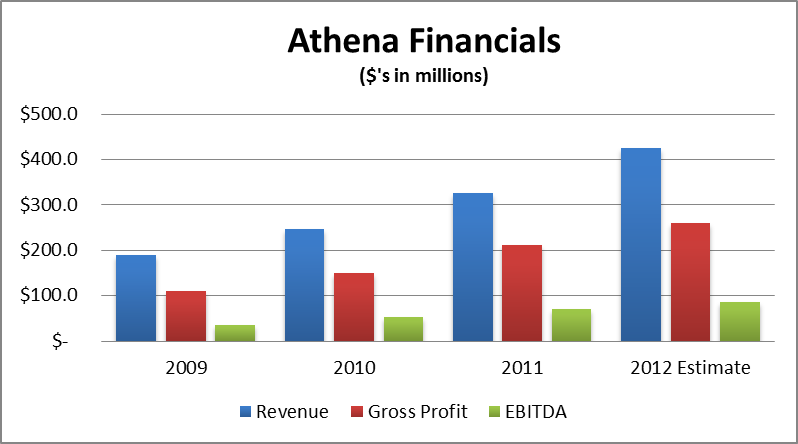
Athena’s financial performance has steadily grown alongside their product footprint and physician penetration.  In 2012, analysts estimate they will do $425 million in revenue and $85 million in EBITDA.  The company’s market capitalizaiton is $3.2 billion.  See chart below:

Athena Financials

The reach the organization has achieved is impressive, but still only a fraction of the market opportunity.  Below you can see the number of doctors in the athenahealth network – which is over 25,000.  There are nearly 1 million physicians in the US.

Athena Table

Athenahealth’s Culture

For the 15 years since inception, CEO and cofounder Bush has run athenahealth end-to-end.  A remarkable entrepreneurial story, similar to TripAdvisor and Akamai, where the founder (or near-founder in the case of Akamai’s Paul Sagan) lead the business over many years.  Cofounder Todd Park, who is now the Chief Technology Officer for the United States, joked in an interview that medical billing is hardly “sexy”, but that by emphasizing the “doing well by doing good” aspects of their vision, athenahealth was able to create a powerful, mission-driven culture.  Bush and Park both emphasize culture in all aspects of the business.  Scaling Lessong #3:  A mission-driven culture (as opposed to green-driven or fear-driven) endures, particularly when the mission connects to a greater social good.

But athenahealth’s culture is more than just a bunch of do-gooders.  Their performance management system is very sophisticated.  One former executive described to me how transparent the organization is with respect to goals and metrics and how well-designed their Balanced Scorecard is for each individual and department.  The company shares that Balanced Scorecard on each quarterly earnings call as well.  As a result, everyone in the organization has a clear view of what the priorities are.  The scorecard includes five major components:  stability, operational performance, client satisfaction, financial performance and growth.  Scaling Lesson #4:  performance management systems and communications systems need to mature and be implemented as the company grows to maintain clarity and transparency.

Visionary CEO

As anyone who has met him can tell you, Jonathan Bush is a unique founder/CEO.  He is open, transparent and (at times painfully) authentic.   I love that his candor and humor haven’t changed, even as he has matured into the CEO of a multi-billion dollar market cap company.  Read the recent Q2 earnings call transcript, and you’ll get a clear sense of what I mean.  During the Q&A, when he’s talking off script, you’ll see a few funny quotes:

Well, one of the great lessons that we all learned in The Princess Bride is never get involved in a land war in Cleveland. [in reference to a slow roll-out at a hospital]

Life, Anthony. It’s a contract for life. All of our contacts are for life. They can all leave whenever they want, but hopefully, we don’t get boring. We keep changing our outfits, and they stay forever. We cut our hair short, we let it grow long. We have contracts for life. [when asked how long the term of a particular large deal was]


Jonathan’s humor stands out, but his willingness to put himself “out there” and be so authentic and direct is not unusual for many founders.  The athenahealth lesson is about passion, endurance and perserverance.  Much like Akamai and TripAdvisor.  Those appear to be the consistent attributes for scaling companies.

Dave McClure Misses An Additional VC Trend…Outside Silicon Valley

There is alot I like about Dave McClure's post on VC industry trends. It captures many of the trends of that are transforming the venture capital industry, particularly the bifurcation of "mega VC" and "micro VC" funds. But I think he's missing one important trend that is happening outside of Silicon Valley.

For those of us who practice the VC craft outside of Silicon Valley, it is clear that the mega VC strategy just doesn't work. VC can't successfully deploy $1 billion unless they are investors in mega hits like Facebook, LinkedIn, Twitter and the like that have the potential to generate > $10 billion exits. Nearly all of the mega hits have been Silicon Valley based. Most of the recent big successful exits outside Silicon Valley (e.g., Buddy Media, Demandware, Endeca, Millenial Media) have been in the $500 million – $1 billion range. If you have a $1 billion fund and need to generate 3x to be successful, that's $3 billion in returns. If you own an average of 15-20% per company, that's $15-20 billion in exits. You can't get there $500 million at a time.

The micro VC strategy also is particularly well-suited for Silicon Valley. The successful micro VCs get into the mega-successes early, and also benefit from the high number of quick flips. Some micro VCs are attempting to make this model work outside Silicon Valley (e.g., Founder Collective, Lerer Ventures, NextView), and are seeing early promise, but the results of that strategy is still too early to call.

What is working outside Silicon Valley is small, focused, lifecycle funds. $150-300 million in size, funds like Union Square (NYC), Foundry (Colorado), Spark (Boston) are among those that have generated the best returns for their LPs this decade. These funds, who are neither mega VCs nor micro VCs. They are in the middle. Outside Silicon Valley, being in the middle can work well because you can get in early with small dollars, like a seed fund does, but get fully behind your winners and own 15-20% for $8-12 million. When the $500 million exit is available, you take it and the fund is small enough that it has a big impact. When you have an opportunity to attempt a mega exit and it is time to raise a mega round of financing, you simply go to the mega fund.

A number of companies in our portfolio have followed this strategy. In our first round of financing, we invested $1 million in Open English, an English language learning platform. Over a few years, we kept investing as the company grew. Once the company achieved real scale, mega fund Insight came in and invested $43 million. Similarly, 10gen was at a very early stage when we and Union Square invested. As the company grew and achieved scale, it came time for a mega round. NEA led a $40 million round last quarter.

At Flybridge, we are trying to execute on that middle strategy outside Silicon Valley – a small, focused fund that will invest early and work hard alongside companies for their full lifecycle to generate solid exits sometimes and, hopefully, one or two mega exits.

So far, this strategy is working for us and others. Whether it works in Silicon Valley, I can't say.

Scaling is Hard, Case Study: TripAdvisor

“TripAdvisor is to travel reviews what Kleenex is to tissues.”


– Henry Harteveldt, Forrester


TripAdvisor may be one of the most fascinating companies I know and so I was excited to dig into their business model as part of my series on scaling.  This is a company that took $4 million of invested capital to build a company now worth over $4 billion.

As I mentioned in my post last week, scaling is hard.  Really hard.  As we have seen with the recent speed bumps at highfliers like Groupon and Zynga, taking “lean startups” from foundation to creating sustainable, scalable, profitable business models is a very rare and special task.  That’s why I embarked on this series:  to highlight a few companies outside of the Google/Amazon/Facebook pantheon that have built large, sustainable, profitable business models at scale.

Last week, I wrote about Akamai, a company with strong network effects that successfully transitioned from a single product to build a platform that garners over a billion dollars in revenue and is now a core part of the Internet’s fabric.  TripAdvisor is more of a classic consumer Internet success story, but with even more powerful network effects and an amazing business model.  Magical, really.

TripAdvisor’s History:  Two Big Pivots

Founded in 2000 by Stephen Kaufer and Langley Steinert, Boston-based TripAdvisor is a travel website that provides reviews and other information for consumers about travel destinations around the world.  The company is now pervasive – with 65 million unique visitors each month scouring the site for reviews of hotels, restaurants and sites around the globe.  I remember last year settling into the booth of a café deep in the rainforest in Costa Rica and looking up to see a placard on the table begging for a positive TripAdvisor review.

Chatting with CEO and cofounder Kaufer this week, I was reminded of the fact that the company started with a very different business model in mind.  I first met Steve when he was VP of Engineering at Centerline software, a software development tools startup, and I was a junior in college.  He was a fellow Harvard computer science graduate and I was looking for a summer job in software development and found him through an alumni directory.  In founding TripAdvisor, Kaufer wanted to take his hard core engineering skills and apply them to vertical search in travel.  That is, build a massive database of travel information that provided a white label search engine for travel sites like Expedia and Travelocity.  Big Data meets travel…in 2000.

Kaufer described to me with some chagrin what happened – after a year and a half, he had no clients and no revenue and was running out of money.  Then, 9/11 hit and the travel industry was decimated.  Kaufer began to despair that his fledging start-up would go under.  Fortunately, on the side, the company had built up TripAdvisor.com as a demo site to show the prospective clients what a vertical search engine could do.  When he saw TripAdvisor.com start to pick up traffic, he decided to pursue an online advertising based business model with banner ads.  “Going B2C was daunting and not in our core DNA,” Kaufer remarked.  But testing hypotheses was very much in the company's DNA, as well as evaluating data to learn and adjust.  TripAdvisor, in effect, was a model lean start-up with an engineering-driven, product-focused founder.

After a few weeks of watching no click throughs, Kaufer executed his second pivot:  a cost per click model (now known as CPC).  Every time a consumer clicked on a hotel to book a room, TripAdvisor would charge the hotel something.  Suddenly, everything began to (literally) click.  Three months into launching the new model, TripAdvisor was earning $70k per month and achieved breakeven.  The company has grown profitably ever since. Kaufer originally hired editors to comb the Web for great travel articles and link to them, and then allowed users to post their own reviews on the site as a whim.  When the company saw that user reviews were getting all the traffic, they adjusted to focus on user reviews, such that fresh, authentic content was always available and didn’t cost the company any money to produce.

TripAdvisor And Expedia:  From $4 million invested to $4 billion in value 

With these adjustments, TripAdvisor grew rapidly and successfully.  The company agreed to be acquired by Expedia/IAC in 2004 for $210 million in cash, a huge win for all, particularly given their amazing capital efficiency:  they had only raised $4 million in venture capital.  Under Expedia, TripAdvisor continued to flourish and grow – they would feature Expedia’s ads on their site and reap the revenue benefit when users clicked on those ads.  Expedia grew to account for roughly one third of the company’s revenues.  In December 2011, Expedia felt it wasn’t getting full economic credit for TripAdvisor buried within its financials and so spun TripAdvisor out as an independent company, where it now trades on the NASDAQ with a $4.8 billion market capitalization as of this writing. 

Scaling Lesson 1:  Focus On Finding A Great Business Model

After some searching, TripAdvisor found a magical business model, representing social media and user-generated content at its best.  Content is free and supplied by consumers who write reviews voluntarily.  These consumers allow this content and their own engagement to be monetized without asking for anything in return.  Customer acquisition is driven mainly through natural search (the art of Search Engine Optimization, or SEO, was practically invented by TripAdvisor) thanks to the huge volume of great content (as Kaufer pointed out to me:  “if a review comes on in Thai of a Bangkok hotel, suddenly it’s a better product”), long history and brilliant manipulation of Google’s search algorithm.  Advertisers are brought to the site and driven mainly through self-service channels, so there is no need for a large sales force or account management team.  As a result, gross margins are very high at 98% (not a typo!) and EBITDA margins are 47%.  Think about that.  For every dollar of revenue, the company is able to drop nearly half to the bottom line.  I’m not sure the Mafia could do better.  In the hyper-competitive world of technology and consumer Internet, it is hard to find a company that is pound for pound as profitable as TripAdvisor.

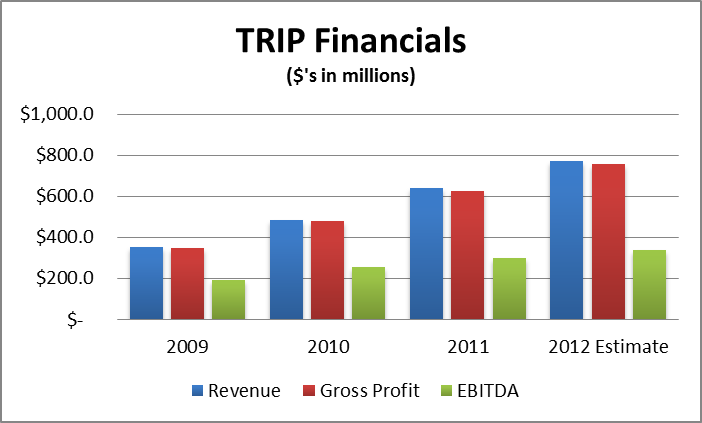
TripAdvisor is a classic example of a network effect business and a reminder of how financially attractive network effect businesses can become at scale.  There are three sides to the network:  the consumer, the venue and the advertiser.  The network becomes more valuable as it grows to each party – with more consumers providing more interesting content, more venues providing more access to vacation options and more advertisers offering deals and convenient bookings.  This virtuous cycle has fueled its growth nicely and allowed the company to drive very efficient value.  The chart below shows their financial performance over the last few years, with forecasted 2012 revenue of $767M and EBITDA of $339M.  At its current 20-25% revenue growth rate, TripAdvisor will join Akamai in the billion dollar revenue club in 2014.  The $4.8B market cap is 6x revenue and 13x EBITDA, so not insane multiples on a comparable basis.

TRIP Financials

As a side bar, I thought it would be interesting to compare TripAdvisor’s Unit Economics with those of Yelp and foursquare.  I took a few of the relevant metrics – unique visitors, revenue and market capitalization – and calculated a few ratios to demonstrate how good a job TripAdvisors does at monetizing their users.  Here's unique visitors, with an estimate for foursquare based on some of their reported numbers:

Monthly Unique Visitors (2)

As the chart below shows, TripAdvisor consistently achieves $12 annual revenue per user (ARPU) as compared to $1 for Yelp and unknown for foursquare. 

ARPU (2)

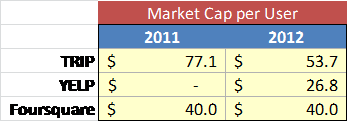
Yet on a market capitalization side, despite having a 12x advantage in monetization, the company is valued only 2x per user by Wall Street than Yelp and a mere 25% higher than foursquare, based on its most recent private financing round (reported to be somewhere north of $400 million pre-money).  Amazing. 
Market Cap per User

Scaling Lesson 2:  Maintain a Sense of Urgency

Kaufer’s description of the TripAdvisor culture and development process makes it clear that he has been able to maintain a strong sense of urgency, even at scale.  “No matter how large we are, I always want to maintain a startup mentality,” said Kaufer.  "We have a once a week release cycle that we have religiously maintained for years…even with hundreds of developers working on a shared code base.  If my team tells me they want to launch a new feature in two months, I ask them what prevents them from doing it in two weeks.  Culturally, I’m happy to play the ‘crazy CEO who doesn’t get how hard it is to build and release stuff’ in order to push.”  I know many CEOs who don’t have the same comfort pushing their engineering teams.  I wonder if Kaufer’s ability is here is in part grounded in the fact that he himself was a vice president of engineering and feels comfortable challenging his product team with authority. 

Scaling Lesson 3:  Maintain a Product Focused Culture

Kaufer described to me that with his engineering roots, the company has always had a test and learn culture and a product-focused culture.  “I enjoy focusing on building a great product,” he commented simply.  “I can maintain that focus as we grow because I have a fantastic executive team who enjoys doing things that I don’t enjoy doing.”  The company’s vice president of engineering posted a terrific blog about how the engineering culture has scaled and shared something with respect to the role of engineers that I thought particularly interesting:  “We do not have ‘architects’ – at TripAdvisor, if you design something, your code it, and if you code it you test it. Engineers who do not like to go outside their comfort zone, or who feel certain work is "beneath" them will simply get in the way.”  In other words, there is a certain style of developer required to fit into the TripAdvisor culture – someone who is focused on building great products end-to-end, just like the CEO is.

Scaling Lesson 4:  Create Entrepreneurial Pockets

Kaufer described his technique for building entrepreneurial centers while scaling.  “Any time you want to expand, you have the question – do you build it into the mother ship or acquire companies and keep things separate?  I prefer to keep it separate and give it some CEO love.  Whether its an internally built effort or something you incubate through an acquisition (we’ve acquired over a dozen companies), keep it separate operationally.  Staff the team separately, give it attention but don’t let it get bogged down with the mother ship.”  For example, one of the company’s divisions, FlipKey, is hiring engineers, just like other divisions within the company.  He tells them to just go out and find the best engineers they can find and hire them without bogging them down in a centralized recruiting process that would clash with other divisions’ hiring.

Comparing TripAdvisor with Akamai

There are a few similarities to the TripAdvisor story as there are with the Akamai case study but some differences.  TripAdvisor founder Stephen Kaufer is the classic technical founder who has grown with the company to be the end-to-end leader.  Kaufer told me he always thought he’d be tapped out and replaced around 100 employees.  With 1,300 employees and 12 years after its founding, he remains CEO of the company.  Although Akamai’s founders were engineers, they hired Paul Sagan and George Conrades to run the company very early on.  Sagan was thus almost like a cofounder and, similarly, has been with the company for 12 years.  There is something powerful about that enduring focus – a leader who continues to grind away at driving improvements, results and managing scale over a long period of time.  Neither leader was ever "exit" focused, but rather focused on building a great business that can endure.

TripAdvisor’s Future

TripAdvisor may have a magical business model, but consumer travel remains a very competitive market.  Google’s $700M acquisition of Cambridge-based ITA and more recent acquisition of travel content leader, Frommer, is an indicator that others are in pursuit of TripAdvisor’s core business and juicy profit margins.

That said, whatever the future may bring, the lessons from TripAdvisor’s successful twelve year journey to scale are enduring.

Thanks to Stephen Kaufer for his help with this profile as well as Zach Ringer for his assistance with the research and analytics.  For more on TripAdvisor’s business and strategic choices, see the Harvard Business School case written about the company.