Scaling is Hard, Case Study: Akamai

I have been thinking lately about how hard it is to scale start-ups.  The Lean Start-Up movement, as exemplified in Eric Ries' book The Lean Start-Up, has appropriately focused a great deal of attention on the hard decisions and techniques required to create a company from nothing.  But once the company has honed in on a strong value proposition and found initial product-market fit, what is the best approach to scaling it?  And what lessons can be applied to the early decisions you make as a start-up?  After all, scaling is hard.  Really hard.

To help shine some light on this topic, I’ve decided to do a series of blog posts of case studies of companies founded in the last 10-15 years that have made the transition from finding initial product-market fit to building a large, scalable, platform company.  Facebook and Google would be obvious choices for this, but so much has been written about each of them and they represent such special business models, I worried that it would be both hard for entrepreneurs to relate and hard for me to develop new insights.  So instead, I am picking a few companies with less well known stories that may resonate with today’s entrepreneurs.  The first one I’ll focus on is Akamai.

Akamai:  The Present

Many people know Akamai as the purveyor of the Internet’s backbone.  Incorporated in 1998 in Cambridge, Massachusetts, the company’s network of over 100,000 globally distributed servers provides an infrastructure layer that accelerates the distribution and delivery of content, media and applications.  With over $1 billion in revenue, 2000 employees and a market capitalization of over $6 billion, Akamai has become a role model for scalable start-ups.  The chart below shows the company’s strong financial performance from 2009 to the present.  In 2012, analysts forecast the company will achieve nearly $1.5 billion in revenue, over $1 billion in gross profit and $500 million in EBITDA.  I can't think of many companies founded in the same era outside of Google and Facebook with similar financial performance.  How did Akamai do it?


Akamai Financials (2009-Present)

Founding Akamai

Interestingly, the company’s founding vision was not a lean idea, but rather a big idea:  to accelerate and manage Internet traffic on a global, highly scalable, highly distributed scale.  Technical founders Tom Leighton and Danny Lewin built the original prototype at their lab at MIT starting in late 1996 before raising capital, so in a sense Akamai’s Minimum Viable Product (MVP) was a prototype with the basic architecture and traffic mapping in place that validated algorithms for the founders and investors alike.  So the first interesting scaling take-away for me of the Akamai story is:  they pursued a very big idea, but utilized lean principles in the sense of hypothesis-testing and avoiding waste.  Later joined by Jonathan Seelig, an MIT Sloan MBA student, the Akamai team raised an $8 million Series A based on the lab prototype in order to commercialize the product.  They didn’t raise their Series B until they proved some of the initial hypotheses around market adoption and were ready to scale the sales efforts, as described below.

Scaling Akamai – Part 1:  A Little Fat

The company quickly realized that its initial commercial product was in huge demand – they had reached product-market fit nirvana.  The first year of revenue (1999) was $4 million – a remarkable achievement.  But the second year (2000) was simply astounding:  nearly $90 million!  Despite the Internet bubble bursting, the company was able to generate over $160 million in revenue in 2001.  Akamai found itself truly inside the tornado.  They raised a Akamai’s Series B of $20 million shortly after the Series A to fuel the growth.

Co-founder Seelig told me that they realized that they had gotten to that rare point where “the opportunity presented itself to go big” at the same time as the capital markets provided capital at a good valuation to support going big.  Seelig described the frenzy inside the company to hire like mad (they had over 1000 employees by the end of 2000), to scale all aspects of the operations and team (experienced operators Paul Sagan and George Conrades were quickly hired to lead the company) and to address the initial product's warts.  Seelig shared with me that these warts were in all the functional areas you don’t think to focus on building for scale in the early days – such as reporting, billing and administration.  This presents the second interesting scaling take-away of the Akamai story:  when you achieve product-market fit, it’s ok to have some waste in order to grow fast.  If you find yourself in that privileged position, don’t be cautious.  Go after it aggressively, even if it means risking making hiring and operating mistakes and wasting capital – so long as this capital is relatively cheap, as it was for Akamai in the midst of the Internet bubble.  Look at the (quite ugly) P&L for Akamai in 1999 and 2000 – costly mistakes were made, but ultimately enabled the company to scale as rapidly as it did:

($'s in millions)      
  1999 2000 2001
Revenue $4.0 $89.8 $163.2
Gross Profit $(60) $(886) $(2,436)
EBITDA $(56) $(899) $(2,414)
 
Market Cap $23,184 $3,165 $536
Head Count 464 1,300 841


Looking at the numbers, it's obvious that 2001 was a dramatic year – the company had to cut back head count significantly as the market capitlalization plummeted from the highs of the IPO.  Even more tragically, the company's founder, Danny Lewin, was killed on one of the 9/11 airplanes.  The leadersihp team had to rally to overcome these two difficult blows and make difficult financial choices to recover.  Akamai learned a scaling lesson that I've seen play out in typically less dramatic fashion, but nonetheless difficult:  scaling is never a linear path. There are always set backs and speed bumps along the way to growth and greatness. 
 

Scaling Akamai – Part 2:  From Product to Platform

As the company’s first product offering – content acceleration – hit the tornado in 1999, they began working on transforming the company from a one-product success to a platform.  Seelig told me that the founding vision always was that Akamai would build a global distribution platform, but the first application was static content from websites.  In effect, this was the company’s MVP to prove out the core infrastructure.  But once this first application took off, they began developing the suite of additional applications that form today’s behemoth – streaming media, dynamic page assembly, whole site assembly, e-commerce distribution, etc.    Here the company was challenged to prove it could repeat its success with its first product.  Systems were put in place and professional managers with experience in building mission-critical products were hired.  This effort leads to the fourth interesting scaling take-away:  Just because your first product is successful, it doesn’t mean you’re a product genius.  Product geniuses are those that build rigorous product development processes that allow multiple successful products to be developed and marketed.  This is the magic of what Akamai and other multi-product companies achieve as they scale.  Without a repeatable product development process, they are doomed to be one-hit wonders. 

Akamai Going Forward

There are a lot of challenges ahead for Akamai.  The company faces competitive pressure that some analysts think will challenge their margins going forward and the stock has slumped recently from a high market capitalization of $8 billion to a “mere” $6 billion.  CEO Paul Sagan has announced he is retiring after 13 years at the helm and the board will need to select a new leader for the company’s next phase.  Whether Akamai turns into an even bigger platform company success story or not is still to be determined in the coming years, but there is no question that the company represents an amazing case study for students of the start-up game focused on scaling.

Special thanks to Jonathan Seelig for his insights and Zach Ringer for his assistance with the research and analytics behind this blog post. For more on Akamai’s founding story and business model, see the Harvard Business School case written about the company.

Why Hasn’t NYC Produced More IPOs (While Boston Has)?

Over a year and a half ago, I did a two-part blog post on the East Coast IPO malaise – one focused on Boston (Massachusetts more broadly), another focused on New York.  In these two posts, I expressed optimism that there was a strong pipeline of companies that would result in public offerings if the macroeconomic environment was stable enough.  And in assessing the two markets, my conclusion was that the New York market had a stronger pipeline of pre-IPO companies that would be attractive to the public markets than Boston.

On the heels of the successful Kayak IPO, I thought I would do a retrospective look back.  In doing so, I realize I was dead wrong.  In the last 18 months, Boston has produced far more IPOs than New York, and the remaining pipeline in Boston seems to be quite strong (see Boston Business Journal's IPO Watch), arguably stronger than New York for the next 6-12 month window.

There have been eleven Boston-based technology IPOs since my blog post, including:  Brightcove ($430M market cap), Carbonite ($240M), Demandware ($740M), EXA ($130M), Kayak ($1.2B), Merrimack Pharma ($730M), Synageva Biopharma ($1.2B), Tesaro ($360M), TripAdvisor ($6.0B), Verastem ($210M) and Zipcar ($730M).  A few of Boston-based the companies that I highlighted as potential IPO candidates in 2011-2012 have chosen to sell instead, including Endeca ($1.1B, Oracle), Kiva ($775M, Amazon) and ITA ($700M, Google).

Meanwhile, not a single New York technology IPO has taken place.  Maybe I'm mistaken, but in reviewing the data, I couldn't find a single one.  There was one big exit from my list of NY IPO candidates – Buddy Media ($700M, Salesforce.com) – but no others.

11-0 in IPOs and 3-1 in big M&A in favor of Boston?  What’s going on here?  Is this a law of small numbers or a fundamental issue?

I’m not sure of the answer, but a few theories have surfaced as I talk to others:

  • The IPO culture hasn’t fully permeated NYC?  There are only very few public technology companies based in NYC:  I count AOL as the only one with > $1 billion market capitalization, whereas Boston has 30-35 innovation economy companies with greater than > $1 billion market capitalization.  Perhaps Boston CEOs, CFOs and boards feel more pressure to go public sooner and/or are comfortable with the IPO process because they community has done it so many times.  Honestly, this theory doesn’t totally resonate with me as NYC is the heart of Wall Street – all the relevant bankers, accountants and advisors are there.  If any technology hub can build a strong middle market public company ecosystem, it should be NYC.
  • NYC’s tech sectors are out of favor with public markets?  This theory suggests that the sectors that NY is particularly strong in – consumer, advertising technology, media – are out of favor for some reason.  Perhaps the poor performance of the Facebook IPO soured Wall Street on the consumer sector and advertising-based business models?  But then why have consumer plays like Boston-based Kayak, TripAdvisor and Zipcar done so well?  As for the adtech sector, why did DC-based Millenial Media, a mobile advertising network, have such a strong public offering if the sector is out of favor?  Again, I’m not sure this theory holds water.
  • NYC companies are more sizzle than steak?  This theory is that because NYC companies are so heavily covered in the mainstream media, they are perceived to be ahead of where they really are in terms of actual business progress.  E-commerce companies like Etsy, Gilt Group and Rent the Runway get a lot of ink compared to, say, Boston-based Wayfair and RueLaLa.  But if you objectively examined their financials in terms of actual revenue scale and profitability, who is really closer to being ready to file their S-1?  This theory resonates somewhat with me.  For example, there is no TechCrunch reporter in Boston, but a number in New York and Business Insider is a strong local publication that does a nice job cheerleading for the local sector.

My firm, Flybridge Capital, operates with both offices and portfolio companies in both cities.  We are seeing amazing things going on in the NYC start-up ecosystem and are investing heavily there in 2012.  My summary view is that the outperformance is due to a more vibrant seed and Series A environment in 2003-2006, which is when many of these companies were started.  Given how strong the seed and Series A environment has been in NYC for the last few years, the results should even out over time.

Unfortunately, I can’t say the same for my Red Sox this year…

Big Idea vs. Lean Idea

“Seems niche.  How many people want to tell everyone randomly what they’re doing and how many really want to look at it?” 

– My entry for Twitter, as recorded in early 2007.

This entry in my "deal flow" journal records my first, inauspicious impressions of Twitter when I initially heard about it.  Today, It is obvious that I totally missed the power of the service, which I now adore and admire.  But what is less obvious to me, and therefore I assume many others, is how to distinguish between a Big Idea that simply starts small — consistent with Lean Startup methodology — as compared to a Small Idea that will always remain a Small Idea.

This question has been on my mind because recently, when I talk to entrepreneurs, I’m seeing too many Small Ideas.  In the last few weeks, I’ve spent time at Techstars, MassChallenge and ER Roundtable.  I love the passion the entrepreneurs are exhibiting in all of the venues and the education they’re getting by being a part of these programs.  And I love that the toolkit for startups is getting sharper and that techniques like the Lean Start Up methodology and terms like "hypothesis testing" and "MVP" are becoming common place.  To be clear, I am a lean startup acolyte.  The class I teach at Harvard Business School, Launching Technology Ventures, dedicates a large portion of time applying the lean methodlogy that Eric Riess so ably outlines in his book to start-ups. 

Yet, I fear that the success of the Lean Start Up movement risks leading entrepreneurs to pursue Lean Ideas rather than Big Ideas.  I'd like to see that trend reversed, by pushing entrepreneurs to distinguish more carefully the differences between Lean Ideas and Lean Start Ups.

First, a few definitions.  Lean Start Up methodology teaches that young companies should view the start-up as a laboratory for experiments, where a minimum viable product (MVP) is created to test the most critical initial hypotheses in order to inform the direction of the company, and whether the value proposition will be compelling enough to build a compelling product, and therefore compelling company.  A “lean idea” is a concept that is small, niche, incremental.  It might be better served as a feature in someone else's product.  Or a point solution in someone else's product suite.  But it is not substantial enough to form the core of an entire company, never mind start-up nirvana, which is to become a platform on top of which other companies seek to build (see chart below, which should have "Platform" as the rightmost point of nirvana for the inventor). 

Today, Facebook is a platform.  The Facebook API set is one of the hottest areas of development on the Web and some even equate Facebook with an operating system, in hushed tones of awe that previously were reserved for Microsoft (oh, how the mighty have fallen…).  But the initial service that was formed and launched in the Harvard dorm room, coded up in a few weeks, was simply a minimum viable product that allowed students to look each other up.

So as an entrepreneur, never mind an investor, how do you know whether you are working on a lean idea will never be anything more than a feature, or a Lean Idea that will evolve into a Big Idea over time, just as Facebook and Twitter did?  I don't have a definitive point of view here, but a few rules of thumb have begun to take shape in my mind:

  1. Don't Settle For Anything Less Than "The Wow".  Declaring something a Big Idea, or a Big Vision, is a lofty moniker.  Set the bar high when you consider whether your idea really is as massive, disruptive and game-changing as you think it is.  When you bounce the Big Idea off your friends and colleagues, do they nod politely and use words like "interesting", "cool", "neat" as opposed to widening their eyes and declaring, simply, "wow".  When I first heard about Square (also a Jack Dorsey production), I thought "wow".  Turning every mobile device into a payment acceptance platform – that's game changing.  Look for the wow.  Don't settle for anything less.
  2. Swim in the Ocean, Not a Pool.  If your company is operating in a massive, massive market area, with plenty of interesting adjacent markets, then you know you are pursuing something that could be really big.  DataXu, a Flybridge portfolio company, initially started focused solely on bringing real-time bidding and machine learning techniques to display advertising, at the time a $10 billion market – large, but not wow, particularly because the solution only worked if the advertising inventory was available to bid on through one of the exchanges.  So let's call that market pool-sized – or perhaps even lake-sized, but not ocean-sized.  The ocean-sized market was the bigger vision that CEO Mike Baker had – that all advertising (display, video, mobile, social) would be addressable through real-time, digital techniques.  And that a system could be built that was so fast, that thousands of data points could be poured in to inform the decision as to which ad to put in front of the consumer in real-time.  That was the wow that is driving that company to be as successful as it is today.
  3. Great Teams Find the Wow.  For decades, VCs have debated whether to focus on great teams or huge markets.  Will great teams operating in a small market outperform mediocre teams operating in a huge market?  Although there are case studies that cut both ways, to transform a Lean Idea into a Big Vision, I would submit you need a great team.  Benchmark's Andy Rachleff's bias, as reported in a Marc Andreessen post, is that the #1 company-killer is a lack of market.  Therefore, he concludes, in the debate between team vs. market, markets rule.  That said, I would submit that in order to transform a Lean Idea into a Big Idea, you need both.  A great team will find a way to expand that initial MVP into a huge market opportunity.

Company-building is never neat and linear.  Did Mark Zuckerburg or Jack Dorsey imagine at the point of creation that Facebook and Twitter could become veritable movements (that most transcendent state for a service – where it is beyond a platform but instead a cultural institution)?  Probably not.  Sometimes a Big Idea grows organically out of a Lean Idea.  But often, that combination of big vision, big market and great team can be seen in the DNA of any idea that morphs into a Big Idea that leads to a Big Platform.

So, when you are formulating your own start-up idea, make sure to distinguish between a Big Vision that begins with a Lean Implementation, and a Lean Implementation that is a reflection of a Lean Idea.  As Jordan Cooper recently wrote in his provocative blog post "Rise Strange Thinkers…We Need You", we need more Big Visions, as strange and outlandish as they may initially sound, to drive this ecosystem forward.  Just because you want to embrace the Lean methodology, doesn't mean you should settle for a Lean Idea.

We Still Don’t “Get” China


I confess to being proud of my family and so when someone in the clan writes a book, I read it with great pleasure.  My brother-in-law, William Landay, recently released his third book, the crime thriller Defending Jacob, to great critical reviews and it has become a NY Times Bestseller.  And my uncle Ezra Vogel recently released a towering biography of Deng Xiaoping, which beat out Kissinger's book on China for the prestigious Gelber Prize, which is awarded to the best book on foreign affairs each year.

So when my cousin, Tom Doctoroff, released his second book on China, What Chinese Want, I was excited to read it.  Somewhat to the chagrin of the rest of the family, Tom left America for China 20 years ago to be an executive for advertising agency JWT (one of the WPP holding companies).  He quickly rose to become CEO of Asia for JWT and from that perch has witnessed the cultural transformation and consumerisation of the country.

What is amazing about Tom's book is that it is a cultural and sociological analysis of Chinese society disguised as a book about advertising and marketing.  Tom's observations range from wonky brand analysis (e.g., in his assessment of how Starbucks has become a sensational success in tea-obsessed China) to sweeping cultural and political insights.  For example, in reviewing China's halting efforts to instill more creativity in their schools in the hopes of creating a more innovative society he states:  

"Put simply, the Chinese are great at application but lousy at innovation…The Chinese are defensive and protective, are culturally and institutionally averse to ideas that buck convention."

I also enjoyed his observations about China's relationship with the United States.  "The Chinese do not want to beat the US," he writes as if trying to assure policymakers and the broader American society at large, "They want to stand beside it, proudly."  This attitude is rooted in the Chinese adherence to Confucian principles of harmony and the principle of being "ambitious, yet cautious to the core".  His explanation of China's fascination with president Obama was also telling, observing that Obama's "underdog status became a font of admiration," and that by reshaping the US political power structure as an outsider he "achieved what a sometimes-insecure China aspires for itself".

Tom's observations on Chinese culture, board room behavior, international affairs and consumerism are that rare insider's view provided by an able reporter who is steeped in American culture and values.  If you want to learn about the motivations and mores behind the next great global force, read this book.

Start-Up Compensation

One of the most frequent questions I get from entrepreneurs is "what is market?" with regard to compensation, particularly for executives such as the Chief Technology Officer or VP of Sales.  It is such a frequent question that it was the topic of one of my first blog posts 7 years ago.

Talent is the most important ingredient at a young company, and so there is great energy put into trying to be thoughtful to pay a fair market rate for good talent, particularly in light of a very competitive market.

Fortunately, like most things in the land of startups, the world has gotten much more transparent in the last few years and there's a plethora of good data available to help answer this question.

One of the best is my Harvard Business School colleague Noam Wasserman's annual compensation study that he performs in partnership with J. Robert Scott and E&Y. Noam describes the study a bit in his blog post, but if you want a far more detailed view of "what is market" than my amateur summary – sliced and diced by industry, size of company, amount of capita and more – then this study is for you. It's a give-get model – if you give your data, you get the aggregated data back in all it's gory detail.

I highly recommend it. 

Are Banks Simply Too Big To Innovate?

Mary Meeker's periodic review of the Internet industry is always a must-read presentation.  This year was no exception – chock full of data, insights and thought-provoking charts.

There is a theme that Mary espoused that I have become a big fan of ever since I read Marc Andresseen's article in the Wall Street Journal "Why software is eating the world."  She framed it as the "re-imagination of nearly everything."  The simple notion is that the confluence of broadband, mobile and globalization in combination with Moore's Law have allowed the technology industry to innovate almost everything in existence.  Facebook's IPO brought their "hack" culture to the forefront of the world's conscience.  Well it turns out, technologists are hacking everything – from advertising to media, from retail to health care, from education to banking.

Ah, banking.  This has not been a good few weeks for the banking industry.  The surprise $2 billion trading loss  at JP Morgan Chase has caused erstwhile superhero Jamie Dimon to appear fallable.  Many are pointing out that the crisis at JP Morgan is an example of a banking sector that is increasingly concentrated in the hands of a few and results in a systemic risk because the top 5 banks are simply "too big to fail."

I would argue, there is an even larger risk for the financial services industry, that in turn provides a larger opportunity.  I think banks are now simply too big to innovate.

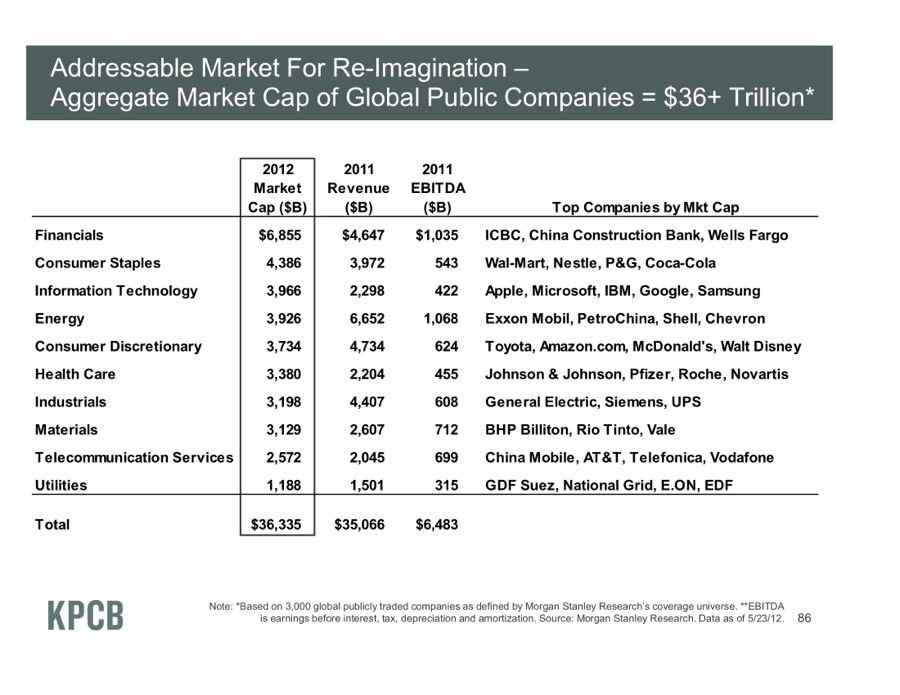
Let's look at Meeker's slide 86 below:

Slide-851
She lists the industries that are ripe for "re-invention" sorted by their 2012 market capitalization.  Financials are on top at a leviathan-like $7 trillion.  There are 200,000 employees at JP Morgan Chase and Bank of America each and 350,000 at Citigroup.  Structurally speaking, these organizations are simpy too large to develop breakthrough, out-of-the-box, re-invent banking solutions.  That opportunity is left to entrepreneurs.

As a result, there are a slew of start-ups "hacking" banking.  We have invested in a number of them that are hacking away at pieces of the financial system.  ZestCash is hacking consumer lending.  SimpleTuition is hacking student loans and banking.  Cartera Commerce is hacking credit card marketing.  AccountNow is hacking checking accounts and debit cards.  Plastiq will soon be hacking large ticket purchasing.  There are hundreds, if not thousands, of others that other investors have backed as well.

So when I look at the innovative progress being made in payments, mobile banking and other major areas, it makes me smile.  Because while the major titans in the industry are caught up in looking backwards, the entrepreneurs are re-inventing the future of finance.  That's an exciting prospect.

Dear Graduates: Push The Boundaries

This time of year is full of Commencement ceremonies across the country.  In honor of this year's crop of graduates, the class of 2012, I've been thinking about whether there is one pithy lesson that I might convey to them as they enter the adult world.  My inspiration in this thinking is a book I read recently called "This I Believe," a collection of essays from famous, and not so famous, people who summarize their life lessons in a brief vignette.  It was inspired by a radio program by Edward R. Murrow in the 1950s and was revived by PBS and recently compiled into a well-done book.

So, in that vein, here's my simple lesson to this year's crop of graduates:  push the boundaries.  Why?  Because they are there to be challenged.  Because conventional wisdom is just that, conventional.  And you don't want to settle for living a conventional life within a conventional world.

This lesson was hammered into me by my father, a Holocaust survivor who never saw a line he didn't try to skip, an inefficiency he couldn't stamp out, or a injustice he didn't try to undo.  One of his favorite phrases is"don't assume anything."  In other words, don't take for granted core assumptions – whether in tackling a math problem or life.  Instead, test them and try to stretch them to their limits, and beyond.  Further, he would rail against the injustice of those would seek to benefit from old rules in an unfair manner.  I still bump into residents of my home town who remember his repeated crusades against the local cable monopoly as a town meeting member in the 1970s and 1980s.  

My Dad was inspired to become an entrepreneur because of this life philosophy – as many entrepreneurs do.  Great entrepreneurs see boundaries as challenges.  They take great pleasure in tweaking the status quo and rethinking decades of assumptions.  And they incorporate this philosophy into their personal and professional narrative as they pursue new products and services that disrupt existing markets.

My 12 year old son lives this mantra to the hilt (I wonder if entrepreneurship has genetic roots?).  He questions every rule, every boundary with a probing, "Why?"  I love him for it, despite the fact that it makes parenting a challenge.  And I know someday, like this year's crops of graduates who push the boundaries, it will put him in a position to change the world.

So, dear graduates of your various institutions, remember this lesson.  A lesson that scores of entrepreneurs and world-changers have learned before you.  Ethically, morally, appropriately…push the boundaries.  We'll all be better for it.

"Any fool can make a rule, and every fool will mind it."

– Henry David Thoreau


Hey Graduates: Forget Plastics – It’s All About Machine Learning

"Tell me, what would you do if you had 1,000 times more data?"


I still remember reading this profound question on December 24, 2007 in BusinessWeek's cover article on Google and cloud computing like it was yesterday.  It was an interview question, posed by then senior Google engineer Christophe Bisciglia (later founder of red-hot cloud software company, Cloudera and more recently WibiData) to job applicants.

For the first time, I began to think through the practical implications of what the advent of the information explosion (now commonly referred to as “Big Data”) really meant to both individuals and corporations.  How would this onslaught of information effect decision-making across a range of industries, what were the practical implications to businesses and executives, and what were the resulting investment opportunities?

That spark nearly five years ago led to an investment thesis here at Flybridge, where we have looked to invest behind Big Data applications and uses across a number of vertical industries.  At the start of my career as an enterprise software product manager, I was trained to think about the impact of disruptive, horizontal technologies and innovation on vertical industries.  Hence, when Christina Cacioppo of Union Square Ventures wrote her excellent wrap-up of last year’s Techstars class ("What Comes Next"), my first thought was to wonder why more entrepreneurs aren’t going vertical – that is, why they aren’t more focused on solving business problems for large vertical industries?

Fortunately, we have been able to find some extraordinarily talented entrepreneurs who have thought deeply about this issue of Big Data’s impact on vertical industries.  For example, in the world of consumer lending, Douglas Merrill and Shawn Budde at ZestCash are using the vast array of signals across online and off-line data sources to determine whether an individual consumer should receive a loan. The young company was recently in the news for the release of their latest underwriting algorithm.  Since when does a company get big time TechCrunch coverage for releasing a new algorithm?

Another entrepreneurial team pursuing applications of Big Data is Mike Baker and Bill Simmons of DataXu.  The company uses a big data approach to determine what the particular advertisement should be for the particular user at that particular moment across all digital channels – display, mobile, video and social.  The company processes 20,000 third party data segments and evaluates billions of impressions each month. 

Most recently, we announced a new investment in a big data company out of Israel called tracx.  The company has been inhaling all of the social media data exhaust out of Twitter, Facebook and other sources to determine insight for brands about consumer sentiment and provide a platform for targeted engagement and campaign management. 

Finally, we have made an unannounced seed in the healthcare market that applies big data techniques to help payors reduce health care costs and more accurately account for revenue.

One of the common threads and underlying skills requried across these Big Data investments is Machine Learning.  This is a cool artificial intelligence-based technique for developing computer systems that learn and evolve based on experience. Each of these companies has based their intellectual property on sophisticated machine learning techniques developed by dozens of PhDs.  It's as if the machines have been in training all their lives to adapt and make use of the Big Data now being thrown at them – a combination of Moore's Law and the cloud mixed in with Machine Learning finally makes it all possible.  It probably has been a growth of 1000x the data available to each of us since Bisciglia's question – and another 1000x is coming for us all in the next few years.

So while McKinsey raises the alarm (in a very nice report) that the implications for Big Data is going to be a massive shortage of trained data scientists (they estimate the US alone will need 1.5 million more by 2018), I would argue that if you young graduates want to build a future in the Big Data Era, I have one word for you (OK, two):  "Machine Learning"


Activist Seeds – The Latest, Subtle Trend in Seed Investing

When I entered the VC business 10 years ago, I tried to keep thinking about venture capital as a business, where the key focus area was on meeting the needs of our target customers — entrepreneurs and limited partner investors.

In the case of entrepreneurs, those needs have changed radically in these last 10 years.  The surge in seed investing over the last few years has been well-reported and analyzed.  With advances in cloud computing, open source infrastructure, development tools and general "Lean Start-Up" techniques, entrepreneurs need less capital than ever before.  And when entrepreneurs' needs change (i.e., requiring less capital), smart investors adjust to meet those new needs.  Hence, the rise of angels, super-angels, incubators, accelerators, micro-VCs and VC-led seed programs.

But as the "Great Seed Experiment" (as my partner, Michael Greeley, calls it) matures, a new trend is emerging.  Entrepreneurs are beginning to learn the difference between what I'll call Passive Seeds and Activist Seeds.  And entrepreneurs are learning that the difference between the two, although somewhat subtle, matters greatly.

Passive Seeds are when a VC invests a small amount of money (for a $200-500M mid-sized fund, typically $250k or less, for a large $1B fund, perhaps $500k or less), to achieve a very small amount of ownership (typically less than 5%) to simply create an option to participate as a more meaningful investor in the future.  Passive seed programs get most of the press attention because of their sheer volume.  

When you ask venture capitalists about their seed programs, many will brag about how many seed investments they have made (20-40 per year is not uncommon) and how wonderful it is that so few of them "graduate" to become series A investments (perhaps 10-20%) because it shows how discriminating they are.  Other characteristics of passive seeds are that one or two of the partners can make the decision to invest, rather than requiring the entire partnership to approve, and the due diligence is very light.  Additionally, in a passive seed round, VCs don't mind if 3-5 firms participate, as opposed to more tyically 1-2, and each VC partner can juggle a dozen passive seeds at any given time.  Sometimes there are more VC investors than employees in a passive seed!

But entrepreneurs are starting to wise up.  The conventional wisdom has emerged that Passive Seeds from VC investors are bad for start-ups and entrepreneurs.  VCs who make passive seeds are not typically engaged enough in the business to add meaningful value.  Further, they send a bad signal to the funding market when they don't invest in the Series A, thus creating inappropriate leverage on the entrepreneur at the time of the Series A decision.  

Seed investor/venture capitalist/entrepreneur Chris Dixon has written extensively about this issue, and I couldn't agree with him more when he declares, based on his discussions with experienced founders, "there is no room for debate" on the issue.

Activist Seeds VC investors are a different story (which Chris acknowledges, although uses different language).  From the VCs perspective, an activist seed is when the firm commits the full time, resources, and energy into the investment that they would do with a Series A.  From the entrepreneur's perspective, they truly want to raise less capital because of all the positive Lean Start-Up trends noted below, but want the active involvement of a value-added VC firm.  

An activist seed from a VC is typically more like $250K-$1 million and the ownership is closer to 8-10%.  The full partnership approves an activist seed and the due diligence, although abbreviated, is thoughtful and serious.  The firm gets to know the business and the entrepreneur better and thus makes a deeper commitment in making the investment.  

The conversion rate of an activist seed into a larger Series A is more like 50-75% and each VC partner dedicates as much time to an activist seed as he/she does in a larger Series A.  In short, an activist seed is nearly identical to a Series A, just smaller, slightly more streamlined, and informal – all appropriate for the stage of the business and the requirements ahead.

So next time you are discussing a seed round with a VC firm, figure out if their firm's philosophy is activist or passive.  At Flybridge, we firmly believe in activist seeds (two nice examples recently in the news are Crashlytics and ZestCash).  Different firms have different approaches.  Make sure you find out which is which, and make sure it's a fit for your needs.  Here are a few questions you can ask yourself to distinguish between the two:

  • Was the entire partnership engaged in the investment decision process?  Did I meet with and pitch to the entire firm?  This results in a greater sense of commitment and shared ownership. 
  • Did the VC open up her network and make a few value-added introductions to prospective talent, customers and business development partners?  Again, this is an indication that the VC is willing to add value along the way and be more active than passive.
  • Was the due diligence process rigorous? Do they seem to really understand my business and the subtelties around what it takes to win?  Did they ask tough questions, check my personal references to get to know me better, put me in front of prospective customers?

Absent these elements, you are at risk of taking money from a VC that views you as "an option" rather than "an investment" – not a place a hard-charging entrepreneur who needs as many friends on his/her side as possible wants to be!

The Bar Has Gotten Higher

chin up bar

When I first entered the venture capital business 10 years ago after being an entrepereneur, my partners warned me that "my bar" for new investments would get higher over time.  In other words, the criteria to make a new investment – clearing "the bar" – would get more strict with time as I developed more experience and saw more things.  I found this to be very true, and the notion that investors get wiser and more selective over time has become common wisdom in the industry.

But there's something very new going on in the last few years – something very striking.  Simply put, the collective bar of the investment community to fund young companies has recently gotten higher – much higher.  

The entrepreneurs I speak to are feeling it every day.  When they pitch their new idea to investors, they are told to build a prototype first.  When they build the prototype, they go get customers.  When they get customers, they are told to show engagement metrics.  When they show engagement metrics, they are told to run some monetization experiments.  When they run monetization experiments, they are challenged to prove scalability.  Maybe I have Passover on the brain this week, but it's like investors are putting entrepreneurs through a nightmarish version of Dayeinu, where no matter what they achieve, it's never enough (speaking of Passover, if you haven't seen this Jon Stewart clip of Passover vs. Easter, it's a must.  I'll wait.).

Why is the new investment bar so high today?  Isn't there plenty of euphoria and "animal spirits" to go around with the IPO market returning, marquee acquisitions (e.g., Instagram at $1 billion) and the impending, earth-shattering Facebook IPO?

I believe this new phenomenon of an extraordinarily high bar is an outgrowth of three related forces:  (1) the Lean Start Up movement, which has trained entrepreneurs on capital-efficient start-up techniques; (2) the plummeting cost of experimentation and the cloud, which allows entrepreneurs to rent infrastructure that allows them to develop prototypes and pilots much cheaply than ever before; and (3) the proliferation of social media, which allows entrepreneurs to read innumerable books and blogs to educate them on building start-ups and effective fundraising.

These three forces have led to a major increase in the collective "Start-Up IQ" of both entrepereneurs and VCs, while at the same time putting in their hands inexpensive tools to progress with their ideas.  Thus, if you are an entrepreneur, your competitors – not necessarily market-based competitors but simply other entrepreneurs who are pursuing capital – are that much more sophisticated and advanced than ever before.

A great example of this is Crashlytics, a compay we led a $1 million seed round along with Baseline last year and then a $5 million Series A, which was announced this week.  At the seed round, the two entrepreneurs (who are in their mid-20s and, like many young entrepereneurs today, wise beyond their years) had already both been successful serial entrepreneurs, had completed a customer discovery and development process with 20 application vendors and had built an alpha product.  In other words, before they had raised a nickel, they had made as much progress as a $10 million funded Series A start-up circa 1999 or even 2004.  They had achieved initial customer validation and identified a precise experiment they were going to run with the first $1 million – whether they could get broad adoption for their crash reporting tool.  Indeed, they crushed their milestones.  By the time they had spent half the $1 million and were ready for a Series A round, they had over 500 organizations using the product across tens of millions of devices.

Crashlytics is a special company run by special entrepreneurs, but their story isn't unique – it is playing out across the world as more start-ups are more sophisticated in their approaches and achieving more with less.  That's generally a good thing for everyone.  But it does mean the bar has gotten higher, much higher comparatively speaking, to raise money.

And in the spirit of sharing more information to help entrepreneurs raise their game, below is a presentation I gave as part of a Skillshare class I delivered at Harvard's i-Lab with a few tips on raising capital:

How To Raise Your First Round of Capital