What my Harvard MBA did NOT teach me

It is graduation season at colleges and universities around the world.  This time of year brings stirring commencement speeches from famous (and sometimes controversial) leaders and thoughtful reflections from students on the considerable time and money they spent in academia.

Two of our students at Harvard Business School wrote a beautiful blog post, with some great visual data, about what they did NOT learn at Harvard that I thought was worth sharing.  The post was written by Ben Faw (a West Point and Ranger School Graduate who worked at Tesla and LinkedIn) and Momchil Filev (a Stanford graduate who worked at Google and was a student in my class at HBS).

While there are many things that we learned during our two years at Harvard Business School, here are a few that we did NOT learn.

The only way to make an impact is to go to Wall Street.

As you can see from the interactive chart below, more HBS MBA graduates are heading out to the West Coast, taking positions in product management, marketing, sales, and general management.  In a dramatic shift versus a decade ago, technology jobs are just as sought as roles in finance.  MBA’s are proving that they can make a difference as leaders in many different industries and fields.  Classes, such as Launching Technology Ventures and Product Management 101, are encouraging this trend – preparing students for these jobs.

US map

Money matters more than people.

Prior to attending business school, we were warned that HBS was filled with people willing to do anything to make inordinate amounts of money and that it is not the place to meet or build true friendships.  Having kept an open mind, we will graduate from Harvard Business School in a few days with many authentic relationships that have already been incredibly rewarding and made us a better version of ourselves.  These amazing bonds are priceless and define our experience here, helping us learn that people matter far more than money.

Experiences are expendable.

The MBA critic will say that most of what you learn in the class can be obtained more cheaply and more effectively by buying the books, studying on your own, and watching classes online.  In reality, no case study, framework, or amazing guest speaker can match the experience of learning from your peers, both inside and outside of the classroom. You can learn material many ways, but the most meaningful learning opportunities require in-person experiences and shared time together. The full-time in-class HBS MBA experience provides both.

More is better. 

HBS teaches us that we can’t have everything.  From day one, we are inundated with endless mixers, social gatherings, and recruiting events.  We are also exposed to hundreds of classmates who each have an incredible story to tell and would be incredible additions to our network.  However, we can’t pretend to really get to know them all, just like we can’t prepare well for every single interview.  We have to make tough decisions.  We have to invest – fully and deeply – in the few people and things that make us the happiest.  Only then can we make a truly meaningful impact as future business leaders. 

Seeking out and receiving feedback is a waste.

No one is perfect, regardless of how impressive their resume.  Everyone can improve if they put effort in and use their friends and peers in the process. After a semester of cases and guest lectures one theme became clear: success post business school depends less on your IQ and more on your ability to work with others. Can you motivate a team and accomplish a common task that is impossible to achieve alone? We would say no if you cannot accept and give the honest feedback that allows a team to function at an optimal level.  As uncomfortable as it is to give and receive feedback, the MBA class contains people who have a vested interest in your success and want to see you “Be all that you can be”.  Seeking out these people and letting them play a direct role in your development creates the potential for amazing growth.

Learning stops when class ends.

While the classroom was incredibly valuable to my development and education (both here and as an undergrad), we found our experience outside the classroom to be equally, if not more, valuable. Ranging from debates over equity investments, deep conversations on business models, or discussions around how to create a sustainable competitive advantage, outside the classroom learning never stopped. Our interactions with professors, peers, and mentors beyond the teaching halls contributed the most to our personal and professional growth.

Try everything.

Focus on your strategy, on your goals, and on what you are uniquely good at and love. The rest is noise. If you are terrible at modeling financials or hate using Excel, learn the basic competency, and then follow your passions. There will be something that makes your eyes sparkle and your face light up. Find out what that is – you have two years to do just that – and then run after it without looking back.

Class photo

A special thanks to Harvard Business School for making entrepreneurship and technology a key focus for the school in the last few years.  Classes such as Launching Technology Ventures and the incredible resources of the Rock Center for Entrepreneurship and the Harvard Innovation Lab have made the MBA experience incredibly fulfilling, and we are incredibly grateful for having the opportunity to take advantage of them during our time here.

To Ajmal Sheikh, Heidi Kim, Julia Yoo and Walter Haas: You have each been wonderful co-authors and co-editors in this writing process and more importantly dear friends, thanks for making an idea become reality. To the Professors, staff, and faculty of Harvard Business School, thanks for making this an experience unlike any other – one chapter ends, the pages turn, and another begins! 

Cultural Dysfunction: The Lack of Women in VC

Shutterstock_woman-700x456

The trade association for the venture capital industry, the NVCA, gathered yesterday in San Francisco to talk about the state of the industry and some of the key policy issues we are facing.  The short list is an obvious one for anyone who has been reading the news lately:  Net Neutrality, Immigration Reform and Patent Reform are all hot topics in our industry.  More inward-looking topics like the rise of corporate VC and new emerging managers also were batted about.

But one panel stood out for me yesterday, and not just because I was on it:  "Women in VC".  Maria Cirino of 406 Ventures led a discussion regarding the stubborn reality of the massive, pernicious gender gap that exists in our industry.  Because the numbers are so stunningly bad – Dan Primack did some analysis a few months ago that showed that only 4% of all senior VC partners are women and NVCA statistics show that 11% of all VC professionals are women – I wanted to spend some time sharing the observations and discussions that came out of the panel in the hopes that it will spur further discussion in the community.

The panel was an awesome group led by Maria and included Kate Mitchell of Scale Ventures, Diana Frazier of FLAG, author Vivek Wadhwa and Veracode CEO Bob Brennan.  I don't know exactly why I was on the panel, to be honest, but it probably had something to do with a blog post I wrote four years ago titled "The VC Gender Gap:  Are VCs Sexist"?  It may also be that at Flybridge, after founding the firm with all men, we have hired a majority of women (5 out of 9 investment professional team members).  That said, the four general partners are still men – more on that shortly.

Wadhwa kicked things off with a recitation of some research in the area.  Specifically:

  • In an HBS research study, it was shown that – all else being equal - investors prefer backing men over women (and good-looking men over less good-looking men):  a male founder is 60% liklier to secure financing from investors.
  • A data point I didn't get a chance to mention during the panel is that only 9% of all HBS case study protagonists are women – something the dean has identified as an issue and has stated a public goal of getting to 20% (I have consciously tried to address this in my entrepreneurship class, where 40% of the protagonists are women and more than half of the panelists I bring in).

With the data on the table, the real discussion began.  Everyone agreed there is a pervasive bias in the industry.  Not everyone agreed what to do about it.  A few observations were interesting to me:

  • Paul Maeder at Highland shared his conclusion that the industry is culturally dysfunctional.  There is no good logical reason for the numbers to be as bad as they are.  He drew an analogy with gay marriage, where there after decades of discrimination, we recently hit a tipping point where suddenly it was no longer culturally appropriate to block gay marriage.  What needs to occur to hit that tipping point regarding women in venture capital?
  • Someone pointed out that corporate VC is less gender biased, perhaps because corporate America has rules that they live by.  Although there is still plenty of sexism in corporate America, there are systems and processes in place to support diversity, recruiting and mentoring.  Small VC partnerships do not live by similar rules.  One woman corporate VC in the room who had previously been at an institutional VC observed that she preferred the partnership dynamic in corporate VCs where the investment committee is not made up of other investment partners (instead, it's the CFO, treasurer and other corporate leaders) and therefore the testosterone-filled competitiveness of the dreaded "partnership meeting" did not exist.
  • The industry is a pattern-recognition industry, and – as Vivek points out in a WSJ article he wrote – pattern recognition can become code for sexism.  One women VC I interviewed in advance of the panel shared with me that "Whether we like it or not, females act and are different than males, and I believe that lack of pattern recognition makes it harder to push through.  So, partnerships need to make a conscious effort to not jump to conclusions when a colleague does something different – rather push themselves to look at results, not merely the path."  Entrepreneur-turned-VC Heidi Roizen wrote a scathing blog post about her own experience last week that touched on this theme called "It's Different for Girls".  It may be easy to dismiss Heidi's stories as what happened in the past, but in talking to my women colleagues at Flybridge, I hear similar stories, including senior VC men using their power status as a tool to hit on younger VC women.  This puts the woman in a no win situation.  On the one hand, these interactions can represent legitimate networking opportunities to build relationships across firms with potential mentors.  But on the other hand, these interactions might put them in an awkward situation and further damage their reputation if and when it is clear that the meeting is not purely professional in nature.
  • I raised the question whether we needed an explicit, organized Affirmative Action program in the industry, modeled after what elite universities have successfully executed on to ensure diversity and gender balance in schools.  I have floated this around to a few other women VCs in recent weeks and get mixed feedback.  Some have said it is absolutely necessary and would bring great focus and attention on the issue, forcing different conversations when sourcing and hiring VC professional talent.  One woman VC friend pointed out that a big part of being a VC is confidence – confidence in your investment judgment, in the board room, in the partners meeting – and that women already have "Imposter Syndrome" and can lack that confidence.  Having an explicit Affirmative Action program might serve to only further undermine their confidence in the business.
  • There was a lot of discussion about how to make sure we fill the pipeline (i.e., recruit junior women into the business from business schools and industry) and then do not lose talent as they progress.  There was good debate back and forth about whether the job was conducive to raising a family.  Many thought it was given the flexibility over your schedule, but the cultural dysfunctionality needed to be addressed to make the work environments more supportive to women having kids while serving as venture capital professionals.  Many high end professional services firms seem to have figured this out (e.g., Goldman, McKinsey, BCG) so why can't VCs?  On this point, we have some interesting case studies of the five women investment team members we have hired at Flybridge, one became a VC partner at another firm (she moved to Europe for personal reasons) and just had her first child, one became an executive at a portfolio company she helped us find shortly after she had her first child, one started her own advisory firm to start-ups while raising her kids.  One is graduating HBS next month and one is with us.

As with any hard problem, there is no silver bullet.  But asking hard questions is what VCs are supposed to be good at, and this is an area where some really hard questions need to be asked.  More to come, I hope.

Hacking Education – Fracking Education

(today’s blog post was co-authored with my partner, Matt Witheiler, with contributions from our colleague, Caitlin Strandberg).

When we make an investment decision at Flybridge, it is typically because of the intersection of two forces:  (1) a top-down thesis about a compelling market opportunity; and (2) a bottoms-up discovery of a compelling team that is pursuing something that rhymes with our top-down thesis.  We are not unique here, but we try to apply a fair amount of rigor to the process so that when we interact with entrepreneurs in our target market sectors, we can demonstrate to them that we understand their businesses and have insight into the opportunities they’re pursuing.

Last week, we closed a new investment in an online education company, our second new investment in this space in a month.  Since these investments were the result of a few years of analyzing the market and working with a few other portfolio companies in online education, we decided we would “open source” our thinking in the spirit of “hacking education.”  Or perhaps more appropriately, “fracking education” in order to shake it up to release the energy needed to transform this ossified system.

Many others have observed that the $1 trillion education market is undergoing massive disruption.  Paying $500,000 for a four year college experience that does not prepare students for the job market is no longer a winning proposition.  Most K-12 schools are stuck in a silo mentality, implementing a rote learning model on a schedule that was designed for an agrarian society.  And flaws in vocational training and workforce development have led to a massive jobs mismatch – there are millions of unemployed yet also millions of unfilled, open jobs.  Many exciting initiatives are being created by entrepreneurs to address these issues – Khan Academy and EdX stand out in particular – but we are still very early in the process of the education revolution.

All the energy and enthusiasm for ed tech is translating into dollars.  CB Insights recently reported that early stage edtech investing has grown substantially from a few years ago.  As an investor, you never like to see a sector get overfunded.  But this one is so large, and has so much room for further disruption, that we feel as if there still remain many exciting new opportunities.

Edtechinvestmentearlystage

Jeff’s first foray in the education space was as an entrepreneur cofounding Upromise, a company dedicated to helping millions of families save money for college.  At Upromise, Jeff saw firsthand how the spiraling cost of college was harming the middle class.  Our investment in SimpleTuition (aka ValoreBooks) in 2006 was a derivation of this insight – to help millions of students engage in ways to save money by accessing less expensive textbooks and loans.  The company now works with over half of all college students in America and growing rapidly.  In 2010, we invested in Open English, a direct to consumer online English language learning service targeting the growing middle class of Latin and South America.  The company has built an enduring brand in the region and serves tens of thousands of students, providing access to a rigorous academic program and live instruction all from the comfort of home.

In the last few years, hundreds of entrepreneurs and startups have emerged to create companies to take advantage of all cracks and fissures in the market.  As part of our analysis of the space, we systematically mapped the sector (tracking 100’s of startups) and created a hierarchy to help categorize the various facets of the industry and hone in on what areas we find most exciting.

In the Prezi below, you’ll find an outline of our Ed Technology Market Map, broken into digestible chunks. Here is what the high-level framework looks like:

Grid (2)

We found we could categorize various companies in the broader edtech theme based on two dimensions: who the customers are (consumers/students, teachers or schools/enterprises) and what age segment they sell into (K12, higher ed, adult + lifestyle and professional). In each cell you will see examples of the types of companies that fit the segment – these are broken out in much more detail with extensive competitive mapping in the Prezi.

You will notice that four of the cells above are shaded light blue. This wasn’t by accident:  these are the areas that we, at Flybridge, believe represent interesting investment opportunities. That’s not to say great companies won’t be built in the grey-shaded cells, it’s just that, in our analysis, these sectors tend to be more difficult or more played out than those in the blue.

This thesis and map is not intended to be the be-all-end-all of edtech investing. Part of our goal in publishing this is to solicit feedback and help further refine our view of the landscape – something that we, as investors, must constantly do. We welcome feedback, thoughts and criticism of all sorts.  Most important, let’s figure out a way to hack – and frack – this broken system.

ED TECH MARKET MAP PRESENTATION 


Civil Rights 50th Year Anniversary – A Trip to Remember

Apologies to readers of my blog who care only about my writings on technology and entrepreneurship, but I was compelled to write a more personal post in honor of the 50th anniversary of LBJ's signing of the historic Civil Rights Act (a law some argue was "the single most important US law in the 20th century").

In celebration of the anniversary, we took the opportunity this week to take a family trip to Alabama, Mississippi and Tennessee to expose our kids to this poignant history.  The things we saw, the people we met, the conversations we had as a family inspired me tremendously.  I am sharing a few highlights in the event that anyone else is interested in exploring this part of the country and this influential chapter in American history.  By the way, if you haven't seen it yet, I highly recommend All the Way, the powerful play starring Bryan Cranston about LBJ's first year in office and his amazing efforts to pass the Civil Rights Act.

After flying into New Orleans (and, yes, having some fun there), we started our trip at Beauvoir in Biloxi, Mississippi – the retirement home of Jefferson Davis after the end of the Civil War.  It was a fitting place to start:  the Union won the war and the slaves were declared free, but the impact from centuries of discrimination and segregation remained.  Below is one of the t-shirts they sell at the gift shop there, which spurred a vigorous discussion with my kids about why the Confederate flag is indeed so offensive and why there is such powerful controversy surrounding it.

We then drove to Montgomery, Alabama where MLK did so much of his good work.  Montgomery is a pretty barren city, but the sites are amazing and many are quite new.  The Rosa Parks Museum, located precisely at the bus stop where she got on and sat in the middle "white section", is an absolute gem.  The kids were mesmerized by the exhibits that provided a visual reinactment of her quiet courage in standing up to years of injustice.  It was particularly powerful to stand in front of the state house where Governor George Wallace was sworn in (102 years after Jefferson Davis was sworn in as President of the Confederate States at the very same spot) and declared in 1963 "segregation now, segregation tomorrow, segregation forever".  Right across the street is the Dexter Avenue Baptist church where MLK pastored for seven years.  Around the corner is the Southern Povery Law Center, which had a beautiful exhibit about fighting for social justice, culminating in one of my favorite Eli Wiesel quotes, which my son captured below.  In reward for its good work, the SPLC staff shared with us that they have received 30 bomb threats in the last 20 years.

SPLC pic

From Montgomery, we drove to Selma to walk across the Edmund Pettus Bridge, where MLK and other leaders crossed to kick off a 5-day, 54 mile march from Selma to Montgomery.  The march occurred in March 1965 – nearly a year after the passing of the Civil Rights Act but at a time when voting discrimination remained rampant.  The march resulted in LBJ submitting (and eventually passing through Congress) the Voting Right Act only a few days later.  Here is a moving excerpt from his speech to a joint Congress:

Even if we pass this bill, the battle will not be over. What happened in Selma is part of a far larger movement which reaches into every section and state of America. It is the effort of American Negroes to secure for themselves the full blessings of American life. Their cause must be our cause, too, because it is not just Negroes but really it is all of us who must overcome the crippling legacy of bigotry and injustice. And we shall overcome.

After Selma, we drove to Birmingham, Alabama and had the privilege of attending the Sunday Easter service at the famous 16th Street Baptist Church.  Over 200 parishoners were there to celebrate the holiday and we enjoyed meeting many of them and participating in the service.  One 81 year old man shared with us his personal connection the four young girls who were killed in the 1963 bombing at the Church.  This bombing contributed to the national outrage that led to the passing of the Civil Rights Act.

Easter in Birmingham

We then drove to Oxford, Mississippi to visit Ole Miss.  Ole Miss was finally integrated in 1962, thanks to the courage of James Meredith and with the support of 500 US Marshalls that JFK had to send to force the issue with the intransigent Mississippi governor.  There is a statue of Meredith on the campus and a beautiful tribute to him.  Shockingly, his statue was found just a few months ago with a noose around it and wrapped in a Conferederate battle flag.

Finally, we drove to Memphis and visited the Lorraine Hotel where MLK was tragically assassinated.  The hotel has been converted into a comprehensive, newly renovated National Civil Rights Museum, with exhibits that track the history of slavery through emancipation through the 1960s all the way up to today's civil rights issues.  I was particularly pleased to see the focus on some of the modern civil rights causes, such as immigration reform.  I was also touched by a video about a non-profit called Black Girls Code, which I'm looking forward to learning more about.

The trip was overwhelming and moving.  It prompted conversations with our kids about the modern issues of income inequality.  For example, my 17 year old daughter asked me at one point:  "Why do certain jobs pay more than others?" which led to a rich discussion about income, justice and the free market.  It raised conversations about bigotry in our community in our time, not just historical acts of bigotry, and it expanded their horizons in a way I had not anticipated.

If anyone wants to get advice about taking a trip like this, let me know.  One of our favorite non-profits, Facing History and Ourselves, was a great resource for us as they led a similar trip for their board in 2001.  We loved being exposed to Southern Hospitality (everyone we met was very kind and welcoming), learning about our history, celebrating how far we have come in 50 short years and recognizing that we have more work to do in the years ahead.

It’s All About Talent (part 1) – Immigration Reform

As a venture capitalist, I spend my time thinking about talent.  Who are the best people in the world to invest in?  How do I help them attract the best people in the world to team with them to build their companies into massive successes from scratch?

That is why I have been so frustrated with our country's backward immigration system.  For me, as the son of an immigrant entrepreneur, it is a combination of a social justice issue and an economic pragmatism that has led me to be so passionate and engaged in reforming our broken system.

In the last few months, as I watched Washington DC fumble around with a comprehensive immigration reform bill (passed in the Senate, floudering in the House), I began to wonder if something might be done on a local, state level to address this issue.  Massachusetts has a pro-business Governor and Legislature, an Innovation-heavy economy, and a history of successful public-private partnerships.  Surely we could figure something out while we wait for the Washington politicians to go through their machinations?

Thanks to the help of a few talented immigration lawyers – Jeff Goldman and Susan Cohen – and a dedicated group of public servants – led by Greg Bialecki and Pamela Goldberg – an idea emerged to address this issue head on in an innovative way that is consistent with the federal rules and regulations, but allows the state to attract and retain international entrepreneurs.

The idea is a simple one:  create a private-public partnership to allow international entrepreneurs to come to Boston and be exempt from the restrictive H-1B visa cap.  How is it possible to do this?  The US Citizenship and Immigration Services Department (USCIS) has a provision that allows universities to have an exemption to the H-1B visa cap.  Governor Deval Patrick announced today that the Commonwealth of Massachusetts will work in partnership with UMass to sponsor international entrepreneurs to be exempt from that cap, funding the program with state money to kick start what we anticipate will be a wave of private sector support.

This innovative program has tremendous potential.  For Massachusetts, it means we are sending a message to entrepreneurs around the globe that we want them to come here to start and scale companies.  For other states, it is a model that can be replicated if local leaders from the private and public sector can come together and cooperate to work out the details to launch and operate this program, as we have done over the last few months.

This year will be a pilot year (with a nod to the Lean Start Up!) and I'm sure we will learn a lot along the way, but I am super excited about the potential that this program presents for the state and the country as a whole.

Related articles

Steve Case: Immigration reform now a real possibility

It’s All About Talent (part 2) – Eliminating Non-Competes

For the last few years, many leaders in the Massachusetts innovation community have been arguing that non-compete agreements should be eliminated.  Article after article has been written in support of putting this policy forward to increase the dynamism of our ecosystem and send a message to the broader innovation community that Massachusetts is a great place to start and develop your career.

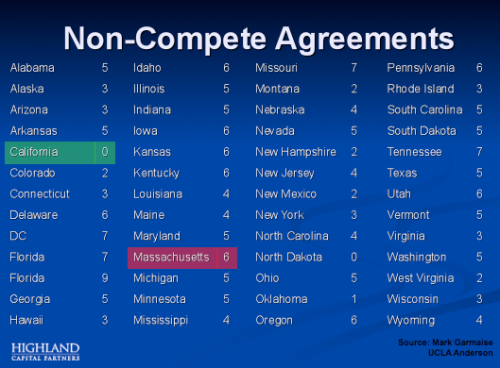
Many studies have shown that non-compete agreements reduce R&D investment and stifle innovation.  MIT Professor Matt Marx conducted a seminal study in Michigan that showed that the enforcement of non-competes caused a sharp drop in mobility for inventors, thereby slowing innovation and economic dynamism.  Professor Mark Garmaise of UCLA published a study which had similar findings and, further, assessed the state by state use of non-competes, concluding that Massachusetts had one of the strictest in the nation (see chart below from Highland's Paul Maeder, putting states on a 0-9 enforceability index scale). 

picture-2.png

Today, Governor Deval Patrick is officially proposing to change all that by putting forward legislation that will eliminate non-competes outright.  If passed, this has the potential to eliminate a huge barrier to the free flow of talent to the best opportunities, thereby creating a more dynamic entrepreneurial environment in the state.

I give tremendous credit to Spark Capital's Bijan Sabet, who first raised this issue seven years ago.  Many legislators and leaders got behind the effort, but no one has been able to galivinize enough support to convince the governor to lead here.  Greg Bialecki and Jennifer Lawrence have made that happen and the tech community will be forever grateful if the legislature will embrace this effort, even if in the face of big company opposition.

House Speaker Robert DeLeo has been a champion for the innovation economy for years, kicked off by his (somewhat cheeky) open letter to Mark Zuckerburg to urge him to open a Facebook office in Massachusetts.  Let's hope he's willing to support legislation that makes it easier for the next Mark Zuckerburg to leave his or her job to start the next Facebook…without the fear of old-school shackles and reprisals.

The Cloud Dividend

When the Cold War ended, President Bush (senior) used to talk about the peace dividend, the downstream economic benefit of reductions in defense spending.  Echoing these words, one of my CEOs declared to me the other day that last week's activity in the cloud may have been one of the most important weeks in technology history, but we won't realize it for many years to come.

At Flybridge, we have long believed that the advent of cloud computing is the most important force in technology in decades.  The entire Lean Start-Up movement and the recent proliferation of start-ups has been enabled by cheap computing power and storage.  When I was an entrepreneur starting my company, Upromise, we had to buy big Sun servers for millions of dollars to launch our fledging website.  Today, that same compute power is available to start-ups for a mere handful of dollars per hours.

Cloud computing

Historically, Amazon's cloud offering (Amazon Web Services, or AWS) had little competition and, as a result, some have observed that as amazing as the cloud has been for start-ups, cloud pricing has not dropped as aggressively as Moore's Law would have suggested it might.

But Google finally appears to be catching up in the ever-important cloud services area.  Last week, at its Cloud Platform Live conference,  Google slashed pricing on their cloud platforms over 50%.  

Then, a day later, at its AWS Summit, Amazon countered with its own radical price cuts from 36-65%.  Despite those price cuts, Google is still cheaper than AWS in many categories.  See the chart below, which GigaOm published, to show the comparison of the two offerings.

rightscale2march26

So why did my portfolio company CEO think this last week of price cuts was so historical?  Because cloud infrastructure is like fuel for startups.  As startup fuel prices go down, the downstream effect is powerful:  starting and scaling companies has gotten yet even cheaper.  With Google and Amazon battling it out, and IBM and Microsoft and others not far behind, this trend is only going to continue.

We have made a number of direct investments on companies circling around cloud infrastructure, startups like MongoDB, Stackdriver, Firebase and Apiary, to name a few.  But what last week's price wars demonstrate is that the entire technology ecosystem will reap indirect benefits as well.  The cloud is becoming a commodity, prices are going to zero, and technology companies around the world are celebrating.

Hogging the Credit – Why Software Is Eating Banking


When this 10s decade is over, we will look back and be amazed that a mere ten years prior, a few, absolutely massive financial institutions controlled the global banking industry.  Software is eating the world, as Marc Andreessen famously observed, and an industry like financial services — whose service offering is essentially all information-based — is particularly susceptible to the disruptive force of technology.  That disruptive force is particularly acute in the credit markets.

Consumer credit has long been a pretty sleepy industry.  For years, the same 5-10 or so banks have been the main issuers of credit cards and the same 4 associations have been the main brands and platforms.  But when the credit crisis hit, everything changed.  Due to market forces and government regulations, banks abandoned the lower end of the consumer market.  20% of US households are now considered underbanked, representing a massive market opportunity.  A further window of opportunity is the fact that credit cards are still charging 20% APR, yet interest rates are effectively zero.

Stepping into the vaccuum are new providers of consumer credit and broader banking services that are 100% virtual.  ZestFinance (a Flybridge portfolio company) and Wonga are among those providing consumer credit in the form of installment loans, with ZestFinance leveraging the magic of big data to do more sophisticated underwriting.  Lending Club and Prosper are showing the promise of peer-to-peer lending, issuing $2.4 billion in credit last year, a 3x increase over 2012.  Institutions are taking notice – one investor that I spoke to in a peer to peer lender shared with me that hedge funds are now flocking to the platform in search of higher rates.  ING – soon to be renamed Voya Financial – demonstrated that a bank could be constructed that serviced consumers over the Internet without traditional branches.  

At the same time, the proliferation of smart phones is allowing consumers to access money and conduct financial transactions with extraordinary convenience.  Why would those services and capabilities be only provided by traditional banks?  China's Alipay reports that they processed $150 billion in mobile transactions in 2013 – nearly 6x the $27 billion PayPal reported (not including the Venmo acquisition, which is bound to accelerate growth in 2014).  This intersection of mobile, convenience and new lending brands is going to substantially erode existing banking franchises in the years to come.  

The business lending market is no different.  In fact, innovation in business credit may be outpacing consumer credit.  Startups such as OnDeck Capital, Kabbage and Capital Access Network have each raised tens of millions of capital and are building large brands and franchises in servicing small businesses.  With their bloated bureaucracies and overhead, banks are not architected to service this market effectively – particularly as more and more small businesses are reachable over the Internet.  OnDeck recently reported a $77 million growth round and that it has acheived nearly $1 billion in loan volume.  Kabbage is rumored to be on the verge of reporting a similar monster round.  And Credit Karma, a credit management service for consumers, just announced an $85 million growth round.

A few weeks ago, Brand Finance released their annual survey of the 20 most valuable banking brands in the US.  Atop the list were the usual suspects:  Wells Fargo, Bank of America, Citi and Chase.  The market capitalization of these four banks is currently around $800 billion.  Will these same brand franchises be unassailable by 2020, or will a new cohort of brands emerge from this soup of startups and innovators?  I know what venture capitalists and entrepreneurs are betting on.

Fred Wilson Attends Harvard Business School

Every year for the last four years, Fred Wilson has been kind enough to come up from NYC and join my Harvard Business School class.  It is always entertaining, enlightening and fun.  As always, I asked the 80 students in the class to live tweet during the class in order to capture the interesting nuggets and take-aways (and exercise their social media muscles).  Below is a Storify of the tweet stream.

If you want to see how this year differed from previous years, go to:

//storify.com/bussgang/fred-wilson-comes-to-hbs/embed


Related articles

Fred Wilson Returns to HBS
Fred Wilson Visits With the HBS Start-Up Tribe
Fred Wilson comes to Harvard Business School

Does Tech Own the Inequality Problem?

"Opportunity is who we are. 

And the defining project of our generation is to restore that promise."

– President Obama, 2014 State of the Union

In a past blog post last summer, I fretted that the latest wave of innovation – as amazing as it is – was not showing up in US worker productivity.  At the time of my writing, the US Bureau of Labor Statistics had provided some pretty depressing data, with very modest productivity gains in 2011, 2012 and Q1 2013.

Fortunately, in the last year, the productivity numbers have shown a major uptick.  It appears that our society and our businesses are getting more adept at absorbing all the new technology of the Internet Revolution.  Unfortunately, the beneficiaries of the greater productivity – presumably driven by the boom in cloud computing, precision manufacturing, wireless broadband and other major infrastructure improvements – are America's elite.

A recent analysis by one of my favorite economic pundits, John Mauldin (who tends to be pretty conservative in his political views), provides some good data that drives this conclusion home.  The chart below shows that full-time, full-year wages for male workers (presumably the female statistics would be clouded by a narrowing of the gender wage gap over this period) have grown strongly for the more educated workers over the last few decades and dropped dramatically for the less educated workers.

Further, if you take a close look at the jobs that are likely to be further impacted by our massive, secular shift towards automation, they are the very jobs that middle and lower educated workers hold.  The chart below characterizes how disruptive technology will be to certain job categories.

Politicians are spending a lot of time talking about the inequality problem in America.  If you consider how much automation and software disruption that is ahead of us, it is clear that the problem is about to get much, much worse.

What role will the technology industry play in dealing with the societal implications?  I hope a large and positive one.  The industry can not allow itself to be represented by the Tom Perkins of the world.  Leaders in the technology industry need to step up and own the inequality problem.  

That's not to say technology leaders should be slowing down our march towards disruption.  As economist Joseph Schumpter pointed out, creative destruction is a powerful, positive force.  But tech leaders need to work hard to improve the underpinnings of our education system (see Khan Academy), broken immigration system (see FWD.us) and other aspects of our society such that creative destruction does not equate to opportunity destruction.  I love it when I read about tech leaders getting more engaged in policy and civic activities.  Let's see more of it.