Blackberries for Sal

We picked blueberries last weekend with our kids.  They are in season here in New England and yielded a great crop this year.  Afterwards, I read to them the classic children’s book, “Blueberries for Sal”, a charming story of a little girl who follows her mother around a blueberry patch, eating berries as fast as she gathers them.  When they drop into her empty pail, you can hear the refrain “kerplink, kerplank, kerplunk”.

As I intoned these sounds, I thought about a VC spin on the story.  What if VCs walked into Monday morning pitches with entrepreneurs and each partner dropped their beloved Blackberries into a pail?  "Kerplink, kerplank, kerplunk".

The Monday Morning Partners Meeting is every entrepreneur’s dream and nightmare rolled into one.  It’s their big chance to present to the entire partnership – a sign that their deal is being taken seriously and that the lead partner is comfortable exposing it to their colleagues.  On the other hand, it’s a forum rife with pitfalls and potholes – either everyone is bored, distracted and checking their Blackberries every few minutes, or they’re peppering you with tough, pointed questions and frowning cycnically.   When my business partner and I pitched the Kleiner Perkins partnership on the Upromise Series A, I still remember how John Doerr drilled into the deep specifics of a slide with a number on it just to see if we truly knew our stuff, caring less about the answer and more how we responded under fire.  In many other pitch meetings, I’ve felt like I was talking to a log as the VC would furrow their brow, nod their head and pretend to listen, while staring down at their rapidly twitching thumbs.

For some VCs, having Attention Deficit Disorder seems to be a competitive advantage and the ever-present Blackberry on the hip is like a narcotic – we always check it to see what new deal might be coming over the transom, how the latest portfolio company did in the quarter and the final score of the Red Sox day game.  But what if VCs literally dropped their Blackberries into a pail when meeting with entrepreneurs and actually focused on the meeting?  I know many an entrepreneur who would breath a sigh of relief if they heard "kerplink, kerplank, kerplunk" as they walked into the Monday Morning Partners Meeting.  It would show great respect for the entrepreneur, a signal that their project is the most important thing right now and deserving of full, high quality attention.

So the next time you’re entering into the dreaded Monday Morning Partners Meeting, bring your pail and collect some Blackberries.  If you have the courage to do that, you might get that coveted term sheet after all.
So You Want To Be A VC?

Summer is a good time for career reflection.  Am I in a job that’s personally satisfying as well as financially rewarding?  Is my career on a productive, long-term trajectory? Many executives conclude over the summer (often during long walks on the beach with their spouses) that it’s time for a change.  Some are interested in exploring what it takes to be a VC.  Unfortunately, I often find that many of those who aspire to be VCs have a hard time grappling with the stark reality of the industry – only 3000 deals occur each year (almost eerily precisely 3000 from 2002-2005), with an average of 1-2 deals per active partner per year imply there are only 1500-3000 active partners making VC investments spread out over 450 firms (the number of member firms in the National Venture Capital Association).  Thus, it remains still very much a cottage industry and therefore not an easy career path for most to pursue.

But for those who remain determined to pursue a career in VC, I can share a few thoughts that I’ve observed from my years on both sides of the table.

Generally speaking, there are two on-ramps to the VC world.  One is what I’ll call “The Apprentice” model:  go to a top college, get a few years of working experience, go to a top business school, spend a few more years in a start-up (typically in product marketing/management) and then join a firm in your late 20s/early 30s as an associate or principal and hope to be accepted as a junior partner into the partnership after 4-8 years.  During that time, you will probably shadow a few of the partners, join one or two boards and try to learn the trade from the experienced, senior partners around you.

The challenge with VCs who follow this path is that the lack of deep operating experience can potentially be viewed negatively by entrepreneurs.  Some entrepreneurs ultimately conclude these types of VCs “don’t get it” because they’ve never walked in their shoes.  On the other hand, these “Apprentice” VCs are often more successful investors because they are incredibly broad in their range of expertise and analytical in their approaches to selecting new investments.

The second on-ramp is what I’ll call the “ex-CEO/Winner” model:  work your way up the start-up ladder, become a VC-backed CEO, navigate a successful exit or two and then join one of the VC firms that backed you and with whom you’ve had a chance to build a relationship (and make money for) over 5-10 years.  This on-ramp sometimes begins with a “Venture Partner” title before becoming a full General Partner (i.e., the training wheels come off and you have your own checkbook, subject to partnership approval).

The challenge with VCs who follow this path is that they can be accused of viewing their VC careers as a lifestyle choice – “the back nine” – and never really go through the hard work, long hours and long years to learn the trade.  After all, this is a business where you fund lifecycles are measured in decades.  Although these types of VCs may have deep knowledge in the particular domain where they had operating experience, they may not have the breadth or analytical horsepower to productively invest in the fully broad range of opportunities most general partners require to be successful.  On the other hand, these “ex-CEO/Winner” VCs have great networks of former employees and business partners and an ability to bond with the next generation of young entrepreneurs for whom they can serve as valuable mentors.

Which path is the more successful one?  I have no idea – but I do know that numerous aspiring VCs who can’t credibly follow one of these two paths have slim odds to entering the industry; in a world where the odds are slim at any rate.  And I suspect many LPs are looking for partnerships that blend the best of both sides into a single, holistic unit.

The Welch Way, Tough Bosses and VCs

To my wife’s chagrin, I’m an avid reader of many magazines.  The Economist, Business Week, Newsweek, Sports Illustrated (did you see Big Papi on this week’s cover?  I’m praying there’s no jinx!) and many others are regulars in my weekly diet.  I also have an affection for management books (Patrick Lencioni is one of my absolute favorites).  So it has been with great delight that I’ve been reading Jack Welch’s weekly series of columns in Business Week, called "The Welch Way".  The one that caught my eye recently was the April 25th column (yes, I am a few weeks behind in the pile…) called, "Tough Guys Finish First".  I thought it had great (probably unintended) lessons for VCs as well as managers.

Welch writes in answer to the question, "Do tough bosses really get more out of their people?", a simple answer:  "yes".  He argues that the right boss is tough as in tough-minded:  "They set clear, challenging goals. They connect those goals with specific expectations. They conduct frequent, rigorous performance reviews. They reward results accordingly, with the most praise and the highest bonuses going to the most effective contributors and commensurate compensation levels distributed down the line, ending with nothing for nonstarters. They are relentlessly candid, letting everyone know where they stand and how the business is doing. Every single day, good tough bosses stretch people. They ask for a lot, and they expect to get it…Weak performers usually wish these bosses would go away. People who want to win seek them out."

Early in my management career, I was eager to please.  I’d avoid confronting people directly with negative feedback because I was nervous that they wouldn’t like me and if they didn’t like me, they wouldn’t follow me.  Then I got a piece of tough feedback from my seasoned boss:  "leadership is not a popularity contest".  His point – good managers give tough feedback and confront issues directly.  Good managers don’t worry about being popular or liked – they worry about results and treating people fairly.

Do VCs, in their role as board members, operate like good managers – tough-minded as Welch puts it?  My experience from both sides of the table suggest it’s all over the map.  Some VCs view their role as the "invited guest" at the entrepreneur’s party and are therefore loathe to rock the boat.  Others think of themselves as the entrepreneur’s boss and therefore dictatorial in providing feedback and direction (one of my VC friends reported to me recently that he thinks of "his CEOs" as divisional presidents that report to him).  Others are conflict avoiders – they seethe with annoyance over company and management performance and talk behind the entrepreneur’s back, but grin to their face and claim they love them – up until the day they fire them.

I’d like to think the most effective technique is to strike that right balance between being a service provider (where, like the lawyer, accountant and recruiter, the VC is there to provide a range of services to the entrepreneur to add value and be helpful) and a board fiduciary who provides tough, direct feedback where appropriate (e.g., I’ve been surprised that VC-backed boards often don’t systematically provide formal, written performance reviews to their CEOs).  Either way, it’s not a popularity contest – that’s certainly not what the LPs pay us for.

Upromise sale to Sallie Mae

I would be remiss if I didn’t make note of last week’s announcement that Sallie Mae is acquiring Upromise, a great outcome for the company I was privileged to co-found alongside Michael Bronner 6.5 years ago and serve as president and COO.  One of my early investors called me and pointed out that for a height-of-the-bubble-era investment (we closed a $34 million series A in March 2000 with a very lofty pre-money valuation, despite being a handful of folks and some fancy Power Point slides), it is miraculous that he was able to make some money on the transaction.

I learned many lessons during my three years there and even beyond as I stayed close to the company’s evolution after I left to join IDG Ventures.  One important lesson is that no one person "makes" a company – it takes a village.  My high school football coach had a favorite line:  "Victory has a thousand fathers, but defeat is an orphan".  Similarly in any successful entrepreneurial venture, there are a thousand people that "make" the company, and I got to see this in spades at Upromise.

Another important lesson is that every entrepreneurial venture is a winding journey with many ups and downs and many phases of life.  There were times when we thought Upromise was going to be a world-changing company and there were times when we thought we would need to shut out the lights after burning through a hundred million dollars.  In the end, the passion of the employees, partners and customers and the perserverance of the investors saw it through to a happy outcome for all.  Congratulations to everyone involved.

“Selling Skype Was The Saddest Day Of My Year”

Last week, I attended the OnHollywood Conference in Los Angeles.  During one of the panels, DFJ’s Tim Draper made a shocking statement:  “Selling Skype was the saddest day of my year”.  Huh?  A multi-billion dollar exit constitutes the saddest day of a VC’s year?

Tim went on to explain that he felt Skype had a chance to be an absolutely huge standalone company, perhaps worth another 5-10x what eBay paid.  He said he is always pushing his entrepreneurs to hold out and not sell too soon.  And in doing so, he put his finger on an issue that runs at the heart of VC-entrepreneur misalignment.

VCs typically have a very diverse portfolio, allowing them to have many “swings at bat” to see a start-up become successful and pay out.  They make good money off the fees in both good times and bad, but they only make great money if they have very large exits.  Mediocre exits don’t typically move the needle for them personally or for their funds.

On the other hand, entrepreneurs typically have all their financial eggs in one basket:  their start-up.  When they have a chance to make good money with 100% certainty, their instinct is to jump at it.  If they hold out, “double down” and pursue a bigger outcome, they are simply adding financial risk to their personal portfolio. 

Let’s do the math on an example to see how this plays out.  Let’s say an entrepreneur owns 10% of their VC-backed start-up and someone comes and offers them $100 million.  Thus, they stand to make $10 million if they proceed with the sale.  Let’s say a VC fund owns 20% and thus will take away $20 million, but assume they’ve invested $5 million already in the company, yielding a net capital gain of $15 million.  Further, let’s say the VC’s “carried interest” is 20%.  Therefore, the general partners of the fund take home $3 million.  Let’s say there are 6 partners that split the carry evenly – that’s $500k for each general partner.

So the entrepreneur is thinking “I can take home $10 million now and change my life” and the VC board member is thinking “I can take home $500k and have an ‘ok’ outcome for me and my fund.  But if I push the entrepreneur to ‘double-down’, perhaps we can sell this thing for $200 million in two more years and perhaps we should do a few acquisitions to bulk up to aim for $400 million in four years.”  See the problem?

This debate tends to be one of the hardest around the board room, particularly today as the IPO market remains dead but the M&A market has become fairly robust.  One discussion I’d like to see more of:  VCs allowing entrepreneurs to take money off the table to align interests and address this conundrum.  Perhaps I’m too “soft” on entrepreneurs, but I have no problem with an entrepreneur taking a few million off the table so that their mortgage and college tuition is covered, freeing them up to embrace more risk and swing for the fences in a way that is aligned with the VCs.  We recently did this in one of our portfolio companies and I’ve seen a few early exits recently in other start-ups because the VCs didn’t do this.

Either way, I’d personally welcome a few of Tim Draper’s "saddest days" in the coming years.

VCs as Glorified Recruiters

“Admit it, you VCs are really just glorified recruiters”, declared one of my recruiter friends the other day in a pejorative, self-deprecating way.  It made me pause, because the barb rang true.  After all, seven of my seven portfolio companies are in the middle of recruiting senior executives to add to their teams – and I, along with the other VC co-investors, am knee deep in trying to help out:  participating in weekly recruiting calls, screening candidates, pumping our networks for leads, etc.  After a few years of observing this business, I’ve learned that this is a common phenomenon throughout our portfolio and others.

So how did I suddenly become a glorified recruiter along with my other, more glamorous brethren?  I guess it’s the old yarn – business success is 10% inspiration and 90% perspiration.  There are a lot of people with good ideas out there trying to start businesses, but very few execute them successfully.  Those that can are typically led by an outstanding team that many investors would back in almost any situation.  A good team doesn’t make a company 10% better; it makes it 1,000% better (at roughly the same cost!).

In fact, the “VC as recruiter” phenomenon is arguably the fundamental value-add a VC provides to a start-up.  Would Netscape have been nearly as valuable and successful a company without Jim Barksdale?  Where would Google be without Eric Schmidt?  If I had been the VC that gave Larry Page and Sergei Brin money rather than John Doerr, would I have been able to convince Eric Schmidt to join these two Stanford PhDs and take the CEO gig at Google – never mind known that he would be the perfect fit there?  Don’t bet on it.

So I guess we VCs should really embrace our roles as “glorified recruiters”.  Rather than shirk from the task, I think we can learn a lot from recruiters about how to assemble teams, putting the right mix of ingredients together, interviewing more effectively.

And while I’m on the topic, there’s another main value-add VCs try to bring to the table that should be demystified.  You’ll hear many emphasize the power of their "rolodex" and their skills as super "business development" executives.  When I first heard the term, "business development", many years ago and asked my manager what it meant, he smirked and observed, "That’s just a fancy term for sales".  I guess that makes VCs glorified salespeople as well!

Wireless Wow

I am posting this blog from Sin City, Las Vegas Nevada, where the annual wireless industry conference, CTIA, is taking place.  Simply put, it is overwhelming and impressive.  There are a reported 40,000 attendees here, making it the largest show in the industry’s history.  And it’s easy to see why:  the wireless platform is arguably poised to surpass TV and the Internet as the center for business, news and entertainment.

I spent today between two separate “tracks” – the Mobile Marketing track and MECCA (Mobile Entertainment, Content and Commerce Applications).  A few takeaways from each:

Mobile marketing

  • 1996 All Over Again.  A common theme from the various speakers was that the state of mobile marketing is much like Internet marketing 10 years ago:  very promising, but nascent and full of confusion and immaturity.
  • Consumer Hate Ads, Love Promotions. When surveyed, consumers express zero interest in mobile advertising (after all, who volunteers for an ad?), but are joining in promotions by the millions.  American Idol is of course the well-known case study.  But a few others jumped out at me.  The magazine Maxim ran a promotion on their website where consumers text in their cheesiest pick-up line; sponsored by Kraft Macaroni and Cheese!  A mediocre TV Show called Veronica Mars doubled their ratings and increased Web traffic 500% when they ran a “get a call from Veronica” promotion – the show’s star would call your cell phone 15 minutes before the weekly episode aired to provide a sneak preview.
  • Still Early – Lots of Groping.  Although 170 million US cell phones are WAP-enabled, only 24 million actually are using WAP access.  This means there’s a lot of experimentation going on and the speakers were pretty cynical about the ability of traditional agencies to provide the blend of creativity and technological savvy tools.
  • Investment Opportunities?  My focus, of course.  As the cliché has it:  when in a war, the arms dealers make all the money.  There’s a whole ecosystem around Web advertising that has yielded some interesting start-up companies.  In theory, mobile marketing should have similar potential.

MECCA (Mobile Entertainment, Content and Commerce Applications)

  • Carriers Making All The Money?  Unlike the Internet, wireless carriers have a lot of power in the m-commerce ecosystem.  Thus, they appear to dominate the economics, often taking 1/3rd to ½ of the top-line revenue imply for being a transport mechanism.  A Cingular executive boasted that they made $2.7 billion in profits last year on data services.  Is anyone else making big money or just seeing high-volume, low-margin transaction volume?
  • Strategic Confusion or Land Grab?  The early players have clouded strategies, typical of an early market land grab (remember Netscape:  a consumer browser company that made middleware for enterprises and e-commerce applications!).  The two main strategies are around mobile content vs. infrastructure/platform services?  The emerging gorilla in the m-commerce market, Verisign, is clearly playing it both ways.  Even their M&A strategy suggests a double-down – first they buy Jamba, a European content play; then they recently announce their acquisition of M-Qube, an infrastructure play.
  • Maturing Industry or Another Explosion Coming?  There are a few worrying signs that the market may be slowing down.  Ringtone download revenue was $500m in ’05 (100% growth over 2004, but only $600m in ’06 (20% growth).  Only 10% of US subscribers download ringtones each month.  And game downloads were reported flat for the last 7 months.  New services are emerging – ringback tones, radio, video – but they are emerging somewhat slowly and consumers seems resistant to signing up for subscription products.  The hypergrowth stage isn’t over, but there is a bit of worry in the air that we may be near the peak.

So those are the observations from the front line.  Now I’m off to where the real action is at these shows – the evening parties and schmooze fests.  If there’s anything worth reporting on tomorrow, I’ll let you know.

The Bubble Begins

Sports Illustrated has a well-known reputation for its “cover story jinx”.  History shows that those that appear on the cover of the magazine are doomed to lose the upcoming big game or suffer a terrible injury.  Red Sox fans famously remember that only days after Nomar Garciaparra cover appeared on the March 5, 2001 issue, it was announced that he had a split tendon in his right wrist and a sure-fire Hall of Fame career was derailed.

I wonder if this Sunday’s NY Times cover story in the business section heralds the same “jinx” for the world of Web 2.0.  “Alive and Well in Silicon Alley” raves about the twenty-something founders of the slews of NYC media .coms that are back in vogue – developing cool new media content sites and luring advertisers and consumers.  The article reports that 14 new start-ups are now housed at the NY Software Industry Association’s headquarters.  I would hazard a guess that all of them are pursuing the attention of consumers and advertisers as opposed to enterprise IT companies.

Silicon Valley appears to be smoking the same exhaust that Silicon Alley is smoking.  One of the top-tier Silicon Valley funds emailed us and the CEO of a new media start-up in our portfolio a recent overture:  “we will invest any amount at any price to get into this deal”.  Nice for our portfolio, but scary for our industry.

Another harbinger of doom:  I was speaking to a CEO friend of mine who is searching for her next gig.  She asked me what areas I was looking at.  I listed a range of things, but when I touched on new media/consumer infrastructure/e-commerce she exclaimed dismissively, “Oh all my VC friends are saying that – everyone I talk to is becoming a consumer investor!”.  Uh oh.

Put it all together, my friends, and I humbly submit that we have now hit the consumer bubble I feared a year ago (see May 2005 post:  “Is a Consumer VC Bubble Coming?”.)

And if this observation is accurate, what should VCs and entrepreneurs do about it?  On the one hand, avoiding bubbles like the plague is an obvious investment strategy.

On the other hand, a lot of money gets made in bubbles, particularly if you get in them early.  My former company, Open Market, had its IPO in May 1996 in what was clearly a bubble-like event, with a $1.2 billion market capitalization despite $1.8 million in most recent annual revenue.  That said, a retrospective look at the IPO run-ups after Open Market in 1996 suggest an investor that stopped investing at the first sign of the bubble would have missed on enormous wealth-creating companies.

I guess the smart money isn’t afraid to investment in bubbles, but simply knows when to get out of them before they deflate.  We’ll see over the next few years where the smart money is.

Syndication Science

VCs and entrepreneurs both seem to really struggle on a deal by deal basis with the question whether to syndicate or not syndicate a deal.  As an entrepreneur, I had my own biases (always syndicate – it’s obvious, I used to think, ignorant of all the nuances).  But now entering my fourth year on the other side of the table, I’ve come to see both sides of the argument.  Since I’m going through this issue on a particular deal right now, I thought it might be worth sharing a few perspectives.

From the entrepreneur’s perspective, often the more help and the more money around the table the better.  One VC has one set of networks for recruiting and business development assistance.  Two VCs have two sets of networks, usually with modest overlap.  And having two sets of deep pockets to tap when things are going good, bad or sideways can be very helpful.  Frankly, I also never liked the idea of being beholden to one VC.  As an entrepreneur, I figured having two or more VCs allowed for more diverse opinions and, in the end, more control to do as you saw fit even if you were in disagreement with one VC, who could be isolated as an “outlier”.  Of course, more VCs tends to mean more dilution.  A single VC should be happy at 30% ownership and, when pushed, will go down to the 20s.  Two VCs typically clamor for 20-25% each, sometimes more in very early-stage companies, and have to be pushed hard to go below 20%.  That said, I drank the kool-aid based on the three start-ups I worked for that having the right partners around the table would drive the right positive outcome more than a few extra points of ownership.  Many entrepreneurs will point out that there is extra overhead in managing two firms.  Although that is true, experienced entrepreneurs seem to not mind.  Manaing three or four VCs on the other hand…

From the VC’s perspective, though, I’ve come to appreciate that there are more nuances involved.  First, it’s important to point out that there is an elitist caste system in the VC world.  Upper crust, top tier VCs rarely partner with those they view to be beneath them.  The flip side is that lower-tier VCs love to partner with upper crust VCs to help enhance their brand image.  One way to sniff this out is when a VC tells you about the deals they’re in, check to see whether they name-drop the co-investors before raving about the entrepreneurs and the business model!

On the other hand, greed (gasp) is a huge driver in the VC world.  Once you like a project and decide to invest in it, your partners look at you and ask:  “if we like it and are going to put all this work into it, why share it?  Let’s own 30% and forget about the other firm.  Besides, what incremental value are they really going to add?"

Then there is the dynamic of structuring the syndicate and how things are divided up.  Many VCs are religious about splitting everything evenly to preserve harmony.  Others take a more aggressive approach and take what they can get, squeezing out co-investors as much as possible to take an unequal share.  Entrepreneurs are trypically pretty bemused by the whole dance.  After working so hard to get a few firms to pay attention to their big idea, they are quite gleeful when the tables are turned and the VCs suddenly act like alley cats clawing over cap table scraps.

However the dance plays out, entrepreneurs should remember that ultimately, they are far more in the driver seat than they appreciate.  And so when it’s time to pick partners, choose carefully, because you are going to be stuck with those partners for a long, long time.

Sour Grapes, Wolves and Sheep

Harvard Business School is having a private equity conference for students this upcoming weekend and, regrettably, is featuring Howard Andersen and his ridiculous sour grapes about the VC business.  Because of this, I feel obliged to blog on this topic.

Simply put, Howard Andersen’s article is bunk.

The venture capital business is hardly for the faint of heart and, unlike the brief period in the mid- to late-90s, is admittedly not an easy business where even the dumb and lucky can make tons of money.  That said, there is still plenty of money to be made and breakthrough innovations to support.

Howard’s comment that the “technology supply is bloated” is absurd.  This is an extraordinarily short-sighted view.  In the next decade, many predict that someone will fund a company that will cure cancer, if it doesn’t exist today.  With the modernization of China and India, we have 2 billion additional consumers entering into the wired world.  The venture-backed company, Google, is transforming the trillion dollar consumer marketing industry and print world. The global proliferation of mobile phones has generated a whole new platform of innovation beyond the PC.  Anyone in the midst of a healthy flow of deals across technology and biotech will tell you that the pace of innovation continues to quicken, not grind to a halt.

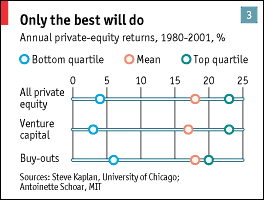
And the description of poor average returns in the business is a simplistic analysis that misses the “dispersion effect” in venture capital returns.  VC fund returns are one of the most widely varied by fund manager of any asset class.  The top quartile VCs account for the majority of the returns.  Even during a period of 0% average returns, top quartile VCs make their investors lots of money.  The chart below from The Economist is the best I’ve seen on this topic.  Howard is right that if you’re a middling-performing VC, you will not serve your investors well.  But the top quartile returns are far better than the S&P and well-deserving of the risk and liquidity premium.  This was a big driver behind the recently reported fantastic growth of the Stanford Endowment, who gained 23% last year thanks to its participation in top-tier Silicon Valley funds.

Economist_graph_1

My advice for business school students thinking about the VC business would be similar to what my finance professor, Andre Perold, gave me when I was graduating business school.  Andre (who sits on the board of Vanguard and teaches capital markets at HBS) taught me that in every market, there are two types of animals:  wolves and sheep.  The wolves are faster, smarter and have all the innate weapons to take advantage of the sheep, buying low and selling high.  If you find yourself in market where you don’t know if you’re a wolf or not, then by definition you are a sheep and are about to see a nasty finish.  The trick for students who want to become VCs is to recognize that although they are initially sheep, if they hang out with a few wolves, learn from them over a number of years, they can grow into becoming wolves themselves.  If they don’t, then they will leave the business frustrated and disgruntled rather than stuffed to the gills with its spoils.