Humility in Entrepreneurs

Jim-Collins-leadership

This past week was the Jewish holiday of Yom Kippur, also known as the Day of Atonement where you fast and pray in synagogue all day and atone for all your sins over the past year. Our rabbi delivered a powerful sermon that took a page from David Brooks' "The Road to Character", emphasizing the importance of "eulogy virtues" (e.g., character) as compared to "resume virtues" (e.g., competence). Rabbis have the opportunity to go to a lot of funerals where they deliver – and listen to – many, many eulogies and so his message was particularly poignant. One of those eulogy virtues that he emphasized was that of humility, defined by Dictionary.com as:  "having a modest opinion of one's own importance or rank".

There is great power in humility, something I have observed in many entrepreneurial leaders. In fact, I find that the entrepreneurs I enjoy working with the most are those that are authentically humble. The day before Yom Kippur, I had two board meetings with two of my most humble CEOs. Both are running startups that are growing, profitable and on a track to make their investors and employees a lot of money. Neither thumped their chest in the board meetings. Just the opposite. Here is how many of their sentences started: "It took me too long to figure this out, but…" or "I'm struggling with the issue of how to…". Rather than cover up mistakes or weaknesses, the humble leader draws attention to them and rallies the group to problem solve together.

Sometimes executives who lack a deep self confidence try to over-compensate with bravado and promotion. As I get older, I find I have less tolerance for this style of operation. That's not to say that there aren't plenty of amazingly successful leaders who are pretentious and overbearing. But for my money, I'll take the humble leader any day. Yes, they need to be exceedingly competent and skilled, but when they can blend competence with character and humility, it is a potent combination.

Jim Collins describes this potent combination in his famous book, Good to Great. Collins frames the five levels of leadership (see pyramid above), which culminate in "Level 5 Leaders" who are humble but have a huge amount of will to succeed.

Thinking about this style of leadership reminds me of a famous speech by General Norman Schwartzkopf, delivered to the graduating class at West Point. I was introduced to this speech by HBS leadership professor Scott Snook (himself a West Point grad). Start at minute 3:08, where Schwartkopf declares:  "To be a 21st century leader, you must have two things:  competence and character." 

Schwartkopf could deliver the Yom Kippur speech at my synagogue any day.

What Makes The Boston Startup Scene Special?

Every fall, I deliver a presentation at Harvard’s iLab, open to the community, on what makes the Boston startup scene so special. It has become a nice opportunity to step back and appreciate all the rich resources entrepreneurs have at their fingertips in the Boston community. Here is this year’s version (which I’m delivering this afternoon), complete with a lot of updated content and data on our local tech hub:

The Playbook for Scale Up Nation

Israel - Start-Up Nation

This post was co-authored with Omri Stern and originally appeared in Harvard Business Review.

Israel has been branded the “startup nation.” For good reason: A tiny country of only 8 million people — 0.1% of the world’s population — has more companies listed on the NASDAQ than any country in the world save the United States and China. Frequently cited as one of the world’s most vibrant innovation hubs, Israel boasts more startups per capita than any other country in the world.

That’s the good news. The bad news is that Israeli startups are struggling to scale. Only a handful of so-called unicorns — companies that have achieved a valuation of over $1 billion in the last 10 years — come from Israel, and only one Israeli firm, Teva, ranks in the world’s 500 largest companies by market capitalization. As a result, tech-sector employment has declined as a percent of the workforce, from 11% in 2006–2008 to 9% in 2013. That’s disappointing for a country with so much potential. But is all of that changing? Are Israeli companies on the verge of developing a repeatable playbook to scale their companies and become market leaders, not just acquisition fodder for the Silicon Valley giants?

We think so.

Decades ago, the thesis of Yossi Vardi, a prolific technology entrepreneur who has invested in 75 Israeli startups, was that Israeli entrepreneurs should seek quick exit opportunities through global corporations interested in buying a window into Israeli talent and technology. Today, this thesis is less relevant. For the first time in history there are Israeli companies scaling up successfully as global market leaders, and the ecosystem is evolving to support them. Indeed, the pattern of scaling seems to be changing meaningfully in recent years. In 2014, for example, 18 IPOs raised a record-breaking $9.8 billion, compared to just $1.2 billion in 2013.

So how do Israeli ventures scale up? What are the challenges and lessons of scaling up? To answer these questions, we built a database of 112 Israeli companies founded between 1996 and 2013 that have met or exceeded $20 million in revenue. We selected this benchmark because it reflects the phase in which companies have proven product viability, achieved initial product/market fit, and are now expanding sales and growing more complex operations. We also interviewed over two dozen Israeli entrepreneurs and the investors from these companies — the leading thinkers in the region — to determine the playbook that these startups are executing in order to scale.

Here's what the data say about Israeli startups:

  1. They’re Israeli-run but with global footprints. Eighty-two percent have global offices, and yet 91% are still run by Israeli CEOs, as opposed to foreign executives hired from the outside.
  2. American VCs are critical. Ninety-one percent of the firms have received funding from foreign (mainly American) VCs.
  3. The founders have started companies before. Sixty-three percent of startups currently scaling up are run by Israeli entrepreneurs with prior founding experience.

This evolving model is being supported and encouraged by the local Israeli VCs. According to Izhar Shay, a general partner at Canaan Partners, “The investment community has matured to recognize they need to plan for scale. They are seeking to build companies so that they are attractive to late-stage funds.” And the late-stage global funds are swarming in, from Accel to KKR to Li Kai-Shing’s Horizon Ventures.

This post outlines some of these patterns, seeks to characterize them, and draws out patterns in the data.

Pack Your Bags Early.

Despite hosting a rich startup ecosystem, Israel is simply too small a country for entrepreneurs seeking to build big companies. As a result, Israeli entrepreneurs need to begin immediately thinking outside of Israel since their primary market is often the U.S. The common approach is to incubate the business locally in Israel with a small development team, prove early product/market fit, and then build a sales and marketing organization abroad, usually in the U.S. In the old model of Israeli startups, many Israeli executive teams would hire a vice president of sales in the U.S. to assist with the local go-to-market approach. More recently, Israeli founders are themselves moving to the U.S. to build the satellite office and to personally oversee the recruitment and management of American executives who can lead the sales and marketing efforts.

However, waiting to move to the U.S. until the late-stage go-to-market phase may be too late. All of the risks inherent in launching a startup are exacerbated by the geographic distance between Israel and the U.S. Hiring talent and gathering customer feedback are even harder when teams are so physically far apart, and this separation can make it harder to build culture, forge partnerships, and raise capital.

So how early should the founders pack their bags and ship out to the U.S.? Our analysis and interviews suggest the prevailing wisdom has shifted toward a simple answer: as early as possible. Although the technical team often remains in Israel, many of the executives interviewed recommend departing for the U.S. as early as a year or two after founding. A move allows the business to get close to the customer, learn their pain points, and adapt accordingly. Understanding the market and establishing product/market fit is a critical seed-stage milestone.

When Udi Mokady and Alon Cohen launched CyberArk — the darling of the cybersecurity industry, with a market capitalization of nearly $2 billion — the founders abandoned the local strategy early on. “We began selling to local Israeli companies but had a strong feeling we were developing a product and go-to-market strategy that was missing the larger opportunity,” said Mokady. As soon as CyberArk raised Series A funding, they set up a U.S. headquarters, in Massachusetts, to immerse the team in the American market. “At the time, moving close to the market was not a given, and venture capitalists did not have a clear playbook. Nowadays the argument is very clear.”

Similarly, when Yaron Samid launched BillGuard, his team debated whether to build an enterprise or a consumer company. One-and-a-half years after founding the company, Yaron moved to New York and discovered that consumers, rather than banks, were the primary customer of BillGuard’s service, which helps customers identify fraudulent credit card charges. With the development team based in Israel, Samid shuttles between New York and Tel Aviv, where he shares weekly insights garnered from conversations with partners, consumers, and investors in the market. Viewing this as the typical challenge of running a global company, Samid believes there is no substitute for the learning that comes from being close to the market.

The second reason to move early is to hire the absolute best sales and marketing talent. Again and again, the most challenging issue we heard about from entrepreneurs and investors is finding and retaining exceptional talent, a problem exacerbated by geographical and cultural distance. According to Modi Rosen, general partner of Magma Ventures, “The challenge of scaling is primarily in hiring for the sales and marketing front. Having the founder [locally] present for this process can be the difference between success and failure.” Companies should strengthen the Israeli management team with local talent who understand how to define the market, how to sell into it, and how to gather feedback. Furthermore, companies need particular executives to serve as the primary liaison between the sales and marketing team in the U.S. and the development team in Israel. There are many Israeli professionals who have worked in the U.S. and have gained management experience at large organizations such as Google, Microsoft, and Amazon. There are also American executives who have experience working with startups with R&D in India, China, and Israel. Both cohorts can bridge cultural and geographical gaps.

In CyberArk’s case, Mokady admits the team faced major challenges in hiring talented and seasoned American executives. “We had a rough start,” he says. “As an unknown Israeli company breaking in to the U.S. market, we were not able to attract A-rated sales and marketing professionals. It took some time to gain momentum and learn how to attract local talent.”

One of the key lessons CyberArk learned is to partner with VCs in order to source top talent. Mokady believes that partnering with a Boston-based VC would have helped CyberArk address its talent problems more effectively because the VC would have vouched for the company. With that said, the founding team had big dreams of becoming a global company from the beginning. Although their investors were not local, CyberArk still benefitted by partnering with foreign VCs that helped them make the leap from Israel to the U.S.

Think Bigger.

This takeaway surprised us. After all, Israeli entrepreneurs are known to be tenacious and eager to tackle complex technological and entrepreneurial challenges. However, in our interviews with Israeli venture capitalists, we learned that around the board room, Israeli entrepreneurs tend to become overly preoccupied with the product and core technology. This fixation generates a short-term view on the potential of the venture to expand beyond the immediate product line. Of course, almost all entrepreneurs are preoccupied with near-term priorities, but our interviews uncovered a pattern of Israeli companies putting too much focus on the product at the expense of building a broad vision for growth, even after achieving product/market fit.

Scaling up begins with thinking about how you build a bigger story and a bigger vision once the company is expanding. Alan Feld, cofounder and managing partner of Vintage Partners, cautions Israeli entrepreneurs not to define their product category too narrowly. “The big idea is to think as a potential industry leader rather than a one-product company. Think of where you want to be in five years and begin building a product pipeline to get there.” For Netanel Oded, of Israel’s National Economic Council, the critique is more poignant: “In Israel, nobody is saying ‘I’m going to completely disrupt transportation.’ Israeli entrepreneurs are first and foremost focused on applying technology to create a business, not necessarily on disrupting big markets through the use of technology.” This subtle difference risks limiting the scope of the opportunities Israeli entrepreneurs are chasing.

Once startups begin to scale up, founders need to ask long-term strategic questions such as: How do I support growth in human capital? How do I strengthen my market position through acquisitions and innovation? How do I prove the unit economics to justify raising a growth round that will let me expand more rapidly? These are also questions that will concern late-stage investors who provide the companies the opportunities to scale and, eventually, go public.

Partner with Foreign VCs

Israeli entrepreneurs are becoming more focused on getting foreign (mostly American) VC partners in the early stages to help them pursue these opportunities from the onset. American VCs have a significantly wider network and have a capability to access management talent, data, partners, and customers to help a company scale. American VCs think about scale from the start, because their large fund sizes necessitate bigger returns. They spend more time on strategy, go-to-market, business development, and financing.

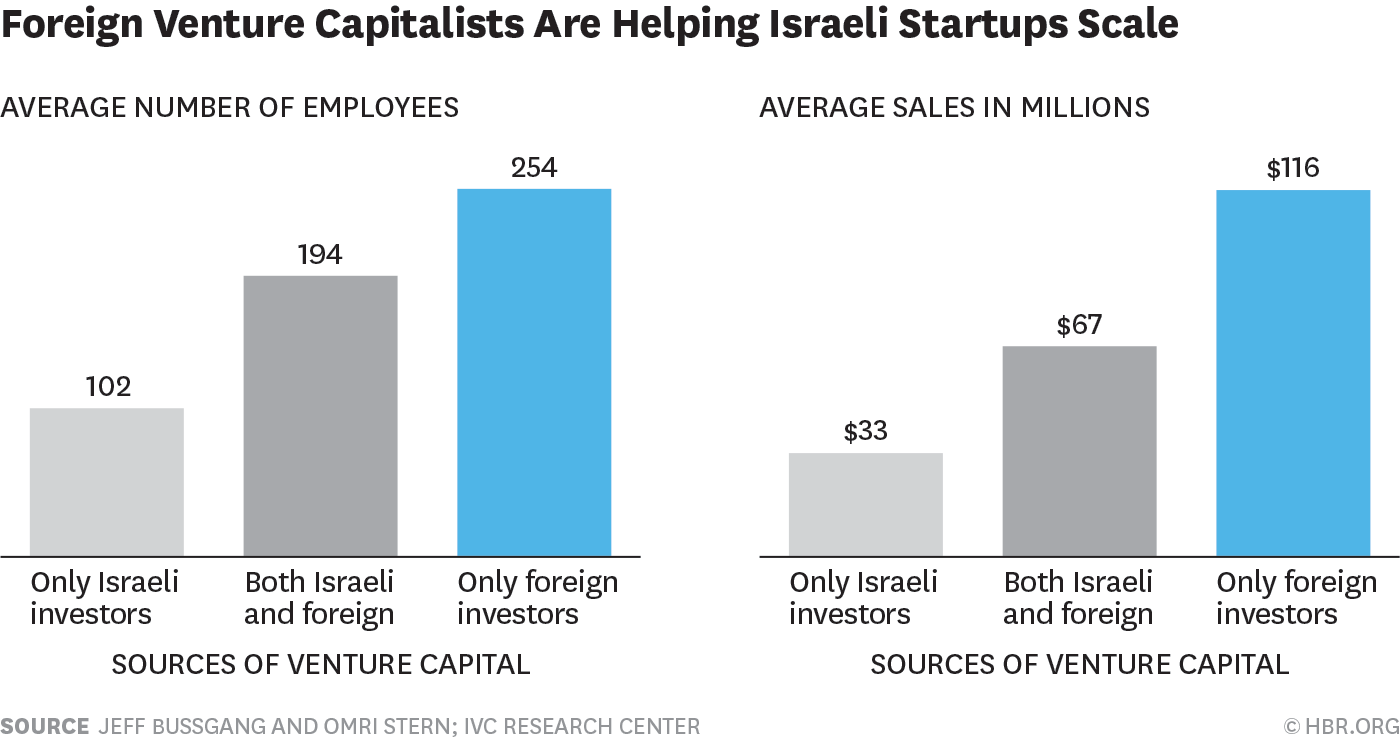
The data reveal how dramatically foreign investors impact the growth of Israeli companies, as measured by annual sales and number of employees. Israeli companies funded solely by foreign investors generated more growth than those funded by both Israeli and foreign VCs and significantly more growth than companies funded by Israeli investors alone. (One caveat: This may not point to causation, as some investors are better than others at picking rapidly-growing companies.)

W150820_BUSSGANG_FOREIGNVENTURE

But American VC partners might not always be the right choice, especially in the earliest stages. Many entrepreneurs and investors argue that Israeli VCs are more frugal and that this discipline is an important early attribute for startups. According to Ori Israely, investor and former general partner of Giza Venture Capital, “There is more fit between [an] Israeli entrepreneur and [an] Israeli investor in the seed stages. Israeli funds often know how to work better with the early stage companies because they provide efficient capital, not necessarily more capital.” Israeli VCs seek to invest relatively smaller amounts—not to squeeze out the entrepreneurs, but to help them be more efficient in the early stages.

The extra runway from an American VC can come with strings attached. Once entrepreneurs bring in an American VC that typically invests at higher valuations, there is greater pressure to hit bigger milestones, move to the U.S., and pursue larger outcomes. So the decision on when to bring on an American VC is an important and strategic one.

Lead Your Company to Scale.

A decade ago, the traditional model for building up Israeli companies was to hire an American CEO. Our interviews and analysis suggest that this model failed. Today, companies reaching scale are run by Israeli founders and/or Israeli CEOs. Studying the liquidity events of Israeli firms valued over $150 million, Vintage Partners found that 81% were run by Israeli founders, while half of the remaining 19% were run by professional CEOs who were Israeli. In short, Israeli entrepreneurs are leading their companies to scale.

This conclusion is an interesting one. On one hand, Israelis need to continue to lead their companies to scale effectively. On the other hand, they need to attract foreign VCs to help them do so — typically by moving to the U.S. and recruiting a U.S.-based executive team.

So how can Israeli entrepreneurs effectively lead their organization to scale? Our interviews suggest Israeli founders have worked hard to mitigate the risks associated with a move to the U.S., developing techniques to effectively manage distributed teams and cut through cultural barriers:

  • Focus on culture from day one. Startups are incredibly fluid early on, and these early days are critical to building teams that can communicate and function effectively in geographically distributed circumstances. Over the course of 2–3 years, the product, the value proposition, and the competition will change dramatically. Yahal Zilka, of Magma Ventures, emphasizes that for the company to be aligned in multiple locations and react effectively to rapidly changing circumstances, employees need to develop a culture of trust and respect that transcends continents.
  • Place one founder on each continent. If the founding team contains more than one person, an effective formula that we’ve witnessed is placing one founder in Israel and one abroad, where he or she will recruit the management team. Typically, these founders know each other very well, have a deep mutual trust and respect, and can communicate seamlessly, often from years of serving in the military together. Alon Cohen, cofounder and former CEO of CyberArk, moved the company headquarters to Dedham, Massachusetts, just one year after founding in Israel. Cohen said that moving the headquarters to the United States had been talked about for some time after the company was founded, in 1999. Shortly after the move, the company hired 25–30 people in the U.S. while maintaining R&D in Israel. Fifteen years later, CyberArk employs more than 500 individuals worldwide and serves more than 1,800 customers, including 40% of Fortune 100 companies.
  • Get a mentor with a solid track recordIt may sound obvious, but unlike in Silicon Valley, there are not many entrepreneurs from Israel who have built unicorn-sized companies. “Over the growth stages in particular, Israeli entrepreneurs need access to mentors that can deliver contextual insights and ask tough questions about scaling up in the United States,” says Dror Berman, of Innovation Endeavors. The mentors who serve this role in the U.S. know how the entrepreneurial game is played, know the relevant growth-stage investors and investment bankers, and are adept at navigating exits at different stages. There are also more institutions and infrastructure for training managers, such as MBA programs, executive education, and certification programs. Most Israeli entrepreneurs have not been through this whole cycle at scale. Those that have are gold.

Israeli entrepreneurs are influenced by the success stories of their past. From 1995–2010, the Israeli startup ecosystem was not focused on creating big companies. Things have changed dramatically in the past two decades. What was once the story of ICQ’s $287 million exit to AOL is now the story of MobileEye’s NYSE IPO and $12 billion market capitalization. Years from now, Waze’s $1 billion sale to Google may look like merely a solid outcome, rather than the canonical case study of Israeli entrepreneurship that it is today.

It is time for more Israeli entrepreneurs to swing for the fences. Building big companies means Israeli entrepreneurs should pack their bags and move to a large market early, partner with American VCs, continue to lead the company through the mid-to-late stages, and focus on building a culture.

In our data set, we found over 100 companies that have the potential to become unicorns and decacorns. We look forward to watching that list grow and evolve.

Many thanks to all those interviewed as well as Walter Frick for his help in editing.

Giving and Taking in StartUp Land


I have been wanting to read Give and Take since the New York Times article a few years ago described the author, Wharton Professor Adam Grant, and his research on "givers", "takers" and "matchers". I finally got a chance to do so this last week while on vacation and was not disappointed. I'd rank the book up there with Drive and Thinking Fast and Slow as one of my favorite popular business books written by academics.

Grant's basic thesis is that being a giver – being motivated solely by your desire to give back, independent of a payback, without keeping score or expecting anything in return – can correlate with professional success. While this conclusion may seem surprising in the self-centered, materialistic, dog-eat-dog world that many think is emblematic of the business world (cue Elizabeth Warren), I thought Grant's conclusions reflected what I have seen as a somewhat recent cultural change in the world of entrepreneurship – a cultural change I am hoping will continue. 

I have written in the past that there is a religion of entrepreneurship, with its shared beliefs and cultural mores. One of those shared beliefs that has emerged in recent years in Startup Land is to be a giver, not a taker.  Recently, even venture capitalists are competing now on who is more entrepreneur friendly, who contributes more to the ecosystem (e.g., disseminating free knowledge and insights, launching diversity initiatives) and who can be most meaningfully "pay it forward".

Some VCs and entrepreneurs are clearly taking these actions out of pure self interest – in Grant's language, they are "matchers":  they give with the expectation that they will get something in return. But many VCs and entrepreneurs that I work with day in day out have adjusted their behavior to becoming pure givers. Giving their time, their resources and their networks without expecting anything in return. And many of these "givers" are very successful professionals – building or  investing in the best companies. Yesterday's news that one of these explars, Sundar Pichai, is becoming CEO of Google, one of the world's most powerful and valuable companies, is touch point in this trend.

Sure, "givers" in Startup Land have to make sure they're not being taken advantage of – they could spend 12 hours a day helping people and not getting their work done – but I like what I am seeing as "nice guys/gals" are emerging in our ecosystem that are not just nice, but also wildly successful. I suspect that this is one of the factors inspiring others to model this positive behavior.

Being a Business Leader Amid Historical Events

There was an overwhelming torrent of news last week. The two Supreme Court decisions and the response to the tragic church shooting in South Carolina are among the most indelible events of our time and all three will be memorialized in history books and discussed for decades to come.

Last week, a CEO friend (Jen Medbery of Kickboard) asked me a series of great questions that I've been thinking about these last few days:

How do I address current events within my own company? Do I bring it up at all? How do I invite dialog with my employees? How are other companies talking about this, especially ones that struggle to build a diverse team, and certainly don't have [the appropriate training and] practice discussing very sensitive topics like prejudice and institutional racism?

In the wake of Ferguson, Baltimore, South Carolina, ground-breaking SCOTUS decisions and much more, I imagine she is not the only business leader struggling with these questions and so I thought I would share a few thoughts to address them.

Context: Facing History and Ourselves

Before addressing these questions, I have to provide a little context. In addition to my venture capital and teaching activities, I co-chair the board of trustees at Facing History and Ourselves, an educational non-profit that trains educators how to teach pivotal moments in history (e.g., the Holocaust, Civil Rights, Apartheid) and connect these histories to the lives of their students in order to improve civic discourse and create a more humane society. The organization provides teachers with valuable pedagogical resources, such as how to teach To Kill a Mockingbird and talk about the Little Rock Nine. They also have a blog that provides pointers on topics like how to talk about race with your kids. I took a Civil Rights history trip with my family last year using an itinerary that was modeled after a series of board trips that the organization has led.  So, my advice to business leaders will draw on Facing History's nearly 40 years of work with teachers and adolescents.

Careful, Your Politics Are Showing

More than ever, business leaders are engaging in current events. They are natural leaders and role models and thus their opinions are sought after.  I have been an advocate of this for years, particularly having innovation community leaders engage in civic work, and so have been thrilled to see business leaders take public stances and lead public discourse. Many CEOs do this by being active on Twitter and Facebook, playing the role of mini-celebrities or media personalities.  Business leaders are cautiously engaging in this new role as they don't want to seem overly political and spark controversies, but when some current events – such as this week's – loom so large in the minds of their employees, business partners and customers, they naturally feel compelled to address them.

Business leaders see many of their colleagues who run the country's most admired companies take corporate action or make statements in response to current events.  After the South Carolina shooting, Amazon, eBay and WalMart loudly announced they would stop selling the Confederate Flag. Shortly afterwards, Apple announced that they would ban all apps that contain the Confederate Flag.  Tim Cook tweeted the following:

//platform.twitter.com/widgets.js

When the Indiana state legislature passed the controversial Religious Freedom Restoration Act last March, there was an uproar in the business community. Some tech CEOs, such as SalesForce.com's Marc Benioff and Angie's List's Bill Oesterle spoke out publicly and declared that they would be reducing their investment in the state.  Others communicated more privately to their employees. One of the CEOs I admire greatly, Kronos' Aron Ain, sent out an email to his entire 4200 person staff stating plainly,

We fully support freedom of religious beliefs. At the same time, Kronos will always treat every employee and every customer in a welcoming, respectful and understanding manner, regardless of where they come from, how they worship, or who they love.

Suggested Strategies to Approach the Issue

Tim Cook and Aron Ain run large companies with billions in sales, thousands of employees and high profiles.  How should other business leaders, less heralded, approach these events, particularly (as Jen cited) issues of racism in a diverse workforce environment?  I suggest using the following framework as a starting point, inspired by decades of research that Facing History has done to help teachers address these issues in the classroom (known as the "Scope and Sequence" framework). In effect, it puts the business leader in the role of teacher and educator – a natural role that they are finding themselves playing.

  • Begin with identity – it's ok to make it personal.  Many of these issues are centered in your personal identity and that of your staff. Therefore, don't be afraid to speak about your personal history and how it shaped your personal values and views. Identity is the lens through which everyone views these issues and so you shouldn't shy away from putting it out there.  One of our portfolio company CEOs, who is openly gay, joked with me the other day with pride that his executive team looks like the cast from Glee.  If you can share your childhood stories of what your identity means to you and how it affected your upbringing and values, the authenticity and honesty can be very powerful and serve as a model for behavior throughout the company. Readers of my blog know that my father's experience as a Holocaust survivor, war refugee and ultimately American immigrant have had a profound impact on me, inspiring my civic work in social justice.
  • Establish ground rules that create a safe place for discussion. To start off, it is critical to make sure you create an open, safe place for discussion where mutual respect and trust are central principles. In all company communications and forums, make sure you create an environment where your staff is comfortable with an open dialog where everyone is allowed to voice their point of view – not speeches and lectures where dictates are being passed down. Perhaps kick off your next all hands meeting with a few personal perspectives about the latest news. Discuss it with your senior staff and encourage them to discuss it with their staffs. The classroom analogy is a useful one. When teachers teach the Facing History curriculum, they are instructed to rearrange the students' desks into a circle rather than a classic classroom configuration to signal the open forum. 
  • Know the history.  Every one of these events has a historical context. The South Carolina church shooting is inextricably linked to the 1963 bombing of a church in Birmingham, Alabama, which is inextricably linked to the Civil Rights movement, which is linked to centuries of slavery and institutional racism. The Supreme Court gay marriage decision is linked to the landmark case in Massachusetts in 2004, which was linked to a broader LGBT rights movement, which is linked to the Civil Rights movement and so on. Conversations about these topics are richer when you can bring in the full historical context. I recognize this puts a burden on business leaders to be amateur historians. That isn't the point. The point is that history informs and contextualizes the current events.  Historical case studies also make it easier to reflect on current events in a less charged fashion. Business leaders can use the history as a tool to educate and frame these sensitive issues.
  • Admit that you don't know everything.  CEOs have a tendency to want to show mastery and confidence in the workplace. For these situations, vulnerability may be an even more important leadership tool.  My friend, Katie Burke, Hubspot's head of talent and culture, did a post related to diversity and then set up follow-up sessions to solicit ideas from employees on how to talk about diversity and current events.  By signalling this openness, you show it's not just about pushing your opinion or agenda, but connecting to a broader cause alongside your staff.
  • Choosing to participate. In the end, employees will want to go beyond dialog. They will want to take actions – and see your company take actions – that reinforce the values that you espouse.  Maybe those actions link to the events, as Aron Ain and Tim Cook did.  But those actions may not be relevant for most companies.  Maybe the actions are internal ones – such as making sure your marketing materials reflect a diverse and inclusive work environment.  Try other small gestures, such as sponsoring a non-profit you admire, attending a service day (e.g., TUGG gives back), or hosting a civic leader, politician, or candidate for public office and use the forum as an opportunity to hold a discourse on civic issues. If you don't provide a forum for actions to back up the words, you run the risk of being accused of being someone who speaks loudly but carries no stick. 
  • Get outside help. There are experts in all of these fields – local professors, church and civic leaders and many non-profits with amazing resources.  Consider hosting a brown bag lunch with a local historian or expert.  Consider creating a book club and assigning a few of the classics (To Kill a Mockingbird, Uncle Tom's Cabin) and then hosting a discussion forum. Be willing to explore the issues intellectually and openly. Even consider creating a company committee to lead in this area, just as you would for any internal project that has cultural importance.  In the end, the outcomes themselves may be less critical than simply the intentions and the dialog itself.

What I have found in my decades of work with Facing History is that people crave dialog on these topics. CEOs are making a mistake if they don't create a work environment that encourages it.  And if they remain silent, they are sending a message that these topics are not important.  Further, they are missing the opportunity to create community and loyalty, never mind speak out and provide leadership on matters that are important to them.  In the end, the "leader" portion of "business leader" must receive equal weight and attention.  Times like these require it.

The Emotional Co-Founder

Image result for image emotional support

There is a bias against solo founders in Startup Land. The conventional wisdom is that being an entrepreneur is so difficult that you shouldn't embark on it alone. Many of the top accelerators, like Techstars and Y Combinator, won't accept founding teams that have solo founders. Jessica Livingston, the lesser-known co-founder of Y Combinator, put it well in a Wall Street Journal article a few years ago:

“We believe being a single founder is one factor that makes it more difficult to succeed… [because] there is just so much to do at a startup. Also, the moral weight of starting a company can be very hard to bear alone.”

I was at an entrepreneur event the other night talking with a friend (Mark Lurie of Lofty) who is a solo founder. He coined a phrase that I love, and so will repeat here (with his permission), which is that having a co-founder to help get stuff done (the first part of Jessica's statement) is less important than her second point:  having, in effect, an emotional co-founder.

The emotional co-founder may or may not be in the company – in fact it can be better if they're not – but they are the sounding board, therapist and support system that the founder needs to get through all the painful ups and downs.

The emotional co-founder can be a spouse, a classmate, a best friend, even an investor if there is a high degree of trust (usually established with one of the earliest investor – i.e., one of the leads behind the seed round or the Series A). One of my portfolio company founders lives with his co-founder and the two serve as very strong emotional co-founders for each other. Admittedly, that's a little extreme.

But if you find yourself a solo founder, don't despair. Just make sure you find an emotional co-founder to help you get through the roller coaster ride.

Hacking Immigration – The Global EIR Coalition

Our immigration reform system is broken. That isn't new news.

There is now a fix for high-skilled, immigration entrepreneurs that can be implemented TODAY with no legislation required. That is new news. And it has the potential to break through the political logjam.

Only 85,000 H1-B visas are normally issued each year to immigration entrepreneurs and high-skilled technology workers. This year, there were 233,000 applicants. Countless others don't bother applying and simply leave the country after collecting their MBAs and PhDs because the odds are so stacked against them.

With the Global EIR program, pioneered by Massachusetts and Colorado, a model has been developed for companies to partner with universities to allow entrepreneurs to become exempt from the stifling H1-B visa cap. Yesterday, the Massachusetts state legislature reaffirmed their support for the program, which was originally proposed by former Governor Deval Patrick and now has been endorsed by Governor Charlie Baker.

Today, my friend Brad Feld and I are announcing the Global EIR Coalition, a scrappy startup non-profit that will work across the country to help other states implement the program as well. We are going to "open source" our learnings from Massachusetts and Colorado in the coming months. Our hope is that by publishing the program's playbook, we can encourage other states to implement the program as well. Massachusetts and Colorado have been pioneers in such areas as health care reform, gay marriage and the legalization of marijuana. It is natural that these two states would lead the way in this important area as well. You can read Brad's post here.

If you're interested in joining the cause, let us know. We know of many states that are working on this. The formula is simple: pull together leaders from the business sector, a university and (ideally but not necessarily required) the local government. Add a good immigration lawyer into the mix and contact us. We'll help show you the way.

Related articles

Colorado adopts Massachusetts program to help retain foreign talent
Venture capitalists open-source new visa approach for foreign-born founders

The Search for Product-Market Fit

 I participated on a panel at the First Growth Venture Network yesterday on product-market fit and customer acquisition.  Lowenstein's Ed Zimmerman, our host, asked me to cram a semester's worth of content (related to my HBS class) in 10 minutes and below are the slides I pulled together:


Advice to Grads: Join A Winning Startup

Around this time of year, many students are focused on finding a job in Startup Land and building their careers. If you have your own idea and no one can talk you out of it, that's awesome. But for most undergraduates and graduate students, they have no idea how to get plugged in to the startup community.  I gave some advice in my post, Seeking a Job in Startup Land, but I didn't give specific pointers to companies who I think are emerging winners and thus good places to begin your startup career.

For many years, I have been keeping an updated list of interesting, scaling start ups (private or recently public) to share with the students in my HBS class to point them in the direction of good, fast growing companies worth exploring.  I recently learned that Andy Rachleff at Stanford does the same, although it is lighter on East Coast companies.  Now that graduation season is coming, I thought I would "open source" and share my current list, organized by geography.  Note that this is my own imperfect point of view with imperfect data (full disclosure: Flybridge portfolio companies are hyperlinked).  Feedback welcome! 

Boston:

  • Private: Acquia, Actifio, AdAgility, Affirmed Networks, Airbo, Anaqua, Applause, BevSpot, Bit9, BitSight, Cloudlock, DataXu, Digital Lumens, Draft Kings, Drifft, Drizly, Dyn, Ellevation, Evertrue, Fiksu, Globoforce, HourlyNerd, Iora Health, Jana, Jibo, Kyruus, Localytics, Nasuni, OpenBay, Panorama Education, PeerTransfer, Promoboxx, Rapid7, RunKeeper, Savingstar, Sonos, Thinking Phones, Valore Books, Veracode, VMTurbo, Zerto
  • Public: Akamai, Care.com, Demandware, EMC, EnerNOC, Hubspot, iRobot, Kayak/Priceline, Trip Advisor, Wayfair
NYC
  • Private: 1st Dibs, Alfred, Appnexus, BetterCloud, Betterment, Birchbox, Bloomberg, Blue Apron, BuzzFeed, Carnival Mobile, CB Insights, ClassPass, Codecademy, Contently, DataDog, DataMinr, Etsy, Fan Duel, General Assembly, Gilt, Handy, Harry's, Integral Ad Science, Jet.com, Kickstarter, Knewton, LearnVest, Manicube, MediaMath, MongoDB, Newscred, Oscar Health, Outbrain, Payoneer, Quirky, Rent the Runway, Sailthru, Shapeways, Spotify, Sprinklr, Stack Exchange, tracx, Vaultive, Warby Parker, WeWork, Yext, ZocDoc
  • Public: OnDeck, Shutterstock
SF/SValley
  • Private:  Airbnb, Atlassian/HipChat, Automattic, Beepi, BloomReach, Cloudera, Cloudflare, Coinbase, Coupa, Coursera, CreditKarma, DoorDash, DoubleDutch, Dropbox, Eventbrite, Evernote, Fitbit, Flipboard, FundBox, GitHub, GlassDoor, HomeJoy, Houzz, IFTTT, Instacart, Jasper Technologies, Jawbone, JustFab, Lyft, Monetate, Nextdoor, Okta, One Kings Lane, Optimizely, Palantir, Pinterest, Plastiq, Quora, Rubicon Project, Shazam, Slack, Slice, SpaceX, Square, StitchFix, Stripe, Survey Monkey, Thumbtack, Turn, Twilio, Uber, Wanelo, WealthFront, Zenefits, Zumper
  • Public: Box, FireEye, Horton Works, Lending Club, LinkedIn, New Relic, Palo Alto Networks, ServiceNow, Splunk, Tableau, Twitter, Workday, Yelp, Zendesk
Israeli (often with HQ in the US – either BOS, NY or SF)
  • Private:  BillGuard, Fiverr, Forter, Freightos, Hola, IronSource, Kaltura, Kaminario, Magisto, ObserveIT, Outbrain, Riskified, SundaySky, Taboola, tracx, Wochit, Wibbitz
  • Public: CyberArk, Mobileye
Other
  • London:  Bla bla car, CityMapper, Duedil, FarFetch, Funding Circle, GoCardless, King, Purple Bricks, Shazam, TransferWise, Vouched For
  • LA: Cornerstone on Demand, OpenX, Rubicon Project, SnapChat, TrueCar, Zefr, ZestFinance
  • SEA:  Avalara, Julep, Juno, Koru, Peach, Porch, Pro, Refin, Zulilly.
  • CO: LogRhythm, Rally, Sympoz, Webroot
  • UT:  AtTask, Domo, Health Catalyst, Hirevue, Inside Sales, Instructure, Plurasight, Qualtrics
  • CHI:  AvantCredit, BucketFeet, Fooda, Narrative Sciences, Raise, SpotHero,  SproutSocial
  • DC: 2U, Cvent, Opower, Optoro, Sonatype, Vox Media, WeddingWire
  • Other: Kabbage (ATL), Open English (MIA), Yik Yak (ATL)

Founder Leadership Models

There are a number of founder leadership models that can work well as a startup evolves. I have lived a few as an entrepreneur and worked with many as a board member. Getting the founder model right is critical because the founder is the soul of a company. If you can navigate a leadership model that keeps the founder involved and engaged in the business as it scales, it meaningfully improves your odds that startup magic will happen.

Putting aside the complexities of multiple founders (as I talked about in my post, The Other Founder), the founder leadership model tends to fall into a few buckets:

  • Ellison Model – Named after Oracle's Larry Ellison, who did this for over 50 years in one of the most amazing executive and entrepreneurial runs in history, this model is where the founder runs the show from end to end with no #2. Founders who pull this off are able to hire strong functional managers, weave them into an operating team and grow as leaders with the help of these strong managers. Steve Kaufer of TripAdvisor is 15 years into running on this model and going strong.
  • Zuckerberg Model – Named after Facebook's Mark Zuckerberg, this model is where the founder hires a #2 early on so (e.g., Sheryl Sandberg) that they can focus on one aspect of the business (e.g., product), while letting the #2 run most of the day-to-day operations.  You sometimes hear board members talking to each other in short hand about this model when they say, "we need our Sheryl".
  • Schmidt Model – Named after Google's Eric Schmidt, this model is where the board hires a professional CEO early on to provide company leadership to build the company around the founder's early vision (e.g., Sergei Brin and Larry Page).  Schmidt joined Google initially as chairman and then 6 months later as CEO.  That is VC playbook 101:  get the CEO-in-waiting on the board, let the founders and them get acquainted, and then see if you can make a match.  But even with the new CEO in place, the founders should remain deeply involved and lead major initiatives (e.g., the founder becomes CTO). And, in a few rare cases, founders return to run the company after the CEO retires, now that they have had time to grow as leaders (e.g., Akamai – where founder Tom Leighton succeeded operational CEO Paul Sagan, and of course Google, where Page succeeded Schmidt).

I have implemented each of these models in my portfolio.  The right model varies based on the circumstances, obviously, and most importantly based on the makeup of the founder and what they are good at and what they love to do.  Good founders realize early on that there is a Start Up Law of Comparative Advantage and that they need to quickly figure out what they are uniquely awesome at and hire the right complimentary team around them.

I find the old school model of shoving the founder aside happens only in rare situations.  More typically, early investors focus on employing one of these three models to keep the founder(s) close to the business and put the right team in place around them to allow the company to successfully evolve and grow.