Have Entrepreneurs Become Too Informal?

I love dressing informally, maybe too much.  My wife frequently reprimands me for dressing down.  I recently met with a US Senator in slacks and a collar shirt (which I thought was being respectfully dressy!) and he wryly cracked that I looked awfully comfortable.  I sometime teach my HBS class in jeans (please don't tell the dean).

But lately, I have been wondering if entrepreneurs have taken informality too far.  I don't mean dress code.  I don't care how they dress.  I mean their thinking and approach.

You probably see it all the time – hipster entrepreneurs with the cool affect walking into meetings carrying nothing but their smart phone.  When asked to present their story, they ramble informally without a cogent direction.  When a substantive discussion ensues, and good ideas and follow-up items are generated, they take no notes.  And when the meeting wraps up, there are no action items that are reviewed, no closure regarding next steps.

My observation is that some entrepreneurs are confusing informal dress with informal thinking.  I like dressing informally because I find it reduces barriers and allows for more direct, open dialog.  I have noticed that people are more comfortable getting right to the point and being candid in their conversations when there are no hierarchies or barriers communicated through dress code.  Studies reinforce this view.

But I can't stand sloppy, informal thinking.  Crisp, logical discussions, well-organized meetings, good note-taking and dogged follow-up are all ingredients of successul, well-run companies.  When a startup entrepreneur conveys the opposite in their approach and style – whether in a pitch meeting or in a board meeting – I question whether (to coin a phrase I learned at my first starup) they can operate their way out of a paper bag.

I sat on a panel this morning at an executive retreat for a Fortune 100 company focused on innovation and the impact of next generation technologies on their business.  The company's president wore jeans for the first time in a business meeting and was getting some good-natured teasing from his staff.  I loved it because it showed he was willing to knock down some walls.  But you can bet the meeting started on time, ended on time and had a very clear agenda.

Care.com IPO and the Upromise Mafia

I was excited to see Care.com's successful IPO yesterday for multiple reasons.  

First, it augurs well for 2014 as another strong IPO year in genearl and for technology companies in particular.  A University of Florida professor has a nice analysis of the 2013 IPO market and shows that there were 146 IPOs in 2013 (51 VC-backed, although NVCA claims 82 VC-backed), up from 94 in 2012 (48 VC-backed) which had been in turn up from 81 in 2011 (44 VC-backed).  Another excellent IPO analysis from Fortune showed that the real winners of 2013 were the class of 2012 IPOs, which have traded up 64% by year end 2013.

Second, it is another nice win for Boston.  Despite a flurry of biotech and enterprise tech IPOs and big M&A events in the last few years, there have not been many consumer wins in Boston and Care.com is a nice one for the region (see my post:  "Boston Unicorns").

But what really makes me happy about the Care.com is the people behind the company.  The five founders (Sheila and Ron Marcelo, Dave Krupinski, Donna Levin, Zenobia Moochala and Diane Musi) worked with me at Upromise and I think the world of each of them.  They started the company with a mission-driven vision and have stayed together as a tight-knit founding team from the onset.

One of the things that makes a startup region successful is when a successful exit happens and an alumni network forms that creates additional successful startups (i.e., the "PayPal mafia" effect).  This happened in my first company, Open Market (IPO'96), which spawned a dozen CEOs/founders in the area (e.g., Gail Goodman/Constant Contact, Jon Guerster/Digital Lumens, Eswar Priyadarshan/Quattro Wireless and m-Qube, Ted Morgan/Skyhook Wireless).  BostInno did a nice piece on the "Open Market Mafia" and has a whole series they call "Tech Mafia Mondays").  I am so happy to see it happening with the Upromise alumni network as well, which includes CEOs/founders like:

  • David Andre, Cartera Commerce
  • George Bell, Jumptap
  • Chris Boyce, Virgin Pulse
  • Michael Bronner, Unreal Candy
  • Michael Libenson and David Rochon, Savingstar
  • Sean Lindsay, Viximo/TapJoy

These kinds of alumni networks form powerful ties that make up the fabric of a robust startup ecosystem.

So congrats to the Care.com team!  I'm sure we will be discussing their alumni network 5-10 years from now!

2014: The Year of Results

A year ago, I felt 2013 would be the Year of Grit – a year characterized by toughing things out in uncertain times.  Well, we certainly did that, and 2013 has ended up looking a heck of a lot better than it began.

2014 is shaping up to be the Year of Results.  We begin 2014 with a lot of optimism in the air.  In a recent survey conducted by the NVCA, portfolio company CEOs and VCs are feeling as good about the future as they ever have, with a stunning 86% of CEOs who plan to raise capital saying it will be the same or easier to do so as compared to last year.  Half of CEOs and VCs are optimistic about next year's exit environment.

A rising stock market makes everyone feel good.  The NASDAQ is up 30% this year and achieved its highest level since September 2000.  The S&P has closed at a record high 44 times in 2013 and the Dow Jones has achieved 50 record highs this year – both indexes are up more than 20%.

When the stock market is down, we VCs like to say that our little tech companies are not affected and simply keep their heads down and build valuable companies.  But when the stock market is up, sentiment swings quickly.  We rush to take companies public or sell them to take advantage of "the exit window".  It is natural, therefore, that a robust stock market has led to a robust IPO market.  More and more companies are eyeing 2014 and research conducted by analyst firm 451 suggests it will be a record year for tech IPOs and also suggests M&A will see a strong increase in 2014 as compared to an already solid 2013.

Now it is time to deliver on all that promise.  Aileen Lee's now-famous unicorn analysis listed 39 companies founded in the last 10 years who had achieved $1 billion plus valuations.  12 are private companies (Palantir, Dropbox, Pinterest, Uber, Square, Airbnb, Hulu, Evernote, Lending Club, Box, Gilt, Fab.com).  At least another dozen with very lofty private valuations wait in the wings (including Spotify, MongDB, Snapchat, Etsy, Actifio, Automattic, OPOWER, Hubspot, Flipboard, Hootsuite, Appnexus and many others).  Not all of these companies will go public or sell out in 2014, but a good number need to in order to deliver on the promise that has been built up in this post-bubble, post-recession era.

And if you are worried about bubbles right now, don't.  I wrote a blog post two and a half years ago in response to cries of a bubble that it felt a lot more like 1996 than 1999 right now.  In other words, when analyzing unemployment rates and other macroeconomic fundamentals as well as positive structural elements of the tech economy, the rebound was just beginning and had a good 4-5 year run in front of it.  Sitting here at the end of 2013, I still feel that to be the case.  The fundamentals of a rebounding US economy in combination with the disruptive forces of the cloud, mobile, big data and software eating everything remain strong.  The start up economy will overheat at some point, it always does, but that point is not now.

So, buckle up for 2014 – a year where many of those lofty promises of better times over these last few years begin to convert into tangible results.

Boston Unicorns

Last week, I used Aileen Lee's excellent TechCrunch article on Unicorns as a jumping off point to analyze the role of the MBA in creating these unusually valuable companies.  This week, I want to take a local lens and analyze these special companies that have been created in Boston.  As was the case last week, I was ably assisted by HBS 2nd year MBA student Juan Leung Li.

In order to have a reasonable population of companies to assess, we tweaked Aileen's definition.  We looked at the companies in New England (call them "Boston and surrounding") that had exited in the last 10 years (2003-2013) with greater than $500 million in market valuation.  Some of these companies had been around for a few years, but we felt this slice would allow us to assess companies that had recently created extraordinary value in a relatively short period of time.  In the case of M&A situations, we value the company at the time of the M&A.  In the case of public companies, we valued the companies at the market close of 11/15/13.

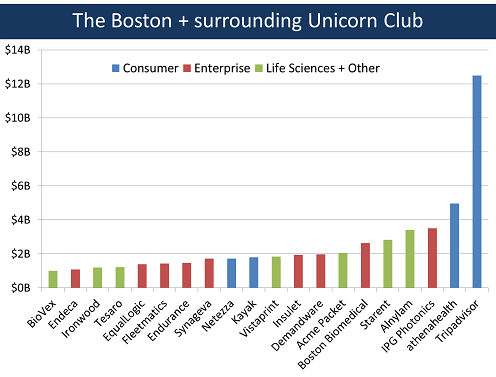
We found 50 such companies (updated from 43 originally).  That is, 50 companies in the Boston and surrounding area that had achieved > $500 million in value during the last ten years.  19 of these had achieved > $1 billion in value (Aileen's cut off, although she had constrained the founding date to the last ten years rather than the exit date, which obviously yields a broader population).  A chart showing these 20 companies can be seen here:

Boston Unicorns 3 v3


A few interesting observations about the full set of 50 companies:

  • Lack of Massive Winners. The perception that Boston has not recently generated massive wins appears to be only somewhat accurate, depending on which sector you focus on.  Of the 19 companies that were > $1 billion in value, seven were greater than $2 billion (TripAdvisor, athenahealth, IPG Photonics, Alnylam Pharma, Starent, Boston Biomedical, Acme Packet).  That said, only three of these companies are software technology companies – TripAdvisor ($12.5B), athenahealth ($5.0B) and Starent ($2.8B) – and they were founded in 2000, 1997 and 2000, respectively.  In other words, there have been no multi-billion dollar valued tech companies founded in Boston in the last 13 years.  There are three companies that have achieved >$1 billion in value in the tech sector founded in the last 10 years: Demandware ($1.9B/2004), Kayak ($1.8B/2004) and Fleetmatics ($1.4B/2004), although the latter was founded in Dublin.
  • Essential Role of Immigrants.  Here was a statistic that blew me away:  over half of these companies (51%) had an immigrant founder.  In my research related to my Senate testimony on immigration reform, I noted that 40% of Fortune 500 companies had an immigrant founder.  Apparently, successful Boston-based startups have an even greater concentration of immigrant influence.
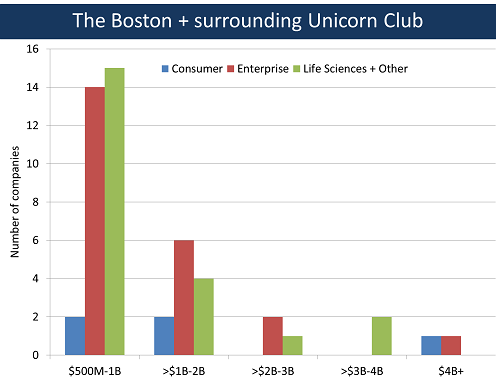
  • Strong Diversity.  The breadth of the Unicorns is impressive, reinforcing the view that Boston's startup ecosystem is one of the most diverse in the world.  Of the 50 companies that achieved > $500M in value, 23 were life sciences (plus materials science), 22 enterprise technology and 5 consumer technology.  To see the companies in their various segments laid out, see the chart below:

Boston Unicorns 1 v6

Much of this data refutes the belief that all the major startup winners have been created in Silicon Valley.  In fact, the vibrant life science sector is now arguably more heavily concentrated in Boston than in any other cluster at any other time in history.  That said, Boston has definitely come up short in the race to build massively valuable tech companies.  And if you want to build a consumer Internet company, there are few role models. 

However, I am quite optimistic about the future. As evidenced by this review of the Boston startup ecosystem, the quality and robustness of the environment has improved greatly in the last few years.  As for big winners, the pipeline looks pretty good.  Globoforce and Care.com have filed to go public and companies like Acquia, Actifio, DataXu, Dyn, Hubspot and Wayfair and are all reputed to be on a similar path in the next year or two.

If you want to see the entire spreadsheet with the underlying data, you can click here.

Related articles

Unicorns and MBAs
What Makes the Boston Start Up Scene Special?
Billion-dollar software success is almost rare as unicorns

Unicorns and MBAs

I like being a contrarian.  As a kid, if a certain TV show was popular amongst my buddies, I’d purposefully ignore that show and search for other shows that were less well known (e.g., Hogan's Heroes was a personal favorite that never hit mainstream).  When someone declares something is conventional wisdom, I look to poke holes and challenge the underlying assumptions.

Recently, the conventional wisdom in Startup Land has been that young, technical founders are the prototype for creating valuable companies.  The formula, this theory goes, is to find a hacker in a hoodie and bring out the wheelbarrow of cash to back them.  Think Mark Zuckerberg/Facebook, Drew Houston/Dropbox, David Karp/Tumblr and – the most recent poster boy darlings of Startup Land – the SnapChat founders

I have always thought that stereotype was skewed. Don’t get me wrong – I love young founders.  At Flybridge, we have invested in many of them (e.g., Eliot Buchanan and Dan Choi at Plastiq) and we plan to continue investing in many others.  But in my twenty years living in Startup Land, I have found that there is no single model or archetype for success.  Success comes in many flavors and combinations.  And, in my last five years on the HBS faculty, I have become more convinced of the value of the MBA entrepreneur. 

Thus, I was thrilled to read Aileen Lee’s terrific analysis of unicorns (companies that have been created in the last 10 years worth more than $1 billion) and have it shatter this piece of conventional wisdom.  Aileen systematically analyzed the common characteristics behind this cohort of 39 companies and found that “inexperienced, twentysomething founders were an outlier. Companies with well-educated, thirtysomething co-founders who have history together have built the most successes.”

Aileen’s analysis didn’t provide any data on the role of MBAs in the unicorns.  So, in partnership with HBS second year Juan Leung Li, we did some of our own digging.  Here's what we learned:

  • 33% of the Unicorns had at least one founding member who had an MBA. Examples include Kayak (Steve Hafner/Kellogg), Workday (Aneel Bhusri/Stanford and Dave Duffield/Cornell), Yelp (Jeremy Stoppelman/HBS) and Zynga (Mark Pincus/HBS).
  • 82% of Aileen's Unicorns had at least one founding member or current executive team member with an MBA. Examples of unicorns where MBAs were hired to help build the company include Evernote (COO Ken Gullicksen/Stanford), Facebook (COO Sheryl Sandberg/HBS), Twitter (COO Ali Rowghani/Stanford).
  • Of those that had MBAs, the leading schools represented were: HBS (21%), Stanford's GSB (17%) and Wharton (10%).

Unicorns pic - companies v2


Unicorns pic - schools
This week, John Byrne of Poets & Quants published a complimentary analysis, ranking the top 100 MBA Start-Ups.  In this analysis, he found some terrific companies that have been MBA founded in the last 5 years, such as Okta, Rent the Runway, Warby Parker and Wildfire.  Among this MBA founder list, HBS (34%), Stanford (32%) and MIT (11%) came out on top.

Why all the momentum with MBAs and start ups? Simply put, the major schools have radically changed their curriculum. These schools and others have become super-focused on training their MBAs to be effective executives across a range of company sizes, from start-ups to large enterprises.  For example, HBS now teaches two courses to help train students to be effective start-up executives:  Launching Technology Ventures (which I teach) and Product Management 101.  MIT is considering offering their own version of these classes in the spring or next year and Stanford has a plethora of strong course offerings for future start-up executives.

So the next time someone tells you that you need a hoodie to be a great start up entrepreneur, don't be afraid to flash your MBA diploma with pride.

To see the detailed spreadsheet that Juan Leung Li did, click here.

The Product Management Revolution

Copyright Martin Eriksson and Mind the Product 2011.

The art of Product Management continues to evolve. I've enjoyed spending time with many VPs of product in the last year since I co-authored an HBS note on the role of the Product Manager to develop more insights, materials and case studies on that revolution.

Earlier this week I taught a seminar on product management to MIT Sloan students as part of their "Sloan Innovation Period (SIP)" curriculum.  Although it's not exactly the EdX experience, in the spirit of open courseware, I thought others interested in the topic might enjoy the materials I used for the class, which are here:

Start Up Nation – Trip Report

I spent last week visiting Israel with a group of fellow venture capitalists touring Start Up Nation - a trip sponsored and organized by CJP. We had a terrific time – despite being in the midst of a pretty tough neighborhood, the country's innovation economy is absolutely booming.  A recent report named Tel Aviv the second most vibrant start up ecosystem in the world, behind only Silicon Valley.

A few take aways from the trip provided us with some insight into why such a tiny country (population of only 8 million) is doing so well:

  1. Big Winners are Emerging.  There used to be a perception that Israeli start-ups had great technology, but were weak at growing sales and marketing and so had to sell out to bigger companies early in their lifecycle, precluding the opportunity to build very valuable companies.  The success of Waze ($1B sale to Google), Wix (IPO filed), Outbrain (IPO rumored to be quietly filed or in process) have entrepreneurs on the ground thinking big.  The Times of Israel reports these success stories are inspiring Israeli start-ups to focus on the IPO path rather than M&A as a potential path to greatness.  I see this through the lens of our portfolio company, tracx, whose ambitions to build a great SaaS social intelligence company seem to rise with the country's ambitions.
  2. Start Up Heroes.  A culture is defined by its heroes.  The American entrepreneurial narrative has been shaped and amplified by the oft-celebrated heroic journeys of Bill Gates, Steve Jobs and Mark Zuckerberg, among others.  The Israeli narrative has gone from celebrating its war heroes (think Moshe Dayan, Ariel Sharon, the Mossad) to celebrating its entrepreneurs.  I think we were told no less than a dozen times that Warren Buffet's largest international investment was in an Israeli company ($6B for Iscar) and yesterday it was reported that he is acquiring his third Israeli company.  The country is bursting with pride at its latest Nobel Prize winner in Chemistry (now numbering 11 Nobel laureates in its 65 year history).  Everywhere you go, Israelis want to tell you how smart and entrepreneurial they are!  Unlike any culture I have ever seen, this country gets the value of raw intelligence.
  3. Partnerships Matter.   Knowing their position as such a small country, Israeli businesses are always looking to partner outside of Israel.  Native Israeli venture capital represents only 25% of the VC capital invested in the market – most of the money is coming from global firms like Battery, Greylock, Lightspeed, Sequoia and others.  The two recent partnerships from Israel's elite technical university, Technion, are manifestations of this open approach.  First, the ambitious partnership with Cornell to build a new engineering school in New York City – called Cornell Tech – which appears to be off to a strong start, helped in part by a $133M gift from Qualcomm founder Irwin Jacobs.  More recently and announced while we were on campus, Technion announced a joint venture with a Chinese university to build a new campus in Guangdong thanks to a $130M gift from Chinese billionare Li Ka Shing, a large investor in Waze, matched by the Chinese government.

These elements suggest a bright future for Start Up Nation.  Now imagine what would happen if a peace agreement with the Palestinians could be reached (for a glimmer of home, read this NY Times report on a recent interview with President Abbas) and a nuclear deal with Iran (again, if you're an optimist, read today's WSJ report on Iran's seriousness in negotiating a deal).

A bright future, indeed.

Mentors and Reverse Mentors

Mentors

I make a lot of lists. It’s an old habit that started when I was in grade school.  Lists of to dos, lists of goals, lists of workouts. Lists, lists, lists.  I’m also a nostalgic person and so I tend to save a lot of these lists and use them as touch points for storing memories and keeping track of the passing of time. Every now and then I’ll come across an old list and re-read it.  Some of them make me think deeply and others make me laugh at my younger self’s absurdity.

Recently, I came across a list in my desk labeled simply “Mentors”.  I’ve had a lot of mentors in my life – many who may not even know they played this role for me.  I’ve always kept an eye on them and noticed the choices they’ve made and how they’ve carried themselves personally and professionally.  A number of years ago, I drew up a list of my mentors as it helped crystallize for me who I admire, why I admire them and what I can learn from them. It was fun to stumble upon that list again and reflect on my choices.

Then, I read an interview with my friend Barb Goose, president of Digitas, where she talks about reverse mentors.  It inspired me to draw up another list.

Reverse mentors are people younger than you who you admire and learn from.  Everyone on my mentors list is older than me.  That was my traditional definition of mentor – someone ahead of you in life that inspires you, helps guide you and show the way to live.

But when I read Barb’s reason for seeking out reverse mentors – younger folks who she learns from in this rapidly changing, digital world – it really resonated with me. Entrepreneurship, technology and innovation are profoundly influenced by the young. If you’re not tapping into their knowledge base and seeking their insight on trends and opportunities, you’re missing out on a valuable resource. Upon reflection, it’s one of the reasons I so much enjoy the teaching I do at Harvard Business School.  I learn a tremendous amount from the students and they are always helping me think about the latest disruptive ideas, technologies and companies that are emerging or challenging how to best go about building start-ups to tackle these opportunities.

So now I’ve got my reverse mentor list.  I’m tucking it away in my desk for another
few years and look forward to tracking the careers and choices of those on it.

What Makes the Boston Start Up Scene Special?

Every year, I give an open talk to the returning students at Harvard Business School on what makes the Boston start-up scene special.  I do it for two reasons:  1) as an advocate for the local innovation ecosystem, I want to make sure all these smart, talented folks from around the world can access and plug in to the amazing local resources available to them; 2) Boston is a microcosm of the ingredients for a successful start up community, a topic of great interest to policy makers and leaders all over the world (for more on this topic, see Brad Feld's excellent book, StartUp Communities).  The city of Boston is a relatively small one (the 21st largest city in the US with a population of 600k and a combined metro area that ranks it 10th), yet it is consistently ranked as one of the most innovative clusters in the world.

This presentation gives you a sense of why.

I have written in the past that in the IT sector, Boston suffers from not having more "platform companies", such as Facebook, Google, Twitter, LinkedIn.  As the above presentation shows, only a few companies in Boston are of the scale where they are platforms for other startups to plug in to and large enough to create their own industrial clusters.  Hopefully, that will change in the coming years.

Enjoy!

The Other Founder

I’ve been thinking a lot lately about the unsung hero of many start-ups:  the other founder. A lot has been written about the founder/CEO and her growth and evolution as a company grows.  But little is written about the (nearly omnipresent in my experience) cofounder – the #2, behind-the-scenes partner who teams with the founder/CEO from the very beginning to build the company.  In the image above, most everyone knows the name and image of Larry Page – cofounder and now CEO of Google.  But how many folks know Sergey Brin (on the right) and the role he has played in building Google to its massive success and a market capitalization of nearly $300 billion?  Sergey Brin is the other founder.

I’ve probably been thinking about this topic a lot lately because I’ve been recently meeting with the other founder at a few of my portfolio companies.  The conversations we’ve been having have a consistent set of themes. The other founder usually begins with a particular range of responsibilities that compliment the founder.  They may run a function, such as product or engineering, or they may have a broader operational role and carry a COO title. Typically, a 5 person company doesn’t need a COO, but it’s a useful catch all title for the other founder because it sounds better than “vice president of miscellaneous” or “SVP of whatever falls through the cracks,” which are more accurate descriptions of their role.

The challenge for the other founder is that as a startup evolves from “the jungle” (super early stages, chaotic organization, prior to achieving product-market fit) to the “dirt road” (developing some organizational maturity and initial product market fit), senior functional executives often get hired from the outside to take over departments.  These executives naturally encroach on the other founder’s responsibilities.

For example, at one of my portfolio companies, the other founder looked after administration, finance, operations, product and engineering.  Basically, everything but sales and marketing. But then the company hired a VP of operations.  And then a VP of finance.  And finally a VP of engineering.  And suddenly, after transitioning each function successfully to an outside senior executive one at a time, the other founder had successively worked himself out of a job.

The board and investors are super focused on making the founder/CEO successful – building an executive team around them, perhaps even a COO/president to compliment their skill set and help the company scale.  Or, as in the case of Google’s hiring of Eric Schmidt, an outside CEO who can guide growth and scale.  In these situations, everyone is focused on the impact on the founder – what his role will be, how he handles the transition.  Very little board attention is typically focused on the role, evolution and growth of the other founder.

I would submit that ignoring the other founder is short-sighted.  I recommend boards and CEOs spend more time worrying about the role of the other founder and helping her successfully evolve over time.  Typically they are intensely loyal to the company and the founder/CEO, valuable sounding boards for the executive team and the founder/CEO and champions of the company culture and mission.

Here are a few approaches or archetypes that I typically see as the role of the other founder evolves over the life of a startup:

1. Become a functional owner. 

The other founder may be “VP of miscellaneous” in the beginning days of the startup, but be explicit about which functional area she should expect to own over time.  That way, she can develop the skills in that area in a focused fashion and slot in appropriately when the time is right. Product management is a popular functional area for the other founder as the other founder is typically close to the customer and business problem being solved. Further, the role doesn’t involve managing tens or hundreds of employees, a skill that is typically better suited for experienced functional operators.  Another one is business development for similar reasons and because it involves selling the company into an ecosystem of partnerships, requiring a blend of product knowledge and marketing skills.

2. Grow into the COO role. 

One successful portfolio company of mine had two young, MBA founders.  One played the
CEO/cofounder, Mr. Outside role and the other played the COO/cofounder, Mr. Inside role.  Even as the company scaled, the young COO rapidly learned how to be a successful operator at scale.  I have had other companies hire coaches to help the young other founder grow into the COO role.  For the right profile, this can be a great role for the other founder.

3. Drive the next strategic initiative. 

As startups evolve into functional startups, they get very focused on the here and now:  shipping the next product release, successfully closing the next quarter, closing an important partnership.  Yet, startups need to always worry about what’s around the corner and have resources dedicated to strategic initiatives that can provide non-linear growth.  This is an area where the other founder can be very valuable.  Because of the respect he has within the company and their ability to cut across functions, he is well positioned to drive strategic initiatives and providing the “startup within a startup”culture necessary to innovate.

This set of themes is one that I’m personally very familiar with because I played this role at one of my startups, Upromise.  My title at the start was president and COO – thus I initially played the Mr. Inside role and rapidly grew into running a large organization.  Then, as we hired a skilled operational CEO, I transitioned to driving strategic initiatives.

I guess that’s why I’m always a sympathetic ear for the other founder.

Related articles

Why You Should Eliminate Titles at Start-ups