Why You Should Eliminate Titles at Start-ups

There has been a recent dialog around a theme I'll call "hacking the corporation" – creating novel approaches to building young companies, particularly when they are in their formative start-up stage and pre-product market fit.  One of them, reinventing board meetings (or, "Why Board Meetings Suck"), has gotten some attention from leading thinkers like Steve Blank and Brad Feld.

I'd like to submit another item to add to the "hacking the corporation" punchlist:  elimnating titles.

At business school, I learned all about titles and hierarchies and the importance of organizational structure.  When I joined my first start-up after graduation, e-commerce leader Open Market, I found the operating philosophy of the founder jarring – he declared no one would have titles in the first few years.  If you needed a title for external reasons, our founder told us, we should feel free to make one up.  But we would avoid using labels internally.  In other words, there would be no "vice president" or "director" or other such hierarchical denominations.

Why?  Because a start-up is so fluid, roles changes, responsibilities evolve, and reporting structures move around fluidly. Titles represent friction, pure and simple, and the one thing you want to reduce in a start-up is friction.  By avoiding titles, you avoid early employees getting fixated on their role, who they report to, and what their scope of responsibility is – all things that rapidly change in a company's first year or two.

For example, one of my first bosses in the company later became a peer, and then later still reported to me.  Our headcount went from 0 to 200 in two years.  Our revenue grew from 0 to $60m in 3 years.  We went public only two years after the company was founded.  We were moving way too fast to get slowed down by titles and rigid hierarchies.  Over the course of my five year tenure, I ran a range of departments – product management, marketing, business development, professional services – all amidst a very fluid environment.  Around the time that we went public, we matured in such a way that we began to settle into a more stable organizational structure and, yes, had formal titles.  But during those formative first few years, avoiding titles provided a more nimble organization.

So when I co-founded Upromise, I instituted a similar policy:  no titles.  We had an open office structure and functional teams, but a fluid organizational environment and rapid growth.  One of our young team members changed jobs four times in her first year.  Only after the first year, as we settled into a more stable organizational structure and I recruited senior executives who were more obviously going to serve as my direct reports on the executive team did I begin to give out titles (CTO, CMO, CFO, etc.).  With the title policy, there was some early tension and discomfort (one young MBA kept referring to himself as a VP externally, although he was clearly playing an individual contributor role and was soon layered).  Often, when you are running your start-up experiments, you are not even sure of the right profile for employees or organization structure for optimal execution.  But you can establish role and process clarity without having to depend on titles.

I haven't been able to institute this systematically in our portfolio, but whenever young start-ups are formed, it's one of the first things I counsel the founder.  Don't let your founding team and early hires get too attached to titles and hieararchy.  In fact, in that formative first year, see if you can avoid them altogether.

A New, Intellectual Fertile Crescent – Allston and Cambridge

In ancient history, the Fertile Crescent extended from lower Egypt, through modern-day Israel and into Assyria and Mesopotamia.  Thanks to the waterways, population density, and diversity of peoples, it was characterized by an unparalleled flow of goods and services and intellectual foment.  The region's nickname, "The Cradle of Civilization" is well-deserved.

Today, Harvard University is announcing that the school is finally progressing with its stalled expansion in Allston to create 700,000 square feet of new lab space and a 36-acre enterprise research campus with a dozen building to house start-ups, biotechs and VCs.

If this project can be completed as planned (something Larry Summers tried to complete during his term as president, but it was stalled due to the economic crisis), it will form a modern-day, intellectual fertile crescent between Harvard and MIT's Kendall Square, linking academia, industry and capital along the Charles River.

To be clear, this is not just a Boston phenomenon.  The scientific progress being made in Kendall Square and throughout the region in the areas of human genomics, bioengineering and personalized medicine at the Whitehead Institute, the Broad Institute and the Wyss Institute are having international impact.  If the Harvard Stem Cell Institute were to move to the new campus and sit alongside the newly created Harvard Division of Engineering and Applied Sciences, nestled next to Harvard Business School and the newly created Innovation Lab, the amount of collaboration and innovation would simply explode.  Notably, each of the institutions mentioned above are 5-10 years old and thus are still extremely early in their progress in bringing to market all the implications of the intersection of the human genome project, big data, cloud computing, Moore's Law and advancements in nanotechnology.

There is a big idea nestled in here.  Let's hope local, state and national leaders recognize the opportunity…and seize it.

Groupon S-1: Mind The Ratios

When evaluating company documents and filings, a hedge fund manager friend of mine has a simple mantra: "read the footnotes".  So when the Groupon S-1 was posted last night, I was eager to pour over it and find a few hidden nuggets that might explain the company's success and provide some indication of what the future might hold.

I think I found it on pages 74 (not the footnotes, I grant you, but buried quite deeply in the 110 page document).  The company presents two case studies for its two oldest cities, Chicago and Boston, and provides a few datapoints that allows one to infer two of the most important metrics for the business – customer churn and customers per merchant.

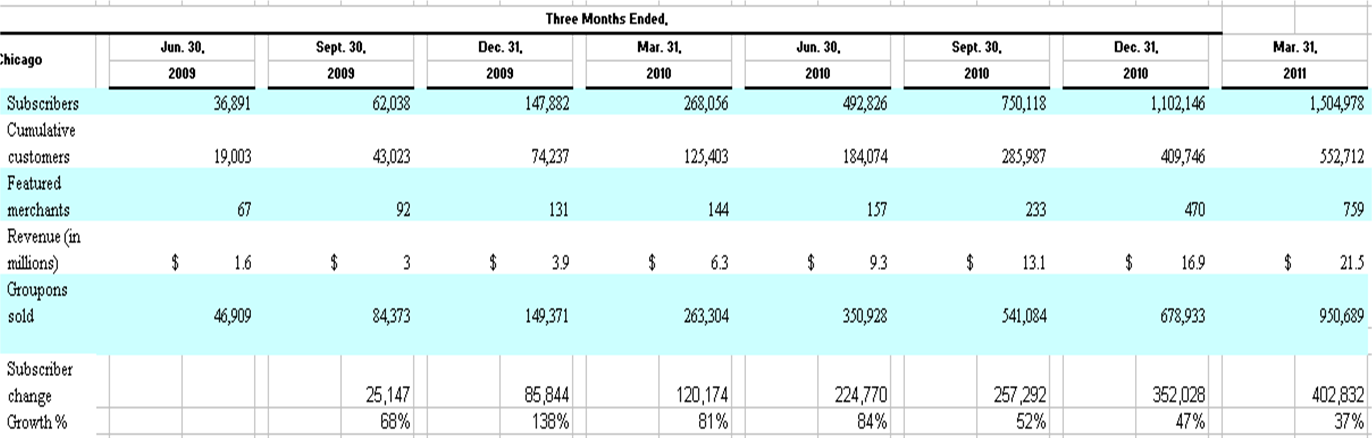
Let's look at the longest-tenure city – their hometown of Chicago.  Here's the chart they provide in the S-1 for performance over time:

Groupon-Chicago


All the numbers are growing, which is terrific.  But what matters in these situations is the ratios of growth, not just the absolute growth.  So let's do some simple calculations.  First, subscriber (defined as someone who receives an email from them) growth per quarter and percentage growth:

Groupon-Chicago 2

As you can see, quarter over quarter subscriber growth is slowing considerably in Chicago.  In Q1'10 it was 81%.  In Q1'11 subscriber growth was only 37%.  This is incredibly important because there are going to be inactive subscribers – also known as attrition or churn – and that number will likely grow over time.  Groupon needs to fill this leaky bucket with new subscribers every quarter.  If not, growth will slow, flatten or decline.

Now, let's look at customer growth.  Typically, I would expect the definition of a customer to be someone who purchases a Groupon in that period.  But a footnote on page 8 provides a different definition.  A customer is defined as anyone who has purchased a Groupon since January 1, 2009.  That is, it is a cumulative figure representing anyone who has purchased in Groupon's history.  Thus, the change in customers is far more important than the absolute number.  Here's what that looks like:

Groupon-Chicago 3

As with the subscriber numbers, this figure is slowing in quarter-over-quarter growth.  In Q1'10, the change in cumulative customers (that is, new customers) was 69%. In Q1'11, it was 35%.

Now let's look at things from the merchant's view.  The number of Groupons sold per merchant and the number of Groupons sold per customer per merchant are two important ratios of merchant success and customer activity.  Here's what that looks like:

Groupon-Chicago 4

As you can see, these ratios are also in decline, with Groupons per merchant per 1000 customers dropping 10x from Q3'09 (21.3) to Q1'11 (2.3).  This ratio is a good proxy for how active the cumulative customer base is.  The lower the ratio, the more likely there are large pools of inactive customers.  Again, if customer engagement attrits over time, then there is a leaky bucket that can only be filled with new customer acquisition. In saturated markets, it is typical for new customer acquisition to slow down and become more expensive over time.

To be clear, I'm incredibly impressed with this company and what it has achieved.  But a careful read of the rations is instructive when thinking about persistence and durability of the model.  Groupon has so many assets at their disposal and is so early in their innovation cycle, that I'm sure we haven't seen anything yet in terms of targeting, loyalty and other techniques to provide sticky customer relationships.  But the ratio data above suggests that the basic model they're executing on right now has some weaknesses that will become more acute over time.

5 Lessons Entrepreneurs Can Learn From the Navy SEALs

There has been a surge in interest with the world of the Navy SEALs since the Osama bin Laden action (this piece in the WSJ was a particularly good profile) and I confess to being caught up in it myself.  One of my portfolio company CEOs, Will Tumulty of Ready Financial, is a former Navy SEAL (1990-1995).  Will was kind enough to introduce me to a SEAL classmate of his, Brendan Rogers (SEAL 1990-2000), who joined me and 20 NYC CEOs/founders from the tech scene last night to talk about the SEALs – the training, the planning and the operations behind their combat operations – as well as draw out some relevant lessons for entrepreneurs.  Brendan went on to HBS and McKinsey after the SEALs and then started his own hedge fund with a partner, so he had an interesting, multi-faceted perspective.

The discussion was wide-ranging and entertaining.  The five key lessons Brendan highlighted were as follows:

  • What's hard is good.  SEALs go through an intensive 6 month training program called Basic Underwater Demolition/SEAL training (BUD/S).  That training program is designed to test a candidate's physical and mental limits.  Traditionally, by the time of SEAL graduation, the attrition rate is as high as 70%.  SEALs quickly learn that the punishment and pain of training hardens their minds and bodies and adapt to embrace the tough environs.  Brendan pointed out that start-up executives who go through hard times should learn to relish them, recognizing that the hard times will toughen the team and train them properly for "battle".
  • 80% training, 20% execution.  SEALs are incredibly well-trained and when they are not on acutal combat deployments, they are spending the vast majority of their time training for a number of different types of missions.  In contrast, at start-ups, executives typically spend 100% of their time executing and 0% of their time training.  Brendan emphasized the importance of training and practice in all areas – employee onboarding, management practices, etc.  He commented on the importance of training for unexpected situations.  The simultaneous shooting of three Somali pirates at sea as part of a hostage rescue two years ago was an example of the kind of outcome possible when  SEALs train under all possible conditions.  The CEOs in the room had wide eyes and were certainly thinking hard about their training regimens and scenario planning after that example.
  • Every seat counts.  Brendan pointed out the price of settling for mediocrity, even in a big organization.  Every SEAL needs to know with 100% confidence that the man behind them will be able to save their life and get them out of a bad situation.  The CEOs in the room were asked if they could say the same about their management teams and if those management teams, in turn, could say that about their lieutenants.  One CEO objected that he had 1000 employees in his company and couldn't possibly hire all "A's".  Brendan replied by citing the example of DDay.  Eisenhower planned DDay with a small number of subordinates who he turned to and said, select 12 men underneath you who can trust with your life to execute this mission.  Each of those men did the same.  And so on and so on.  That cascading effect resulted in the successful employment and combat engagement of over a 2 million troops throughout Europe.  The lesson?  Don't let a large organization be an excuse for mediocrity.
  • Everyone is expendable.  The SEALs are trained in a nearly identical manner and no one SEAL is indispensible to the unit or the mission. The nature of combat is that anyone can be lost at any time.  Entrepreneurial companies have a harder time executing on this philosophy since there are specialists and superstars, but Brendan's message was to make sure contingency plans were thought through for any set of personnel circumstances.
  • You never know the measure of a person until they are tested.  As mentioned earlier, the SEALs training program weeds out 70% of participants.  Brendan conveyed that the people he thought would never drop out did while others proved to be more resilient and tougher than imagined.  Until your people are really tested (see "what is hard is good"), you can never be sure who will step up and who will falter.  One sure sign, based on pattern recognition, is that those that talk tough and are full of bluster are predictably those that are the first to blanche in the face of adversity.  Quiet strength and determination in a start-up are invaluable.  When you see it in your people, bottle it.

Everyone left with a great appreciate for those brave men who serve our country so ably, and the system behind it that produces such a consistent, excellent "product".  Brendan is also the co-founder of the Navy SEALs Foundation, a non-profit that helps take care of the families of SEALs when things don't go as smoothly as they did in Pakistan a few weeks ago.  I was inspired to make a donation to the organization immediately after the dinner.  You can read more about them here.

One final humorous note – Brendan observed that the spouses of Navy SEALs are as tough as nails themselves and impossible to impress.  They still make their spouses take out the garbage, do the dishes and change diapers – no matter how impressive their accomplishments in the field of battle.  I suspect many start-up executives have similar, appropriately humbling marital arrangements!

Washington Report

In addition to my day job as an early-stage venture capitalist, I spend some time on civic activities – I think I must have gotten the social justice gene from my Dad.  One of my passions is my work as co-chair of the Progressive Business Leaders Network (PBLN), a nonpartisan group of business leaders that are committed to pro-business, pro-competitiveness policies that are also sustainable and socially responsible.

Last Thursday, I helped lead a delegation of over one hundred CEOs to Washington DC – our most impressive turnout ever – to advocate for policies consistent with our values.  We met with over a dozen senators, a handful of Members of Congress and a number of executive branch leaders.

There were many highlights, but here were a few:

  • Start-Up Visa. Rep Jared Polis (D-CO), a former entrepreneur, reports that the Start-Up Visa initiative is languishing because there isn't a single Republican in the House that will co-sponsor it.   Sen Kerry (D-MA) and Sen Lugar (R-IN) put forward a bill in the Senate (Start-Up Visa Act of 2011) but it's not moving because of the House.  Rep Polis also shared that he is starting a Congressional Caucus on "Innovation and Entrepreneurship" along with Rep Vern Buchanan (R-FL) – clearly an important movement to focus and coordinate policy efforts.
  • Internet Privacy. Kerry and his staff told us about the recent Internet Privacy Bill he and Sen John McCain (R-AZ) have proposed.  They believe a business-friendly, consumer-friendly version will get passed into law eventually after some negotiations with Sen Jay Rockefeller (D-WV), who is pushing for a more liberal bill that includes a Do Not Track provision.
  • Deficit Reduction. Sen Mark Warner (D-VA) briefed us on his work as part of the "Gang of Six" – the six senators who are trying to develop a bipartisan, deficit-reduction plan.  As everyone knows, the deficit data is scary (I recently read analyst John Maudlin's book Endgame, which is about as scary a book about the global economy as one can imagine).  To take $4 trillion out of the deficit over the next 10 years (the common number focused on by the Ryan Plan, the Obama Plan and the Simpson-Bowles Plan), it is clear that entitlements, taxes and draconian spending cuts are all on the table.  Many insiders believe a proposal will be put forward this week.
  • Investment and Growth Policies. Austan Goolesbee, Chairman of the Council of Economic Advisors and a frequent guest on The Daily Show, provided his views on the economy and the policies required to drive growth.  He seemed less focused on the deficit (scarily, frankly) and more focused on "growing our way out of this".  He highlighted the President's focus on innovation policies and job growth, although when pushed he was squishy on details.  He did observe that the fixing the IPO market malaise needs attention (an issue that is dampening growth – as analyzed extensively by these two Grant Thornton Reports, one titled "A Dysfunctional IPO Market Fuels Unemployment"). 
  • Deregulation.  Will Marshall and Mike Mandel from the Progressive Policy Institute (PPI) briefed us on the need for deregulation.  There is a growing awareness in Washington on the importance  of reducing regulatory burdens on business.  What a pleasure to hear a Democratic group advocate for this!  In fact, Mandel shared a good insight:  governments should apply regulatory policy during business cycles much like they do monetary and fiscal policy – loosen during times of economic weakness, tighten during boom times.  He highlighted Sarbanes Oxley as a huge mistake, just when the economy needed less regulation in the IPO market, not more.  He also railed against regulatory overreach on the part of the FCC.

These were just a few of the many highlights.  The call to action given to us by the elected leaders still resonates.  "We need you.  Keep caring.  Stay engaged." pleaded Senator Warner.  We have only a few months left to achieve a long-term deficit reduction plan and making progress on pro-innovaton policies over the next few months before election fever strikes.  Everyone needs to stay engaged in what happens next.

Hire a Recruiter…Now

The unemployment rate in America is hovering around 9%. But if you are a competent engineer, sales executive, online marketer or general manager in Silicon Valley, NYC, Boston or other start-up hotspots, the unemployment rate is 0%. 

The talent market has gotten as competitive and aggressive as I have ever seen in the last 20 years. CNN recently reported that 40% of the 130,000 job openings in Silicon Valley are for software engineers.  Senior executives have never been harder to secure.  That's why, even though it flies in the face of conventional wisdom, I'm advocating that all my portfolio companies hire recruiters when they are trying to fill senior or key positions.  Immediately.

Typically, when a young company gets financing and begins to hire, they seek to leverage the network of the founding team and their investors. This network provides some valuable leads and perhaps a few hires. Leveraging existing networks has greater benefits than simply cost savings and convenience.  Teams that have worked together in the past simpy are well-positioned to out-execute those that haven't due to their common history, language and relationships.  I have read studies that show that one of the factors that correlates highly for success in a startup is if the team has worked together and made money together in a previous startup. 

But tapping those informal networks alone doesn't scale. And reacting to inbound people flow generates an adverse selection bias – the best people are not looking, so they will never contact you and respond to your job posting. 

As an entrepreneur, I was initially very skeptical of fast-talking, expensive recruiters. I thought hiring them represented a personal failure on my part as an entrepreneur.  After all, it was my job to secure the best and brightest talent through my own efforts and my own network. But my years of recruiting have taught me that startup CEOs are at a distinct competitive disadvantage if they don't get outside help for recruiting. Here are the top five reasons why:

1) You Never Have Enough Proactive Time. As an entrepreneur, you are always battling dividing your efforts into proactive time (where you direct the activities through your own energy) versus reactive time (where you are reacting to people and forces around you).  With the inflow of real-time information and people coming at you from all sides and demanding your attention (employees, investors, customers, etc), it's hard to find enough proactive time in the day.  Recruiting is a proactive exercise.  It requires effort and energy from the entrepreneur to generate candidate flow, meet candidates, vet them, check references.  It is therefore important to have an outside force push you to react to candidates and help you prioritize the recruiting effort, just as your VP Sales is pushing you to prioritize sales and your VP Marketing is pushing you to prioritize marketing.

2) Hiring Inexperience.  Most entrepreneurs are first time CEOs or even second time CEOs who simply do not have a lot of experience hiring, particularly hiring the particular executives they're hiring for (Try this exercise – ask your favorite CEO/entrepreneur how many times they've hired a CFO. Most never have but even if they've done it once or twice in the past, are they really now an expert at it?).  Like anything else, hiring is a science.  A recruiting friend of mine likes to say, "interviews are inquisitions, not discussions".  Too many entrepreneurs don't actually know how to interview well.  Further, they're not experienced at assessing their current human capital needs, analyzing the gaps of management team members, and then understanding the market and how to fill the gaps.  Good recruiters are invaluable in this regard.

3) Shallow reference checking.  Busy entrepreneurs and busy VCs typically do cursory reference checking when making even senior hires.  They allow themselves to be swayed by their own conviction, let the candidates spoon feed them their top fans from past jobs and ignore the opportunity to push for a deep understanding of candidates' histories and claims.  When I make an investment in a company, I typically do 8-10 reference checks and get a wide variety of perspectives from people who have worked with the entrepreneur in the past and seen them in a range of different situations.  It's hard to have the discipline to replicate this thoroughness when making a senior hire, particularly when trying to move quickly in a competitive hiring market (see "You Never Have Enough Proactive Time" above).

4) Quarterbacking the Selling Process.  Many hiring managers don't realize that the due diligence process for a candidate is as thorough, if not more so, than your due diligence on them.  The best candidates have choices and are sought after.  Even though you are deciding whether to "buy" over the course of a series of interviews, you need to be in a position to sell every step of the way.  "Everyone's trying to be the coolest place to work," observed one Stanford junior who is being barraged with job opportunities.  Recruiters can be very helpful in quarterbacking the selling process – proactively surfacing objections and handling them with data and follow-up conversations, linking candidates to the right people at the right time in the process.

5) Focus on closing.  Closing candidates in this competitive a market is very hard.  Counter-offers, compressed timeframes and personal considerations all get in the way of smooth closes.  Again, if you don't have alot of proactive time available to you (and who does?!), there's great benefit to having a focused closer.  Further, I have found having an intermediary helps tremendously with the negotiations.  A candidate will be unafraid to tell a recruiter what it takes to get the deal done, and a tough back and forth with the help of an intermediary can avoid bad feelings aftewards between two principals that will need to work together as a team when the dust settles.

Too often I hear entrepreneurs say, "I'll work my network for a few weeks and then we'll hire a recruiter."  Many VCs are over-confident about their own recruiting prowress and will tell entrepreneurs to wait until they talk to their partners and surface a few great candidates from their network.  The problem, of course, is that everyone gets busy and distracted. A few weeks turns into a few months, a few candidates get turned up and interviewed but then discarded, and finally when the network comes up dry, the group reconvenes and decides to hire a recruiter.  Now the recruiters need to be selected, interviewed, reference checked, negotitated with and ramped up – causing more delay.  By the time you get around to getting the recruiter ramped up, the board and CEO feel frustrated that they are already behind.  To be clear, not all recruiters are created equal and some are a waste of time and money. But if you can find a good one, don't let them go. 

Paul English, cofounder of Kayak, is a truly gifted recruiter and there has been alot written about his approach to hiring.  If you can be that exceptional, perhaps you don't need a recruiter.  And, believe me, the price you pay for these folks feels exorbitant, particularly if you are in the scrappy, lean start-up phase of development.

My bottom line advice is to just bite the bullet and hire a recruiter now. The difference will cost you an incremental $50-100k, but everyone knows hiring an "A" has a massive positive impact as compared to a "B" – and that impact is compounded if it can be achieved 3-6 months sooner.

What if it’s 1996, not 1999?

In May 1996, Open Market completed a successful IPO and more than doubled on the first day of trading, ending with a $1.2 billion market capitalization.  We had recorded $1.8 million in revenue the year before. 

If investors observing this extraordinary phenomenon in 1996 were to have concluded that the technology market was in the midst of an unsustainable bubble, they would not have been wrong.  But if that observation led them to refrain from investing in the Internet sector, they would have missed one of the most stunning legal creations of wealth in history.

In 1997, a Charles River Ventures fund yielded a stunning 15x return, backing such superstars as Ciena, Vignette and Flycast.  Matrix had a fund in 1998 that yielded an eye-popping 514+% IRR.  The Internet bull market continued to run for four more years after the Open Market IPO, finally ending in the spring of 2000.  The average venture capital fund raised between 1995 and 1997 returned more than 50% per year.

Amidst all the recent talk of boom vs. bubble, there is a hue and cry that the current environment may smack of 1999.  But what if it’s actually more akin to 1996?  What if the fundamentals are good enough to support four more years of insane behavior before the music stops and the natural business cycle correction settles in?

The chart below from this week’s Economist on unemployment made me pause and consider this question.  As evidenced from the unemployment curve in the last economic cycle, these business cycles can often last 4-5 years.  2009 was the trough year of the most recent business cycle – and a deep trough at that.  2010 was a year of firming and climbing out of a hole, but the tepid IPO market and general macroeconomic malaise seemed to linger until late in the year (similar to how 1995 felt).  2011 is the first year where it feels like a real boom – much like 1996.  Employment lags economic output and is an admittedly imperfect indicator, but if you continue the analogy, it may be that the next 4-5 year boom cycle lasts until 2015!

Consider the following:

  • When bellwether players go public (such as Netscape in 1995), there is a massive rush of capital and companies that follow.  Facebook will likely go public in 2012 and be valued in the $50-75 billion range.  This IPO and others like it (e.g., Groupon, Zynga) will create tremendous liquid wealth for a number of people and institutions who will likely pour that wealth back into the start-up ecosystem.  That liquidity flowing back into the start-up ecosystem will arguably fuel the boom.
  • Macroeconomic choppiness is holding back more dramatic market euphoria.  Tsunamis, Middle East crises, government shutdown threats and a looming budget deficit are all dampers on the market.  But if some of these dampers clear out – if there is a period of reasonable international stability,  if a divided US government can strike another fiscally responsible deal for the upcoming budget year and begin to deal with some of the long-term, fundamental drags on growth, then the markets will become even more euphoric.  Remember, it wasn’t a straight line between 1995 and 2000 – there were a series of macroeconomic crises on the domestic front, such as a near government shutdown (sound familiar?) as well as international crises, including the Mexican debt default, Russian currency defaults and the Asian market crisis.  Let’s not forget that Time Magazine featured Alan Greenspan, Rob Rubin and Larry Summers on the cover in February 1999 with the headline:  “The Committee to Save the World.”  At times, this period saw pretty grim macroeconomic trends, while the Internet continued to boom in the trenches.
  • Thanks to recent decades of strong growth, the combination of China, India and Brazil have GDPs that are 4x the size and impact on the global economy as compared to the 1990s (see chart below).  Demand from these, now larger, economies are having a very positive effect on the US tech market. They are gobbling up mobile devices, PCs, routers and other technology gear at a rapid rate.  This powerful source of economic demand didn't exist 15 years ago. 

  GDP int'l

  • All the existing technology players are awash in liquidity and all the numbers are bigger this time.  There are eight US-based global technology companies with market capitalizations of greater than $100 billion (Apple, Google, Oracle, IBM, Microsoft, Intel, HP, Cisco).  There are a handful of companies that are very well-positioned, growing fast and could be the next $100 billion players (Amazon, Dell, Netflix, EMC, VMWare, Salesforce.com and Baidu come to mind). These companies either didn’t exist in the mid-90s or are in infinitely stronger positions than they were 15 years ago.  Internet usage, mobile phone usage, advertising dollar spend – all have grown enormously over the last 15 years to provide a stronger foundation underneath the latest boom.  See the chart below, which will only explode further when updated for more recent figures that will take into account Internet access via mobile phones.

Internet growth

The point here isn’t to be Pollyannaish.  I recognize that we have major structural issues in the global economy and they are perhaps more daunting than they have ever been.  And the recent run up in the stock market has many arguing that the bull market won't last much longer.  If oil soars to $150 per barrel, a few more soverign nations default on their debt obligations and gridlock persists in Washington, we could be looking at another recession as soon as 2012.

Yet, with entrepreneurship on the rise, with this generation of young people (“the Entrepreneur generation”) surging in their use and interest in technology and digital content, with some of the positive fundamental forces in innovation, it may just be that the music may not stop for another 4-5 years.  Wouldn’t that be something?

Board Meetings vs. Bored Meetings

I have been thinking alot about start-up best practices.  There has been a great deal written about how to pitch VCs and how to drive towards product-market fit, but there is relatively little out there about managing your board.  I spent a very modest amount of time on it in my book and there have been very few good blog posts on the topic.

Yet a well-functioning, well-managed board of directors is incredibly critical to a start-up's success.  Whether your board is full of VCs, angels, outside directors or a blend of all three, learning how to effectively manage your board is critical to your start-up's success and your personal success as an entrepreneur.

One of the best books on the topic is the somewhat obscure Board Room Excellence by a wise old start-up lawyer I worked with many years ago, Paul Brountas.  I send a copy of the book to every CEO I invest in and it gets rave reviews.  With a dozen years of of board work under my belt, here is the play book I try to encourage my CEOs to follow in running the board meetings.

First, the preamble – what happens before the board meeting:

  • Materials get sent out in advance, typically 2 days.  The materials contain:  CEO's overview, a briefing on the one or two key strategic issues that will be the focus of the meeting, financial and functional updates from each of the executive team members and the overall key operating metrics for the business.
  • The CEO sends a cover email along with the materials summarizing the one or two key strategic issues and soliciting board feedback for additional issues, observations or reactions to the material in advance of the meeting. 

Then, during the meeting, the agenda flows as follows:

  • The CEO begins alone with the board for 30 minutes where the CEO provides a one-page summary of the business and the key issues from their standpoint.  I often suggest presenting this in a "Red/Yellow/Green" format – what's going well, what's making you nervous, and what's not going well.  The best one-page summaries are very brief – hence the one page rule – and help focus the board's energies as well as provide a window into the CEO's priorities, thinking and "stay awake" issues.
  • The CEO then invites the CFO in and perhaps members of the management team to provide summary functional and financial updates.  Because the materials were distributed in advance and each board member has read the materials, it's more of an interactive Q&A than presentation.  This portion of the meeting lasts 30 minutes.
  • The CEO then invites members of the management team to join in a discussion on the one or two key strategic issues that will be the focus of the meeting.  The board has read the preparation materials in advance and so not every bullet on every slide needs to be read.  Often this is an opportunity for the management team members to present materials and get some board exposure.  The CEOs frame the  issue, present a recommendation as to how to proceed alongside their team, and then ask the board for help and guidance.   Ideally, a board decision is made at that point or in the private session that follows.  This portion of the meeting lasts 60 minutes.  The key issues may be approving the annual financial plan, the product roadmap, a briefing on a major partnership, the new product launch, an acquisition, an international launch or a new marketing initiative. 
  • Then, the CEO remains with the board for 30 minutes for an executive session.  This provides an opportunity for the board to reflect on the content of the meeting with the CEO and have additional dialog around the strategic issues.  In this session, for all of 5 minutes, resolutions are voted on, options grants are reviewed and previous board minutes are approved.
  • Finally, the CEO steps out and allows the board to have a non-management session.  When I was an entrepreneur, I was initially uncomfortable with this idea of stepping out of the room so that the board could talk about me and "my company".  But I came to appreciate the value of the private session for both the board and the company.  It's an opportunity for the board to gain alignment on the key takeaways, direction to give the management team, and also a forum to make decisions around compensation and bonuses, CEO performance feedback, financing, and generally build a functional decision-making unit.  This session typically lasts for 30 minutes.

After the board meeting, ideally the following would occur:

  • The lead director will summarize the points of board feedback to the CEO verbally or in writing in a follow-up call or email.  If the topic is a sensitive one, this may be done face to face.
  • The CEO would in turn summarize their takeaways in a follow-up email to the entire board.  This ensures alignment and clear communication so that nobody is confused about what the CEO decided to do with the advice received – particularly if there were conflicting opinions around the room and a single direction needed to be selected.

The best board meetings are working sessions, not reporting sessions.   A key role of the board, among other things, is to contribute to the company and work hard to increase shareholder value.  If the CEO isn't making the board work and creating a meeting framework that gets the most out of the board, then shame on everyone involved.

Boards should evaluate their CEOs once a year in a formal, 360-degree review process.  One of my new year's resolutions this year was to do this across my entire portfolio and, although its been somewhat burdensome, it's been a very valuable exercise.

In turn, boards should evaluate themselves every year.  The board should ask itself a few simple questions, like:  How effective is the board?  Does it work as a decision-making body?  Is the CEO getting the most out of the board?  Only through a rigorous focus on self-improvement and honest assessment will progress get made on any of these dimensions.

So that's my download on board best practices.  Would love to hear your tips and add them to my arsenal.

A Call to Arms on the IPO Malaise and Inaction

I almost never agree with a single thing written on the Wall Street Journal editorial pages.  Yet, I found myself muttering "amen" to myself a few times as I read this morning's editorial on "Whatever Happened to IPOs?".  It is just stunning to me how little interest there seems to be on the part of a supposedly pro-business Congress and (more recently) Executive Branch on this one simple thing that would unleash innovation and jobs – watering down Sarbanes Oxley.

The IPO market has improved somewhat in 2011 and so perhaps that has taken some pressure off, but the fact is that the regulations and costs associated with an IPO are so overwhelmingly daunting for our young venture-backed companies that they simply avoid them altogether.  I used to hear from investment bankers that a company north of $100 million in revenue and consistently profitable can find a welcome public audience.   But recent conversations that I have had with bankers has carried a different, even more depressing message.

I am now being told by investment bankers that if a company's revenue is less than $200 million and the projected market capitalization less than $1 billion, they are at risk of being relegated into the "public company ghetto" – a sad corner of the public markets where you have no analyst coverage, no float and so no liquidity.  Your stock simply drifts down and down without any institutional support.  And so even $50-100 million companies in our portfolio and others – growing profitably and creating real value – look at the IPO as an unattainable goal.  I profiled a number of companies in New York and Massachusetts that fit this criteria in response to Bill Gurley's excellent piece (IPO Anxiety) from a Sillicon Valley perspective a few months ago.  But when I talk to CEOs and board members at these companies, they roll their eyes at the IPO prospect – it feels simply too unattainable.

Some complain that the source of the problem is the lack of mid-tier investment banks.  Others complain that the lack of analyst coverage is the issue.  In both cases, it's a cause and effect problem.  The cause is Sarbanes Oxley and the lack of volume.  The effect is that bankers and analysts follow the money.  If the rules were more relaxed, there would be more bankers and analysts, for sure.  This is the Information Age – analysis and bankers will follow opportunities.  They may not be as well known, but banks like Jeffries & Co, Needham & Co, GCA Savvian and now BMO are aggressively courting companies to help them go public and would be all over a more robust market for companies in the $300-600 million market capitalization range. 

In 2009, the National Venture Capital Association (NVCA) made this topic their policy focus.  They released a series of spot-on recommendations to help bring back the IPO market.  But then everyone got distracted with the financial crisis and (yet) more regulation related to SEC registration and battles over the tax treatment of carried interest.  I don't know if there have been any hearings or serious consideration on policy options to provide more liquidity for the IPO market since the NVCA's recommendations.  But clearly there's been no action.

It's time to beat the drum on this.  Surely we can find a group of members of Congress who are willing to match their rhetoric on fostering innovation will doing the hard work of loosening up Sarbanes Oxley.  The StartUp Visa movement has made terrific progress thanks to online, grassroots support.  Let's use that as a model for the IPO market.  John McCain's on Twitter (@SenJohnMcCain).  Send him a tweet and see if he's listening.

Mastering The VC Game – Paperback Edition

My book, Mastering the VC Game, is going to be coming out in paperback.  My publisher, Penguin's business imprint Portfoilo, has asked me to make some edits and updates for the new edition, which I have been dutifully working on.

For fun, I experimented with getting some community input on this task.  I posed a question on the popular Q&A site Quora:  "What should I tweak in my book, Mastering the VC Game, for the upcoming paperback edition?" and got some great responses.  It is yet another example of how rich the discouse now is in the blogosphere  on the start-up ecosystem.  I am working on each of them, as well as other feedback I've gotten from reviewers.  By the way, if you want to read some of the book for free, I have made the first 40 pages available here.

One thing I was struck by was that the start-ups I chose to profile in 2009 have absolutely exploded in popularity and value.  Baidu was worth $12 billion at the time of the writing.  It is now $41 billion.  Constant Contact, LinkedIn, Twitter and Zynga were other companies I profiled.  Each of them has grown in value from 2-10x since the time of the writing a short eighteen months ago.  I don't know if it makes the lessons from these founders captured in the book that much more valuable.  I think we sometimes need to spend more time studying the lessons learned from start-up failures and perhaps this is something I will devote more energy to in the months ahead.

So, stay tuned for news about when the new release will be coming out.  In the meantime, I'm sharing this funny cartoon that Andy Cook of Rentabilities was kind enough to have drawn up and sent to me.  It brings to life the concept of "putting money to work" that I tweak VCs for in the book.  The only thing I don't like about the cartoon is that the VC is wearing a tie – very unrealistic nowadays…