Start Up Nation – Trip Report

I spent last week visiting Israel with a group of fellow venture capitalists touring Start Up Nation - a trip sponsored and organized by CJP. We had a terrific time – despite being in the midst of a pretty tough neighborhood, the country's innovation economy is absolutely booming.  A recent report named Tel Aviv the second most vibrant start up ecosystem in the world, behind only Silicon Valley.

A few take aways from the trip provided us with some insight into why such a tiny country (population of only 8 million) is doing so well:

  1. Big Winners are Emerging.  There used to be a perception that Israeli start-ups had great technology, but were weak at growing sales and marketing and so had to sell out to bigger companies early in their lifecycle, precluding the opportunity to build very valuable companies.  The success of Waze ($1B sale to Google), Wix (IPO filed), Outbrain (IPO rumored to be quietly filed or in process) have entrepreneurs on the ground thinking big.  The Times of Israel reports these success stories are inspiring Israeli start-ups to focus on the IPO path rather than M&A as a potential path to greatness.  I see this through the lens of our portfolio company, tracx, whose ambitions to build a great SaaS social intelligence company seem to rise with the country's ambitions.
  2. Start Up Heroes.  A culture is defined by its heroes.  The American entrepreneurial narrative has been shaped and amplified by the oft-celebrated heroic journeys of Bill Gates, Steve Jobs and Mark Zuckerberg, among others.  The Israeli narrative has gone from celebrating its war heroes (think Moshe Dayan, Ariel Sharon, the Mossad) to celebrating its entrepreneurs.  I think we were told no less than a dozen times that Warren Buffet's largest international investment was in an Israeli company ($6B for Iscar) and yesterday it was reported that he is acquiring his third Israeli company.  The country is bursting with pride at its latest Nobel Prize winner in Chemistry (now numbering 11 Nobel laureates in its 65 year history).  Everywhere you go, Israelis want to tell you how smart and entrepreneurial they are!  Unlike any culture I have ever seen, this country gets the value of raw intelligence.
  3. Partnerships Matter.   Knowing their position as such a small country, Israeli businesses are always looking to partner outside of Israel.  Native Israeli venture capital represents only 25% of the VC capital invested in the market – most of the money is coming from global firms like Battery, Greylock, Lightspeed, Sequoia and others.  The two recent partnerships from Israel's elite technical university, Technion, are manifestations of this open approach.  First, the ambitious partnership with Cornell to build a new engineering school in New York City – called Cornell Tech – which appears to be off to a strong start, helped in part by a $133M gift from Qualcomm founder Irwin Jacobs.  More recently and announced while we were on campus, Technion announced a joint venture with a Chinese university to build a new campus in Guangdong thanks to a $130M gift from Chinese billionare Li Ka Shing, a large investor in Waze, matched by the Chinese government.

These elements suggest a bright future for Start Up Nation.  Now imagine what would happen if a peace agreement with the Palestinians could be reached (for a glimmer of home, read this NY Times report on a recent interview with President Abbas) and a nuclear deal with Iran (again, if you're an optimist, read today's WSJ report on Iran's seriousness in negotiating a deal).

A bright future, indeed.

Mentors and Reverse Mentors

Mentors

I make a lot of lists. It’s an old habit that started when I was in grade school.  Lists of to dos, lists of goals, lists of workouts. Lists, lists, lists.  I’m also a nostalgic person and so I tend to save a lot of these lists and use them as touch points for storing memories and keeping track of the passing of time. Every now and then I’ll come across an old list and re-read it.  Some of them make me think deeply and others make me laugh at my younger self’s absurdity.

Recently, I came across a list in my desk labeled simply “Mentors”.  I’ve had a lot of mentors in my life – many who may not even know they played this role for me.  I’ve always kept an eye on them and noticed the choices they’ve made and how they’ve carried themselves personally and professionally.  A number of years ago, I drew up a list of my mentors as it helped crystallize for me who I admire, why I admire them and what I can learn from them. It was fun to stumble upon that list again and reflect on my choices.

Then, I read an interview with my friend Barb Goose, president of Digitas, where she talks about reverse mentors.  It inspired me to draw up another list.

Reverse mentors are people younger than you who you admire and learn from.  Everyone on my mentors list is older than me.  That was my traditional definition of mentor – someone ahead of you in life that inspires you, helps guide you and show the way to live.

But when I read Barb’s reason for seeking out reverse mentors – younger folks who she learns from in this rapidly changing, digital world – it really resonated with me. Entrepreneurship, technology and innovation are profoundly influenced by the young. If you’re not tapping into their knowledge base and seeking their insight on trends and opportunities, you’re missing out on a valuable resource. Upon reflection, it’s one of the reasons I so much enjoy the teaching I do at Harvard Business School.  I learn a tremendous amount from the students and they are always helping me think about the latest disruptive ideas, technologies and companies that are emerging or challenging how to best go about building start-ups to tackle these opportunities.

So now I’ve got my reverse mentor list.  I’m tucking it away in my desk for another
few years and look forward to tracking the careers and choices of those on it.

What Makes the Boston Start Up Scene Special?

Every year, I give an open talk to the returning students at Harvard Business School on what makes the Boston start-up scene special.  I do it for two reasons:  1) as an advocate for the local innovation ecosystem, I want to make sure all these smart, talented folks from around the world can access and plug in to the amazing local resources available to them; 2) Boston is a microcosm of the ingredients for a successful start up community, a topic of great interest to policy makers and leaders all over the world (for more on this topic, see Brad Feld's excellent book, StartUp Communities).  The city of Boston is a relatively small one (the 21st largest city in the US with a population of 600k and a combined metro area that ranks it 10th), yet it is consistently ranked as one of the most innovative clusters in the world.

This presentation gives you a sense of why.

I have written in the past that in the IT sector, Boston suffers from not having more "platform companies", such as Facebook, Google, Twitter, LinkedIn.  As the above presentation shows, only a few companies in Boston are of the scale where they are platforms for other startups to plug in to and large enough to create their own industrial clusters.  Hopefully, that will change in the coming years.

Enjoy!

The Other Founder

I’ve been thinking a lot lately about the unsung hero of many start-ups:  the other founder. A lot has been written about the founder/CEO and her growth and evolution as a company grows.  But little is written about the (nearly omnipresent in my experience) cofounder – the #2, behind-the-scenes partner who teams with the founder/CEO from the very beginning to build the company.  In the image above, most everyone knows the name and image of Larry Page – cofounder and now CEO of Google.  But how many folks know Sergey Brin (on the right) and the role he has played in building Google to its massive success and a market capitalization of nearly $300 billion?  Sergey Brin is the other founder.

I’ve probably been thinking about this topic a lot lately because I’ve been recently meeting with the other founder at a few of my portfolio companies.  The conversations we’ve been having have a consistent set of themes. The other founder usually begins with a particular range of responsibilities that compliment the founder.  They may run a function, such as product or engineering, or they may have a broader operational role and carry a COO title. Typically, a 5 person company doesn’t need a COO, but it’s a useful catch all title for the other founder because it sounds better than “vice president of miscellaneous” or “SVP of whatever falls through the cracks,” which are more accurate descriptions of their role.

The challenge for the other founder is that as a startup evolves from “the jungle” (super early stages, chaotic organization, prior to achieving product-market fit) to the “dirt road” (developing some organizational maturity and initial product market fit), senior functional executives often get hired from the outside to take over departments.  These executives naturally encroach on the other founder’s responsibilities.

For example, at one of my portfolio companies, the other founder looked after administration, finance, operations, product and engineering.  Basically, everything but sales and marketing. But then the company hired a VP of operations.  And then a VP of finance.  And finally a VP of engineering.  And suddenly, after transitioning each function successfully to an outside senior executive one at a time, the other founder had successively worked himself out of a job.

The board and investors are super focused on making the founder/CEO successful – building an executive team around them, perhaps even a COO/president to compliment their skill set and help the company scale.  Or, as in the case of Google’s hiring of Eric Schmidt, an outside CEO who can guide growth and scale.  In these situations, everyone is focused on the impact on the founder – what his role will be, how he handles the transition.  Very little board attention is typically focused on the role, evolution and growth of the other founder.

I would submit that ignoring the other founder is short-sighted.  I recommend boards and CEOs spend more time worrying about the role of the other founder and helping her successfully evolve over time.  Typically they are intensely loyal to the company and the founder/CEO, valuable sounding boards for the executive team and the founder/CEO and champions of the company culture and mission.

Here are a few approaches or archetypes that I typically see as the role of the other founder evolves over the life of a startup:

1. Become a functional owner. 

The other founder may be “VP of miscellaneous” in the beginning days of the startup, but be explicit about which functional area she should expect to own over time.  That way, she can develop the skills in that area in a focused fashion and slot in appropriately when the time is right. Product management is a popular functional area for the other founder as the other founder is typically close to the customer and business problem being solved. Further, the role doesn’t involve managing tens or hundreds of employees, a skill that is typically better suited for experienced functional operators.  Another one is business development for similar reasons and because it involves selling the company into an ecosystem of partnerships, requiring a blend of product knowledge and marketing skills.

2. Grow into the COO role. 

One successful portfolio company of mine had two young, MBA founders.  One played the
CEO/cofounder, Mr. Outside role and the other played the COO/cofounder, Mr. Inside role.  Even as the company scaled, the young COO rapidly learned how to be a successful operator at scale.  I have had other companies hire coaches to help the young other founder grow into the COO role.  For the right profile, this can be a great role for the other founder.

3. Drive the next strategic initiative. 

As startups evolve into functional startups, they get very focused on the here and now:  shipping the next product release, successfully closing the next quarter, closing an important partnership.  Yet, startups need to always worry about what’s around the corner and have resources dedicated to strategic initiatives that can provide non-linear growth.  This is an area where the other founder can be very valuable.  Because of the respect he has within the company and their ability to cut across functions, he is well positioned to drive strategic initiatives and providing the “startup within a startup”culture necessary to innovate.

This set of themes is one that I’m personally very familiar with because I played this role at one of my startups, Upromise.  My title at the start was president and COO – thus I initially played the Mr. Inside role and rapidly grew into running a large organization.  Then, as we hired a skilled operational CEO, I transitioned to driving strategic initiatives.

I guess that’s why I’m always a sympathetic ear for the other founder.

Related articles

Why You Should Eliminate Titles at Start-ups

Scaling Sales: From Craft to Machine

I've been thinking a lot lately about scaling sales.  

In every start-up, finding initial product-market fit is a magical moment.  Before this occurs, the sales process is a craft or an art – custom-made by the founder or evangelist sales VP.  You dive deep into a customer development process, working closely with a few customers who feed you requirements and are willing to trial an imperfect product that is evolving quickly.

But once you achieve initial product-market fit and are down the Sales Learning Curve, suddenly you are faced with a new challenge:  how do I scale up the sales efforts?  How do I build a repeatable, scalable sales process that is like an industrial machine – not a crafts project?

Across our portfolio and in my own entrepreneurial experience, I have seen three main sales models work successfully in scaling B2B sales:  1) Enterprise; 2) Telephone; and 3) Developer-driven.  B2C sales and customer acquisition efforts are a different matter (and one I'll perhaps address in a future blog), but for B2B, those three models are the most common pattern.  I'll discuss each one below.

1) Enterprise Sales

The enterprise sales model is a pretty simple one and was the predominant model ten to twenty years ago in the IT industry.  If you want to scale sales, you hire more sales reps.  Find a new sales rep with industry experience, a rolodex and a strong track record.  You assign an annual quota to each rep, train them, feed them some sales tools and assign them a sales engineer (particularly for more technically complex products) and coach them along the way.  After 3-6 months, they work their way down the learning curve, close their first deal and are off to the races.

The typical quota for a sales rep varies by type of business model (SaaS vs. perpetual), product gross margin (e.g., 80-90% software products vs. 40-50% advertising products) and company maturity (e.g., a "jungle" stage company would have a lower quota than a "highway" company).  Typically you want to see a 3x ratio between the contribution margin per rep (factoring in the lifetime value of the customer, or LTV) and the cost per rep to acquire that customer, fully loaded (i.e., customer acquisition cost or CAC).

For example if you have a 90% gross margin SaaS software product and assign a $1.1M in quota for a rep (i.e., $1m in contribution margin) that makes $250K at target and assume another $50k in benefits and travel costs and $30k in marketing and support costs for a total of $330K, then you have a 3x LTV:CAC ratio in year 1.  Another rule of thumb for SaaS companies, some focus on "the Magic Number", which is the ratio of new sales to sales and marketing expenses.

If the customer is a recurring customer, then they are more valuable and a lower quota might be tolerated, although a separate group of account reps are often accountable and paid commissions for the renewal revenue.  If the marketing support is greater and the product is more mature, than a higher quota might be assigned.  In my former company, Open Market, we had rising quotas each year as we got more mature, from (if memory serves me) $1.1M to $1.3M to $1.5M to $1.7M to, finally, $2M in annual quota.  Advertising sales reps, with a 40-50% gross margin, might have $3-5M in annual quota.

Although it is an excellent fit for complex enterprise-class solution selling, many people think classic enterprise sales, as a standalone go to market model, is broken.  When you analyze it carefully, unless you can support large quotas due to very large deal sizes, it can simply be too expensive to hire senior sales representatives, distribute them around the country, set up offices and support them.  Many are therefore proponents of a sales model that relies more on telephone-based selling, as described below.

2. Telephone Sales

The telephone sales model is based on a group of lower-paid, typically younger sales representatives that sit in cubicles next to each other and grind out call after call.  To implement this sales model effectively, there needs to be a tight coordination between sales and marketing to generate qualified leads and to feed these leads to the sales organization.  There also needs to be a large target universe of potential customers to justify the volume of calls – the model simply doesn't work if your target market pool is in the hundreds or even thousands.

Sales reps in this model may be closers or simply openers who qualify leads carefully and then hand them off to the closers (in this scenario, the telephone-based representatives are often called business or sales development representatives — BDRs or SDRs).  Many organizations will have two separate groups – a group of SDRs that are nurturing leads and conducting product demonstrations and a group of telesales reps who are closers.  It is not uncommon for the SDRs to be right out of college or, at most, have only 2-4 years of experience and be earning base salaries as low as $30-40K.  Their quotas may be as low as $400-500K, but their salary at target might be only $80-100K.  With no travel budget and no field offices, the numbers pencil out nicely.  The telesales team can also be a nice training ground for enterprise sales reps – a path that can be cheaper and less risky than hiring someone externally.

Generating a high volume of leads for the telephone sales rep is the key to making this model work.  It is all about (highly qualified) leads, leads, leads.  Leads may be through inbound marketing techniques (such as webinars, blogging, white papers or other forms of content marketing) or outbound marketing techniques ("smile and dial" against a list of prospects).  The Hubspot folks (who are terrific in this area) estimate that each SDR in their mid-market group needs 150 leads per month to be productive and busy while for the small business team, they target feeding 2000 leads per sales rep per month.  This is an appropriate number to figure out and model to help guide whether you need to ramp up marketing (demand generation) or sales (closing) as you scale.

To that point, a well-run telesales operation will be super metrics-driven.  You can measure EVERYTHING – how many calls per day per rep, how many connects per call, how many positive conversations that lead to follow-up, how many demonstrations, how many proposals, etc.  These measurements help with the "machine-building" process as you can more predictably assess how you are doing at any given time and where you need to focus your resources – more leads, more SDRs, more closers, etc.  The best sales VPs of telesales operations are more like accountants than charismatic salespeople.  If you hire a charismatic leader as  your head of sales, make sure you hire a director of sales operations to support them.  I never fully appreciated the value of this role until I saw it in action myself at Open Market where the director of sales operations managed all the numbers and operational details, freeing up the charismatic sales VP to hire, lead and close the big deals.

Alignment between sales and marketing is critical in any sales model, but under the telesales model it is even more critical.  Organizationally, SDRs may even work under the marketing organization while the closers work for sales.  Whatever the organizational configuration, the definition of a lead, clarity on the quantity of leads being targeted, and alignment on the quality of a lead required before handing off from marketing to sales are all key elements to work through.  Marketing automation platforms are particularly helpful here so that you can track someone from website visit all the way down the funnel through close.

Again, there are many who believe even the telesales model is flawed and outdated.  Hiring armies of young, inexperienced professionals and training them to become sales reps and operate in a "boiler room" style environment can be expensive.  To achieve friction-free revenue (and who doesn't want friction-free revenue?), a third sales model has emerged which I'll call "Developer Driven".

3) Developer Driven Sales

My partner, Chip Hazard, wrote a terrific blog post on the power of developer-driven adoption, something we have seen play out very successfully at a few of our portfolio companies, but most notably 10gen (maker of MongoDB).  As Chip points out, if you can architect your product as a platform (build APIs that are accessible to 3rd party developers) and get bottoms-up adoption from the development community, you can drive adoption without investing heavily in sales.  Chip's examples are mainly from technical products (his main area of expertise), but this approach can be employed for any product where customers can trial, see value quickly and begin adoption without taxing your sales resources.

To do this effectively, you often need to employ a freemium business model – making it easy for a developer or customer to try your product for free, get set up and quickly self provision (ideally within 5 minutes) without ever speaking to anyone at the company.  This provides the ultimate inbound marketing model – customers contact you when they have tried your product and are convinced it provides them with value.  Once value is established and the product usage ramps up, you can hear the cash register ringing.

Instead of hiring telesales people, you hire "Community Managers" who arrange hackathons and meetups, actively engage the community on the forums, and shares relevant content through various social channels.  When things are really working well in a developer driven model, developers are embedding your platform in their products and each developer becomes a marketing agent for the company.  In effect, your developer support team becomes your marketing team.  

Summary

The magic in developing a go to market strategy is that there is no "one size fits all" approach.  Many companies will design their sales and marketing machine as a blend of each of these approaches.  Use a developer-driven model to drive trial and inbound activity.  Telesales to close high-volume, smaller deals.  And then enterprise sales for the select strategic deals with average sales price (ASP) > $100K.

Different phases of your business will see more emphasis on one area than another.  For example, many companies embark on a freemium model initially, then depend on inbound upsell, later hire a telesales team to ramp up the upsell process by adding outbound activities, then hire an enterprise team to close the big deals.  Dropbox is an example of a company that has followed this path with tremendous results.

The main point is that you need to be as strategic and thoughtful in designing your go to market model as you are in your product or company strategy.  Only then can you evolve from a crafts model to a machine.

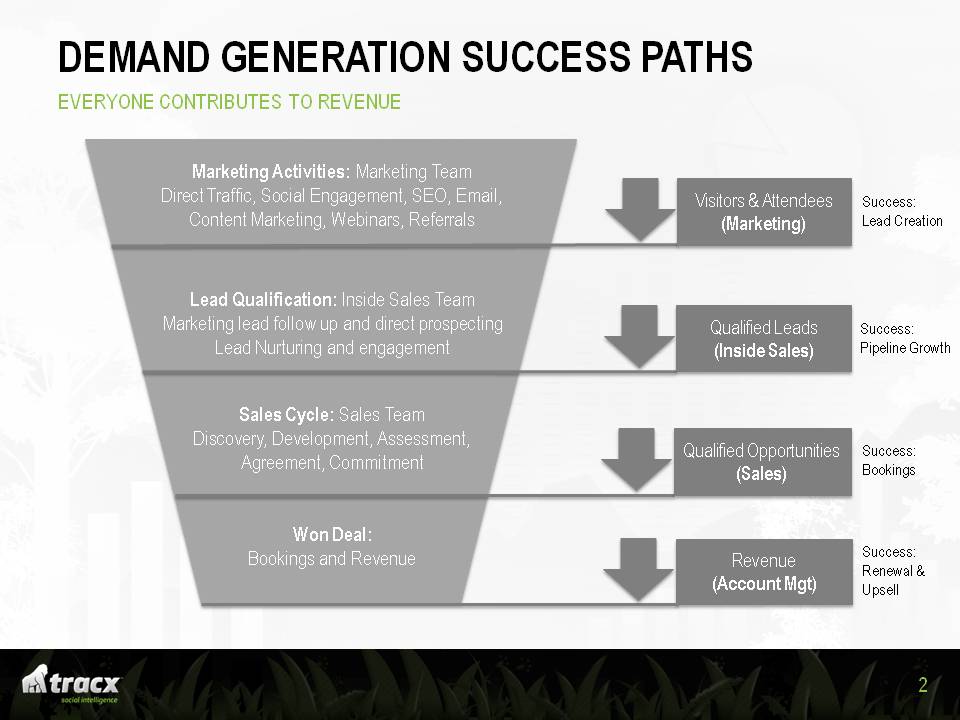
I include a chart below from a recent board presentaiton from my portfolio company, tracx (a SaaS social intelligence platform) that frames the multi-stage process in a particularly clear manner.

07132013 Sales Board Deck slide 28

To read more on this topic, here are a few books / blogs I recommend:

Related articles

Scaling is Hard
Scaling is Hard, Case Study: TripAdvisor
Sales Metrics | Looking Past the Same Old Sales Metrics | Domo | Blog
Scaling is Hard, Case Study: Akamai
An Initial Sales Rep Comp Plan to Lower Your Stress Level, Increase Cash, and Make Everyone a Lot of Money

Don’t Forget the “Tech” in “AdTech”

Today's IPO by Tremor Video is seen by many as a harbinger for the adtech community (full disclosure:  Tremor Video is a Flybridge portfolio company).  Rightly so.  Tremor is the first public offering of an adtech company since Millenial Media's IPO in April 2012.  One can argue how successful the Tremor IPO was, and the broader industry implications, based on the first day's opening price and trading, but the real test of these offerings is what happens next – how companies perform and execute over the next few quarters.

One thing that is clear, though, is that the advertising community would be wise to keep an eye on the "tech" portion of "adtech".  I have argued in the past that software is eating marketing.  Simply put, technology is radically transforming the marketing function and the role of the marketing professional.  The flow of advertising dollars into digital, addressable media is well-documented and well-understood.  It is estimated that in 2013, $100 billion will be spent on digital forms of advertising, representing more than 20% of the total advertising market and continuing to grow rapidly in share  (see chart above).

Less understood is that managing digital advertising is far more complex than its analog counterpart.  Advertising agencies have retained their industry wide hegemony as a result of this complexity.  With so many new technology vendors popping up and so many immature point solutions being deployed, the core competence of agencies has gone from being great at relationship managemnent to being great at technology platform management.  As DataXu's Mike Baker likes to say, Mad Men have become Math Men.

But, in every industry, software improves and gets simpler and simpler.  Technology platforms gain in scale, become more mainstream and training programs become more mature.  As all this happens, agency services are required less and less.

So, the lesson that may get loss in the Tremor IPO hoopla?  Agencies are being transformed.  Technology companies are sweeping into the advertising industry, much like they did in marketing (see Salesforce.com, Eloqua/Oracle, Exact Target/SalesForce, Neolane/Adobe).  And the days of getting the job done with thin technology in combination with armies of bodies are over.  To be a valued, strategic player in the market, you had better have a thick, differentiated technology stack.

The Productivity Paradox

Think about all of the amazing technology innovation that has impacted businesses over the last three years.  Since 2011, we have seen an explosion in cloud computing, in mobile, in technology-enabled business services and in globalization.  All of us feel more productive as professionals and our businesses feel more productive instutionally.  As a nation, the US must be cranking in productivity.  Killing it — particularly after rebounding from a recession, right?

Now look at the latest US productivity statistics (Q1 was just released last week):

  • Q1 2013:  0.5% (annualized)
  • 2012:  0.7%
  • 2011:  0.6%

In other words, despite three years of amazing innovation and growth, we don't seem to be gaining in productivity.  What's going on?  

In 1986, observing a similar phenomenon on the heels of the PC revolution, MIT Economist Robert Solow quipped:  "You can see the computer age everywhere but in the productivity statistics."

Those of us that are immersed in the innovation economy may find this hard to believe, but we are not, as a whole, actually more productive when we are in the midst of an innovation cycle boom.  New technologies take time to absorb, refine and make mainstream.  Computer software can be reprogrammed quickly.  Humans can't.  

Forrester captured this phenomenon nicely in a chart they produced a number of years ago predicting "the next big thing" in computing:

Forrester chart

We can't imagine a world without broadband wireless, iPhone 5s, iPads and the cloud.  But we've got a lot of work to do to absorb these amazing technologies and make us all more productive as a whole.

Should I Join an Accelerator?

Today is Demo Day for Techstars Boston.  I love Techstars Demo Days for many reasons, not the least of which is the amazing community that gathers to hear the brief, well-rehearsed pitches from the various start-ups who have spent months planning for this big event.

As accelerators like Techstars gain in popularity, many entrepreneurs wonder whether they should be applying and, if admitted, joining an accelerator and when they shouldn't.  I get this question a lot from my students, particularly as they're graduating and scrambling to figure out where they should start their company, how to raise capital and whether an accelerator is right for them.  Here are a few guidelines that I would think about if I were an entrepreneur making such a decisions.

First, broadly speaking, accelerators serve a very valuable role in the entrepreneurial ecosystem.  In many ways, as Eugene Chung of Techstars NY points out, they are like finishing schools for entrpreneurs.  Like a college, there is a rigorous admissions process.  And once admitted, the participant receives an extraordinarily rich education, in this case in the field of entrepreneurship.  Also like college, the best accelerators represent valuable networks, where your "classmates" and even other alumni as well as boosters all become a part of your professional support system.  Finally, the brand of the network will always be associated with your brand.  Dropbox and Airbnb will always be known as "Y Combinator companies", which initially helped buttress their brand, and more in more is helping enhance the Y Combinator brand.

So with that in mind, here are a few reasons when I think an accelerator is a great choice for the entrepreneur:

  • Outsiders to the Entrepreneurial Community.  You are early in your entrepreneurial career and want to super-charge your entrepreneurial network.  To be clear, this is not a comment about age – you might be in your 50s and new to entrepreneurship.  But, as Launchpad LA's Sam Teller observes, "Across the board, accelerators provide one key value:  dramatically expanding your network."
  • Outsiders to the Particular Community.  Every major innovation hub in the world now has an accelerator and most have numerous (Boston alone has over a dozen).  If you are from outside that particular community, the accelerator is an amazing way to build a network in that particular city.  As Brad Feld points out in his book on innovation ecosystems, there is tremendous power in being connected to a hyper-local, dense entrepreneurial ecosystem.  Accelerators are magnets for the leaders in a given community – at Techstars Demo Days, it's always a "who's who" of that particular community.  The quality of the mentors at the many events and one-on-one sessions over the are course of the program is outstanding – typically, you can't get access to these people any other way.
  • New to Fundraising.  Accelerators pride themselves, and often measure themselves, on their ability to help their graduates raise capital.  For example, across nineteen Techstars classes in its four year history, over 70% of all Techstars graduates have raised capital (Techstars publishes an amazing chart that lists every company in every class and their fundraising status as well as employee count).  If you don't have existing relationships with investors, accelerators are great ways to establish instant credibility and an instant network.

That said, not all accelerators are created equal.  Just like with a college, your personal and professional brand will always be associated with that particular accelerator, so choose wisely.  Some accelerators specialize in certain domains (e.g., Rock Health for healthcare or Learn Launch for edtech).  Others have stronger reputations for fundraising vs. product development.

If you want to get a sense of the quality of the particular accelerator you are considering, you should ask around about them – graduates, senior entrepreneurs, VCs, start-up lawyers, bankers and accounting firms will all have their opinions.  One tech reporter, Frank Gruber, publishes an annual ranking of accelerators that is pretty good, although it leaves out hybrid organizations that aren't technically accelerators, like Boston's Mass Challenge (which is a contest) and NYC's First Growth Venture Network (which doesn't take any equity).

Accelerators are thus not for everyone.  If you are already well-connected to a particular entrepreneurial community, have a entrepreneurial track record and network, and are comfortable with your fundraising skills and relationships, then an accelerator probably isn't worth it for you.  But if those attributes don't describe you as an entrepreneur, an accelerator may be an excellent choice.

Now…off to demo day!

Immigration Reform – Senate Testimony

I was invited to testify at a Senate hearing tomorrow in front of the US Senate Committee on Commerce, Science and Transportation.  Below is my planned testimony.

(update: the video of my initial statement is below and the full hearing video is here) 

The immigration reform debate is near and dear to my heart and has whipped up the passions of many in the Innovation Economy, including Mayor Bloomberg, Mark Zuckerberg, and countless others.  It feels like, finally, we may get some positive movement on this and I'm honored to have the opportunity to help in any small way I can.

JJBussgang Senate Testimony – Immigration Reform – 5-8-13

http://www.scribd.com/embeds/139813328/content?start_page=1&view_mode=scroll

If you are inspired to lend your support, visit / contribute to:

I am a Bostonian

I was born and have lived in the Boston area almost all my life.  I went to school here, met my wife and married her here, built a family and pursued my career here.  I am a rabid fan of all the sports teams and love exploring and connecting with every nook and corner of this community.  Never have I been more proud of the resilience of my home town.  Never have I felt more meaning in the statement:  “I am a Bostonian.”  In the Flybridge partners meeting this morning — which was held at one of our homes as our office is a part of the crime scene and in “lock down” mode — we discussed where we were when we learned of the horrible events, how we felt, who we know who was touched by it all.  We checked in with loved ones throughout the meeting and fielded kind notes from friends and colleagues.

For those of you who have written, texted, tweeted and called with words of solidarity and support, thank you. The sensitivity and tenderness that my kids’ schools have shown
is another reflection of what an amazing community we live in.  We are all more bonded together by this sad experience.

The talk in the town is that next year’s Boston Marathon will be the greatest in history.  Many of my friends who have never ran before are thinking seriously about running in
it.  Many vow they will be at the finish line cheering the runners on.  Many more still
vow that the fundraising efforts next year will dwarf years past.  The theme throughout the city today is “we will persevere, we will thrive, this will not slow this great community down.”

The world is watching us and we intend to step up.

I am a Bostonian.