MBAs and Y Combinator: Oil and Water?

Michael Seibel of Y Combinator (YC) wrote a provocative tweet a few weeks ago, observing that MBAs who apply to YC appear ill-prepared. Below is the tweet and some of his follow-up observations.

Screenshot-2017-04-30_17.28.05

Although my day job is a seed-stage venture capitalist (at Flybridge Capital), on the side I teach entrepreneurship at Harvard Business School (HBS) – in particular, a 2nd year MBA class called Launching Technology Ventures (LTV) – and am proud of the fact that our students are performing very well in StartUpLand. Whether it’s unicorns like Cloudflare, Coupang and Grabtaxi, major exits like LearnVest or promising up and comers like Rent The Runway and Earnest, plenty of interesting companies have been created by HBS students right out of school in the last few years. And HBS alumni are proving to be effective and scaling and managing startups and large-scale tech companies years after graduation, not just starting them right out of HBS. Sheryl Sandberg/Facebook, Michael Bloomberg/Bloomberg, Mark Pincus/Zynga, Jeremy Stoppelman/Yelp, Meg Whitman/HP are among a few examples.

That said, I respect YC, its success in picking and training winners, and its immense experience as a startup pattern recognition machine. So I asked Michael for more detail regarding what he was seeing in MBA applicants so that we could make sure we’re addressing any gaps here at HBS. His feedback was interesting and I wanted to share it here (paraphrasing a bit and incorporating other feedback I hear in the marketplace):

  1. MVPs vs. Research – The knock on MBAs is that they classically spend too much time doing research and not enough time building a minimum viable product (MVP) and getting actual market feedback. We’ve done a good job of this at HBS, I believe, where Eric Ries (Lean Startup), Steve Blank (customer discovery) and getting out there and running experiments is hammered into each of our students in their first years. In the second year, we have electives like my class and others that emphasize this approach to company building. But clearly, we should be doing more, pushing our students to be builders not researchers.
  2. No Tech Co-Founder – We could have a robust debate about whether tech co-founders are critical given how many MBA startups have been successfully created without a tech co-founder (e.g., BlueApron, Warby Parker). That said, this criticism is an important one to address. Having technical proficiency is critical to being successful in StartUpLand and, further, having a technical co-founder helps immensely when it comes to MVP creation, iteration and general product development velocity. Velocity is one of the most important, least understood attributes of successful startups that is greatly enhanced by a technical co-founder. So, what’s HBS need to do here? Well, we urge students to mingle with their MIT counterparts, but that’s too passive. We’ve started an EIR program, but need more CTO types as EIRs. And Harvard is in the midst of moving its School of Engineering and Applied Sciences (SEAS) across the river to be co-located with HBS – and doubling its size (thanks, Steve Ballmer). In the last few years, CS50 (Harvard’s introductory computer science class) has been taught at HBS and this year, for the first time, a Code Club was created at HBS. Another major initiative – HBS is launching a joint MS/MBA degree, targeted at hybrid technical-business folks who want to enter StartUpLand. Good steps in the right direction, but clearly we need to do more. Next year, I’m determined to create more opportunities for organic mixing for techies given founders need time to get to know each other informally before leaping into a business partnership.
  3. Commitment. This one was the hardest to hear from Michael. He feels our students are not exhibiting full commitment to their startups but, rather, at times appear to be dabbling. I am sympathetic to his perspective on this. Like most VCs, I only invest in pigs not chickens. Too many MBAs are acting like chickens – not “all in” and exhibiting a willingness to pursue the startup no matter what. As Michael described, “One of our primary qualifications for getting into YC is whether this company would exist without YC.”  There is no hedging your bets in StartUpLand.

Speaking on behalf of my HBS colleagues, I know we’re determined to keep pushing our students on these and other areas to make sure that we are producing startups that are embraced by YC, Techstars and other top-notch incubators – never mind investors – rather than appear like strangers in a strange land.

Michael and I did a podcast to continue this conversation on the YC blog, which you can listen to (or read the transcript) here.

(by the way, if you want to prepare for your YC interview, read this and this)

Combining Tech and Biz – Harvard Launches A New Joint Degree

Image result for hbs

When I was a computer science undergraduate student at Harvard in the late 80s/early 90s, it was a decidedly uncool and obscure field. We were buried in the basement of the Science Center, coding in LISP and C++ on a UNIX minicomputer. The few of us who survived the brutal problem sets and all-nighters graduated with a strong foundation in software but zero insight into the technology business. Four years later, when I graduated from Harvard Business School in the mid-90s, we learned a ton about business, but nothing about technology.

As a tech entrepreneur, venture capitalist and Harvard Business School (HBS) professor, I have spent my 20+ year career trying to blend these two disciplines:  business and tech. Thus, I was thrilled with this week’s announcement that Harvard is creating a joint master’s degree between HBS and the School of Engineering and Applied Science (SEAS). Simply put, the new degree will focus on teaching geeks and techies the business of innovation and tech company management.

This program came together very, very quickly. My colleague, Tom Eisenmann, was one of the main driving forces and somehow managed in less than six months to design, create and secure approval for the program from both faculties and the Harvard board. The fact that SEAS is nearly doubling in size (thanks, Ballmer) and moving next door to HBS in Allston (thanks, Paulson), makes the collaboration between the two schools all the more appropriate and fitting. The benefits of teaching and inspiring future leaders at the intersection of these two important disciplines are immeasurable. I am so glad Harvard and its faculty chose to vigorously innovate in this area.

To learn more about the joint MBA/MS degree, which is accepting applications starting September 6th (!), go here.


The Empire Strikes Back: New York & Boston Are Unstoppable Tech Hubs

No doubt, the New York tech scene has had its ups and downs this year — but Sarah Kesller’s article looks back over the last few years particularly grimly and unfairly, starting with the title: “New York’s Unrealistic Dream of Rivaling Silicon Valley Should End with Etsy’s Collapse”.

In it, she reviews the punditry from 2010, declaring that all New York needed were a few anchor companies to breakout to become the next Facebook or Google.

Part of the Problem: Selection Bias

Unfortunately, that hasn’t played out due to a litany of missed expectations, which Kesller chronicles in detail. She notes that the stars of that period — Etsy, Foursquare, Gilt, Kickstarter, Meetup, Tumblr — have not proven to become the mega-unicorns that many hoped.

They have either sold or gone public at good but not Valley-level prices — like Etsy’s $1B public market cap, Gilt’s $250M sale and Tumblr’s $1B sale — or still exist at an uncertain point on their journey with unfulfilled expectations, such as Foursquare, Kickstarter, Meetup.

Kesller misses the more subtle but larger point that it is very hard to pick winners in StartupLand. While those six companies may not have been massive winners, there have been a few amazing companies emerge out of New York in the last few years that were not on anyone’s “top six” radar in 2010 (or even founded!).

Reality: New York is Cranking

Examples of emerging breakout companies based in New York include:

  • WeWork: worth $20 billion in their latest round
  • Vice: widely reported to be worth $4.0 billion
  • Jet.com: sold to Walmart for $3.3 billion in cash and stock
  • Oscar: widely reported to be worth $2.7 billion
  • BlueApron: widely reported to be worth $2.0 billion and preparing an IPO
  • MongoDB: widely reported to be worth $1.5 billion in its last financing*

* Which I can neither confirm nor deny as we are major shareholders having co-led the Series A.

I remain very optimistic about the next 5–10 years in the New York tech scene. Through our work (led by my partners David Aronoff and Jesse Middleton), I am seeing ambitious entrepreneurs pursuing amazing and diverse market opportunities every day.

The recent IPO of Yext (trading at $1 billion) is a solid step forward for the New York tech scene and there are dozens of private companies worth +$500 million that are growing fast and have tremendous potential. Flatiron Health is pursuing the ambitious goal of fighting cancer with data. Buzzfeed has dramatically changed the way media companies think about information dissemination.

Others like Appnexus, BetterCloud, Compass, Sprinklr, Warby Parker and Zocdoc are an amazing cohort worth watching.

And Don’t Forget Boston!

Interestingly, in contrast, the Boston tech scene has seen the reality run ahead of the hype. Boston’s historical strength in life sciences, enterprise software, cloud, big data and artificial intelligence are all proving to be very fruitful.

For the Boston tech scene, it has been an amazing few years for some very valuable, emerging anchor companies.

I did a quick analysis of what has happened to the value of today’s top six emerging anchor companies (measured by market cap) in the Boston innovation scene from 2010 to 2017. I used Crunchbase’s data to estimate the private valuations in 2010 by using a simple rule of thumb regarding ownership sold in their last round of financing or the initial market cap at the time of their IPO if it happened close to 2010.

The results in the chart below are pretty dramatic. This cohort of Boston companies — Demandware, Hubspot, Logmein, TripAdvisor, Vertex and Wayfair — was worth $15.6 billion in 2010 and are now worth $51.2 billion in 2017.

That’s a 3.3x increase! This increase compares favorably to the Russell 1000 index, which increased only 2.0x during this same period.

The conclusion? Sarah needs to be careful about selection bias, I am still very bullish about the New York tech scene (where Flybridge continues to invest roughly half our fund) and the Boston tech scene has had an unheralded strong run.

Like everything else, it just takes a bit longer than we all might have anticipated. Hang in there, New York — and keep pedaling!

Special thanks to Rashana Lord for helping me collect and analyze the data and Michael Gasiorek of StartupGrind (where this post originally appeared) for editing assistance.

Hacking Growth by Sean Ellis

Hacking Growth: How Today's Fastest-Growing Companies Drive Breakout Success by [Ellis, Sean, Brown, Morgan]

One of the cool things about StartUpLand is that it brings innovation to organizational design, not just old-line industries. Lean Startup methodology, customer discovery and agile development are among just a few managerial innovations that started in StartUpLand and swept through corporations large and small, young and old.

Another one of those high impact, general organizational innovations is the rise of the Growth function. I have written about this phenomenon a fair amount, including this Harvard Business Review piece, Every Company Needs a Growth Manager.  The founder of this movement is Sean Ellis, a brilliant marketer who has been a part of successful startups like LogMeIn and Dropbox and become so passionate about the growth movement that he started a company and community dedicated to it: GrowthHackers.com. Now Sean has written a book, in conjunction with Morgan Brown, called Hacking Growth, which is being released tomorrow. Having had the opportunity to read it in advance, I can tell you it is a terrific book and belongs up there with Geoffrey Moore, Eric Ries and Steve Blank’s books as a fundamental part of the canon of StartUpLand (since, as everyone knows, entrepreneurship is like a religion).

I have long admired Sean’s work and have had him as a guest in my HBS Entrepreneurship class, Launching Technology Ventures.  I preach the use of his “40% test” to all my startups and students (i.e., would > 40% of your customers be very disappointed if your product were to disappear?). Thus, I had high expectations when I learned he was writing a book that would codify his decade of experience launching, building and advising growth teams.  Reading the book, I was not disappointed.

Sean and Morgan cover the key elements of what the growth function does, how to build it, operationalize it, measure it and ensure success. Chock full of case studies and practical examples, the book gives a practical guide for the practitioner. In addition to synthesizing his best blog posts (and others) on the topic, it covers new ground by providing more detailed, pragmatic frameworks (e.g., how to measure and prioritize growth ideas using the ICE method:  assessing impact, confidence and ease). It also introduces a concept I love, “channel/product fit”, which provides six factors for ranking potential acquisition channels, assisting with prioritization (based on a technique used at Hubspot by another extraordinary growth leader, Brian Balfour). The step-by-step approach to hacking acquisition, hacking activation, hacking retention and hacking monetization will be invaluable for executives at companies of any size.

Some critics have claimed that Growth Hacking is just a fancy name for Marketing. In response to this question, Sean joked with me once that he invented a new label because the marketing function was valued so lowly in StartUpLand as compared to product and sales functions. Whatever you call it, the insights and rigorous approach behind enlisting cross-functional teams to break down silos and use out-of-the-box, creative thinking to conduct rapid, real-time marketing tests is a major innovation that deserves study. Reading Hacking Growth is a good first step in that direction.


Advice to Grads: Join A Winning Startup (v. 2017)

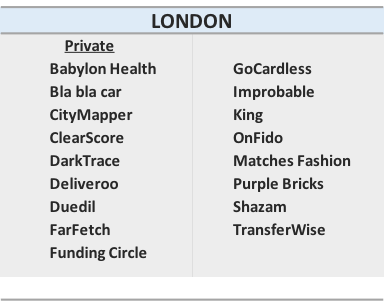
It’s that time of year again! Graduating students hungry to dive into the startup community (aka StartupLand) are eager to start their careers but struggle to select the right, specific opportunity. Each spring, I provide a comprehensive list of exciting, growing, hiring startups–both private or recently public–that are worthy of consideration as places to start or continue a career in StartupLand.

Before we get into the companies themselves, I suggest checking out my post Seeking a Job in Startup Land, where I give some advice on how to select the right company for you. Once you have reviewed this framework for deciding what you’re looking for, this post will give you a list of over 350 companies to research and approach.

As usual, the list is compiled and organized based on location since I believe in selecting a geography to plug in to (and contribute to) a community and ecosystem. I received fantastic input from angels, entrepreneurs, lawyers and VCs across the world, helping me pressure test and compile this list (note: Flybridge portfolio companies are in blue). I’m sure I made many mistakes and omissions, which are all my own. Feedback welcome!

Picture1.png

Picture1.png

nyc.png

Picture1.png

Picture1.png

Picture1.png

ATL: Kabbage, MailChimp

CHI: AvantCredit, BucketFeet, Civis Analytics, Dough, Inc., Fooda, Groupon, Iris Mobile, Kapow, Narrative Sciences, Raise.com, RemoteYear, ShopRunner, Shiftgig, SpotHero, SproutSocial, Uptake

CO:  FullContact, Ibotta, LogRhythm, Rally, SendGrid, Sympoz, TeamSnap, VictorOps, Webroot, Welltok

DC: 2U, Cvent, Optoro, Sonatype, Tracx, Vox Media, WeddingWire

SEA: Apptio, Avalara, Avvo, ExtraHop, Julep, Juno, Koru, Peach, Porch, Pro, Redfin

UT: Bamboo HR, Canopy Tax, Domo, Health Catalyst, Hirevue, InsideSales, Instructure, Lucid Software, Observe Point, Pluralsight, Qualtrics, Solution Reach, Workfront

That’s it! Edits/suggestions welcome. Special thanks to all those who provided me with input (who shall go nameless to protect the innocent) as well as my colleague, Nick Shanman.

How To Raise Your First Round of Capital

I gave a presentation this afternoon to my Harvard Business School class about how to raise your first round of capital. For those interested in seeing my advice on this topic as a former entrepreneur turned VC who has written a fair amount about fundraising, here are the slides:

I welcome any feedback or stories you might have!

Why “Ops” Is Taking Over Startup Land

ops-logo

A little over a year ago, I wrote that for startups, the Secret Weapon for Scaling was Sales Operations.

Since my writing about the importance and value of Sales Operations (where there are now 11K job openings on LinkedIn for this role), I have observed with great interest the explosion of operations functions in every function in Startup Land (a less geographically biased way of referring to the world of startups than “Silicon Valley”). Here are a few examples:

  • Business OperationsOne of my talented HBS students works for the finance department at Pinterest in a job titled “Business Operations”. I have seen many of my portfolio companies create this role under the CFO as a complement to FP&A (financial planning and analysis). Whereas the FP&A function is typically responsible for instrumenting the financial metrics and reporting them, the Business Ops function has emerged as the group that interprets the strategic implications of the business metrics more broadly and then formulates and drives new initiatives cross-functionally to address key issues. For example, how do you measure the success of a new product launch — and what do you do post-launch about the results you do measure? Business Ops focuses on decisions, not just data, and then helps operationalize those decisions within a startup. A quick LinkedIn search shows 15K openings for Business Operations, 15M title holders in the network, including companies like Circle, Lyft, NerdWallet and many others.
  • Product Operations: One of my portfolio companies, DataXu, recently created and filled the position head of “Product Operations”, a role that reports to the CTO who manages the entire 150+ product and engineering team. That executive will be responsible for measuring the product development process and implementing the necessary changes to make it more effective. They are also charged with training new hires and managing vendors. In short, they are like a “COO” or “VP of Ops” on behalf of the product organization. DataXu is not alone in hiring for this role. A quick LinkedIn search shows 6K opening for Product Operations and 200K title holders, with executives holding this title at growth stage companies like Fuze, Sonos, Wayfair and many others.
  • Marketing Operations: One of Flybridge’s marketing advisors has been discussing with me the rise of this role. The Marketing Ops role has been created because of all the data coming out of marketing automation tools and other systems. Marketing Ops makes sure that the right leads are being transitioned to sales in the right way and that the sales reps are using the sales force automation systems properly and that they are integrated with the marketing automation systems. Marketing Ops might be the group that scores the leads, tracks them through the sales process and does the win/loss post-mortem analysis. Watching the data, making sure it is integrated across the organization, managing the marketing systems, and reporting cross-functionally on key marketing metrics are all the jobs of the marketing ops function. Our portfolio company, MongoDB, has a nice job description for their open position — Director of Marketing Automation and Operations — that tells the story well. There are 5K openings on LinkedIn for this role and 9M people with that title in their profile.

Why has Startup Land suddenly gone bonkers over Ops roles and embedding them within every function? I think the simple answer is Big Data and process maturity. As companies stabilize their business models and find product-market fit, they begin to adjust from a hunch-driven operating model, where decisions are made by the founders in large part on gut instinct, to a metrics-driven model, where decisions are made by professional managers based on data. With the availability of so much data across all functions to professional managers, they need more analytical and operational horsepower to synthesize that data and derive insights from them that drive the business. Hence, the thirst for an operations staff—analytical, mid-level executives who can get into the weeds, derive insights and turns insights into action cross-functionally.

I have been preaching this message to all my portfolio companies: if you’re a startup executive and haven’t begun to operationalize your organization, you’re at risk of falling behind.

You Know What’s Cool? $1 Billion in Revenue…and Still Run by the Founder

Image result for 1 billion image

As 2016 comes to a close, one local company here in Boston is about to cross $1 billion in revenue: athenahealth. Going from zero to $1 billion in revenue is an extraordinary achievement, particularly for a company that is also very profitable (which athenahealth is).

Here is something even more extraordinary – the company is still run by its founder and CEO, Jonathan Bush. In fact, the number two executive in the company, COO Ed Park, is also a founder and is just now stepping down after nearly two decades running the company.

And here is something even more extraordinary still:  look around Boston, and you find that four of our emerging anchor companies have also just recently crossed $1 billion in revenue, are very profitable (except for Wayfair, who is free cash flow positive) and are still being run by their founders. Put this list on one chart, and it’s pretty remarkable:

Company Founder/CEO 2015 Revenue ($M) 2015 Adj EBITDA ($M) MarketCap ($B)
Akamai Tom Leighton 2,197 897 11.3
athenahealth Jonathan Bush 925 184 3.8
TripAdvisor Steve Kaufer 1,492 466 7.2
Wayfair Niraj Shah 2,250 -16 3.2

As 2016 comes to a close, it is worth celebrating the extraordinary achievement of these four tenacious and talented entrepreneurs. At a time when there is a lot of cynicism regarding unicorns and paper-based valuations in Startupland, it is refreshing to see four founders who not only took their company from zero to IPO, but continue to lead their companies to over $1 billion in revenue and beyond.

For more about the stories of three of these companies, you can see a few mini-case studies that I wrote a few years ago here:

Again, hats off to each of these four founder/CEOs. Their stories are definitely worth studying!

To Hack.Diversity, We Need to Come Together

Last January, I read a Bloomberg BusinessWeek cover story, Why Doesn’t Silicon Valley Hire Black Coders. I was struck by it because it went to the heart of an issue that has bothered me for years.

The innovation economy has two fundamental, related problems threatening its growth and sustainability: (1) a severe lack of technical talent, leading to a persistent hiring shortage; and (2) a severe lack of diversity, leading to a monolithic perspective.

For some reason, and despite generally good intentions, the demand for talent and the supply of diverse talent has not corrected itself naturally. My conclusion, after reading the article and talking to many experts in the area, is that tech’s diversity problem is a market failure due to a fragmented talent pool of diverse candidates, under-resourced recruiting functions at startups, cultural friction and social networks that don’t naturally overlap. This problem was one that needed an intentional, strategic solution.

Inspired to address this complicated issue, a group of private and public sector leaders in Boston has been meeting over the course of this year. Today, we are pleased to announce the launch of Hack.Diversity, an initiative to increase the breadth of talent into our innovation economy. The program will be managed by the New England Venture Capital Association, which seemed an appropriate place given its role as a hub in the innovation ecosystem (and Hack.Diversity is similar to the student internship program, TechGen).

Hack.Diversity is bridging the gap between Boston’s innovation economy and communities of color. The program will recruit, train, and mentor Black and Latino computer science and engineering graduates throughout Massachusetts, and create a pipeline of opportunity into the innovation economy, while also coaching our companies on diversity and inclusion. The goal is to address both the severe lack of diversity in the technical ranks of our top, innovation companies and help students of color find attractive career opportunities in technology. Our first talent partners are Bunker Hill Community College, Resilient Coders, UMass Boston, WPI and Year Up. Our first employer partners are Carbonite, DataXu, Hubspot and Vertex Pharmaceuticals. In addition, we are building a mentorship network of dozens of executives of color in the Boston tech sector to link up one on one with each intern to help coach their pathway to career success.

A few articles written about the initiative can be found here:

If you’re interested in being a part of the program — as a mentor, employer, donor or aspiring participant, check out the website: www.hackdiversity.com.

If we can bring the two Bostons together to address the inequality and divisiveness in our community, we can create a shining example for others throughout the country.

Why Liberal Arts Majors Make Great Product Managers

There is a canard rampant in Startup Land that you need to have a computer science or engineering degree to be a great startup product manager. As a computer science major whose first job in tech was as a product manager, and as someone who has worked with (as both an entrepreneur and venture capitalist) and taught (as a professor at Harvard Business School) hundreds of product managers, I can tell you that this line of thinking is simply bull. And it may be leading to perpetuating the industry’s gender imbalance.

Let me explain by first focusing on what the product manager job requires.

What Is The Job?

An effective product manager is an entrepreneur, strategist, technical visionary, cross-functional team leader, and customer advocate all rolled into one. They try to understand what it means to walk in the shoes of the customer — what their problems are, what their environments are like, what they read, who they talk to, who they listen to, what their worries are in life. And then they try to extrapolate those insights into personas they can use as an anchor for product design decisions.

At a high level, product managers have three primary responsibilities:

1. Defining the product to be built — whether a new product or an evolution of an existing product — through a customer discovery process.

2. Negotiating and securing the resources to direct towards product development, or prioritizing the already allocated resources

3. Managing product development, launch, and ongoing improvement by leading a cross-functional team — the team members report directly to someone other than the PM, however, so while the PM has considerable responsibility, you might also have little formal authority over other staff members.

The product manager role is a general management position, so product managers tend to be generalists rather than functional specialists. Some of the best product managers are simply great communicators. They’re clear thinkers who have strong interpersonal skills and good judgment. It’s more about character and makeup and the broad skills you develop either in a professional or graduate environment, where you learn to be an effective communicator, a good writer, and a good interpersonal communicator. Where you learn to make decisions crisply. Where you learn to handle ambiguity.

Guess what? Those skills are all consistent with a liberal arts education. As Fareed Zakaria puts it in his book, In Defense of a Liberal Arts Education:

A liberal education teaches you how to write, how to speak your mind, and how to learn — immensely valuable tools no matter your profession. Technology and globalization are actually making these skills even more valuable as routine mechanical and even computing tasks can be done by machines or workers in low-wage countries. More than just a path to a career, a liberal education is an exercise in freedom.

Yes, it helps to be technically proficient, but for that, take an online class or two at our portfolio company, Codecademy. Great product managers need to know how to talk to engineering, but that’s communication not coding. They need to be effective in evaluating decisions and drawing on business judgment, but that’s analytical thinking not analytical programming.

A Few Profiles

Let me share a few profiles of amazing senior product leaders that I know by way of example:

  • Yasi Baiani, a senior product leader at Fitbit, the wearables leader that has a market capitalization of $3 billion. On the side, Yasi is about to embark on teaching entrepreneurship and product management at her alma mater, Berkeley. She majored in business.
  • Melody Koh is head of products at BlueApron, one of the hottest private companies in NYC, a revered unicorn, and rumored to preparing for a 2017 IPO. She studied commerce and economics at the University of Virginia before entering Startup Land.
  • Adam Medros is head of products at TripAdvisor, where he has been for over twelve years, helping lead them to a nearly $10 billion market capitalization. Adam’s major before joining Startup Land? Economics and German at Dartmouth.

Guess what each of these product leaders has in common? Spectacular communication skills, leadership ability, product passion and business judgment.

Why This Matters

In addition to making sure startups are open to hiring and training the very best, I am drawn to this topic because I think it results in a subtle barrier for women to become entrepreneurs and venture capitalists. The prevailing wisdom is that the best entrepreneurs are former product leaders. And there is a prevailing wisdom that former entrepreneurs make the venture capitalists. Therefore, if you accept the prevailing wisdom to be that only former coders can become great product leaders, you are limiting your entrepreneur and venture capital funnel to a narrow pool of candidates, with 88% of engineers being men. That’s bad policy on many, many dimensions.

But I am passionate about this topic for another reason. I love the product management function — it is where I started my own career — and want to see the discipline be an excellent opportunity for everyone. That is why I continue to teach about it, write about it and talk to my portfolio companies about it.

So stop telling folks they need to be former engineers or computer science graduates to become product managers. Hell, hire a Symbolic Systems major and watch what magic can happen.