Why Entrepreneurs Seem to Be Growing Fangs

One of my favorite business school professors, Andre Perold, used to like to say that in every transaction in the financial markets, there are only two types of actors:  wolves and sheep.  As you might expect, the wolves have the edge in the encounter, due to superior market information or negotiating position.  If you find yourself in a market transaction and don’t know for sure that you are the wolf, then, sadly, you are the sheep.

Venture capital investors are historically accustomed to being the wolf.  During most periods, there has been a supply and demand imbalance that favors the VCs.  Entrepreneurs needed a lot of money, there were only a few VCs with money (it’s a shockingly small industry, with less than 500 or so active firms, according to the NVCA), and the VCs got to sit back and leverage their position of superior information and insight to choose their deals and drive favorable terms. 

In recent years, this imbalance has been turned upside down.  Entrepreneurs need less capital – even life sciences and cleantech start-ups are applying lean start-up methodology to be more capital-efficient – and information about VC deals is more transparent than ever (15-20% of all VCs now have blogs and the amount of information publicly available about how the business works is easily 100x as compared to 10 years ago, when I was an entrepreneur raising VC money).  Thus, for particularly “hot” companies, when there is momentum and competition, the entrepreneurs have become the wolves, and the VCs find themselves donning sheep’s clothing. 

As a result, many VCs – particularly bigger funds – are chasing “hot” deals aggressively, irrespective of price.  Facebook, LinkedIn, Groupon, Zynga, Twitter and many others are able to raise capital at extraordinary valuations.  For these investments to pay off, the investment thesis is based on a strong IPO in the future.  But the wrinkle in these momentum investments is that the currently weak IPO market is stretching out time to liquidity more than ever.  Thanks to their position as the wolf, founders (and angel investors) can often get liquidity from their late stage investors (particularly through Digital Sky Technologies – a Russian Bear in the transaction mix?).  

But the VCs, and in turn their LPs, are left holding an illiquid bag.  One LP complained to me the other day:  “The founders get liquidity, the angels get liquidity, and the pressure to go IPO is taken off the shoulders of the board and management team.  All fine and dandy – but where’s my liquidity?!”  A little IRR math shows the price of this elongated time to liquidity – a 5x return in 5 years yields a 38% IRR.  If the VCs decide to allow founder liquidity and put off an IPO, they’re likely taking on an incremental 3-4 year holding period (most major shareholders don’t get liquid until 1-2 years after the IPO).  To achieve that same 38% IRR in 9 years, a 20x return is required!  If the founders take money off the table, they are incented to go for the bigger win and don’t mind taking the time to get there.  But the early-stage VCs might certainly have preferred a $250 million exit and immediate liquidity to waiting four more years for the billion dollar exit – and the same IRR. 

Some VCs are well-positioned to chase the hot deals and patiently back the big winners.  Others are better off investing in capital-efficient businesses and taking the $100-200 million exits when they come along, even if it means selling their best companies too soon (“We are suffering from PME – pre-mature exit,” one micro-VC confided with me last week).  

Which path is the right one?  And who has the edge in the market flow in the coming years?  No one knows for sure, and every situation is unique and must be evaluated as such.  But with so many options to choose from, those entrepreneurs I’ve been noticing with larger fangs seem to be smiling more than ever before.

Two Venture Capital Industries – But One Lean Start-Up

Fred Wilson posted a blog last week regarding the "Two Venture Capital Industries" — observing that the Internet/software industry, where he invests, has undergone great change due to the lower-cost model (commonly known as the "lean start-up" movement) but the more capital-intensive industries, such as life sciences and cleantech, where the fundamental economic model has not been altered.

The post is a great one, and it raises something I've been thinking a bit about lately, which is whether the lean start-up approach to building start-ups can be applied to industries beyond Internet/software.

HBS Professor Tom Eisenmann is creating a course next spring on "Launching Technology Ventures" where he is going to delve into lean start-ups, finding product-market fit, what are the key start-up activities before product-market fit and what are the most important activities afterwards, and other salient topics.

In my role as an EIR at HBS this year, I'm teaming with Tom on this course.  The case studies will go beyond Internet/software start-ups in exploring how other sectors can apply lean start-up theory.  One of the reasons I have so much personal conviction of the breadth of these theories is that there are two companies in our portfolio – one a clean tech and the other a life sciences – that have applied parts of the lean start-up methodology very effectively. Their stories help illuminate the opportunity for others.

The clean tech company is Digital Lumens, recent Innovation award winner at the World Economic Forum.  We seeded the company, and founding entrepreneur Jonathan Guerster, with a mere $500,000 to explore a thesis around software-controlled, industrial LED lighting.  Jonathan recruited a technical team out of Color Kinetics and built a proof-of-concept.  We then raised a $5 million Series A, hired an outstanding CEO (Tom Pincine), and the company built v1.0 of the product.  With the success of v1.0 behind it, the company sought out a few customers to work through the kinks.  Once that was done, and rapid product iteration cycles, the company raised a Series B and is now scaling sales operations.  If you didn't know the company was a demand-side energy technology company, you would think the above description applied to a Web 2.0 company.  Digital Lumens may require 10s of millions of dollars end-to-end, but just because it's a capital-intensive business, doesn't mean they couldn't apply lean start-up approaches to change the risk-reward profile for the early investors.

Similarly, Predictive Biosciences has been on a lean start-up path.  That sounds odd to say for a company that has raised a total of $56 million to pursue a very big vision for urine-based biomarkers (pee in a cup and Predictive will tell you if you have cancer – and what type).  But the initial investment we and Highland made was a mere $500,000 each to spin the IP out of Children's Hospital, hire an initial technical team to build the product/prototype, and figure out which market to target and how.  Only then did we raise a $10 million Series A, and even that capital was deployed in a very focused, test and learn fashion until the initial market (bladder cancer) was identified and vetted.  Again, many of the same lean start-up processes that Mint.com or Xobni or others have deployed in the Web 2.0 would feel very natural to  the dozen PhDs running Predictive.

So, yes, the cost revolution impact to one type of VC investing has been enormous.  But the lessons, frameworks and paradigms can be applied successfully to the "other" VC type of investing as well.

Back to School Blog: An Open Letter to Boston-Area Students


(Warning:  the
following blog post will seem parochial for all readers outside of the Boston area.  Sorry about that.  The message applies to every aspiring innovation hub.)

Dear Boston-area student,

Welcome (back) to the Top
City of the Global Innovation Economy
! 
It’s sure been quiet around here without you.  I know how excited you are to hit the books
again – cram for exams, stress about your careers and freeze your butts off
during the long winter months.  Good
times.

But here’s what’s great about having you here.  You provide the fuel that makes our
innovation economy hum.  Every year, you
show up and shake up our assumptions about what’s new, what’s hot and give us a
glimpse of what’s over the horizon.  And
for that, we are super-grateful, even if we don’t always do a good job showing
it.

So here’s a little advice for you – do us all a favor and
plug in to the community that surrounds you. 
Get engaged and integrated.  There
are a crazy number of opportunities and venues for you to show up and
network.  Close your laptops, turn off
your iPhones, jump on the T and get out there and participate in the local
innovation ecosystem. 

Here are a few of the things you should have on your
must-do/must-see/must-read hit list:

  • Stay in MA – this
    is a mico-scholarship program that allows you to attend the incredible
    array of industry networking events for free.  Just sign up and show up gratis to get
    savvy in your favorite area of interest, whether it’s clean tech, bio
    tech, web 2.0, mobile, whatever.
  • DART Boston – The
    start-up game can be a lonely one. 
    DART Boston
    makes it social and fun.  It’s a
    group of 20-something peers who are engaged in the start-up game and
    hungry for knowledge, perspective, mentorship and dialog.  They get together periodically for
    social hangouts and learn sessions and are about as plugged in a group of
    young, ambitious folks as you can find in the city.
  • Mass Challenge – Our governor, Deval Patrick,
    has huge religion when it comes to fueling the innovation economy.  As such, he helped create Mass
    Challenge, “the world’s largest start-up competition”.  Go to the waterfront, swing by the
    Barking Crab and buy yourself a lobster roll, and then walk over to Mass
    Challenge HQ and see the open start-up haven that is forming.  They have multiple events and guests
    every day to fuel the young start-ups that are being incubated there.
  • Other blogs and Twitter tips – There are
    dozens of blogs and valuable Twitter streams from local VCs and
    entrepreneurs.  One of the
    best summaries of them is here
    , provided by a local Google exec.  We have more VCs per capita than
    anywhere in the US.  You can’t grab a tall decaf latte in Cambridge, Back Bay
    or half of the western suburbs and not bump into a VC or angel
    investor.  They particularly tend to
    hang out at Harvard, MIT and Babson, so don’t be shy about visiting those
    schools and attending those talks if you don’t see them happening in your
    neighborhood.  I did a talk last
    year at HBS entitled,
    “What Makes Boston’s Technology Start-Up Scene Special?”
    which might be a useful orientation for you as well.

Look, there’s a reason Boston
is consistently ranked as one of the top innovation cities in the world.  We value geeks (Bill Gates and Eric Schmidt
draw bigger crowds than Lady GaGa when they come in town to speak), encourage
rebellious thinking (see:  Minutemen,
American History), worship start-ups (why else would a World Championship
winning pitcher,
Curt Schilling, aspire to become a successful start-up CEO as
a second act?) and generate our fair share of big winners (see:  EMC, Akamai, Genzyme, TripAdvisor).

But, honestly, the real reason so many communities try to
emulate what we have is because of you. 
You keep it fresh, every September. 
Thanks for showing up.  Now get
out there and mix it up.

Who Will Champion Entrepreneurship?

Grand-tetons

I love Jackson Hole, Wyoming.  It is one of the most extraordinarily beautiful settings in the world.  One cannot help being in a good mood when observing the breathtaking wildlife, open sky and the awe-inspiring Grand Tetons.

Thus, reading the reports from the August annual economist confab in Jackson Hole could not have been more depressing.  If the practitioners of the dismal science sound this pessimistic amidst such an uplifting setting, what will their attitude be when they trade back in their cowboy boots for green eyeshades and return to their drab offices to stare at spreadsheets?  A usually staid Allen Sinai sounded positively hyperbolic, yet apparently spoke for many at the conference, when he told the New York Times, “I’m more worried than I have ever been about the future of the U.S. economy. The challenge is unique: poor and diminishing growth, a sticky unemployment rate, sky-high deficits and a sovereign debt that makes us one of the most fiscally irresponsible countries in the world.”

In his Oval Office speech on Iraq, President Obama acknowledged his concerns about the economy and declared, “Our most urgent task is to restore our economy and put the millions of Americans who have lost their jobs back to work…We must unleash…innovation…and nurture the ideas the spring from our entrepreneurs.”

So here’s what I don’t understand.  If everyone, including the president, believes that supporting innovation and entrepreneurship is the best path forward, why aren’t the policy leaders taking action?  Thomas Friedman of the NY Times has been hammering on this issue for the last year, calling on the president to “launch his own moon shot” and make innovation and supporting the start-up economy his top priority.

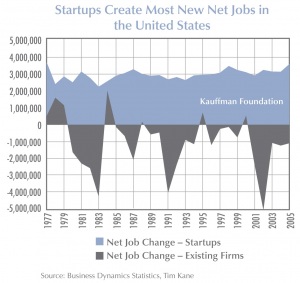
First, let’s review the data.  The Kauffman Foundation did a comprehensive study of historical job creation and, not surprisingly, found that small businesses are the main source.  “Without startups,” writes Senior Fellow Tim Kane, there would be no net job growth in the US economy.  This fact is true on average, but also true for all but seven years for which the US has data going back to 1977.”  See the following chart:

Job-creation-and-destruction1
 

But despite the obvious data and the presidential rhetoric, we are not seeing any action from policy leaders on either side of the aisle. It’s almost as if the policy makers think speeches exhorting innovation is more important than doing the hard work of pushing forward legislation that will actually positively impact the innovation economy.

I’m no policy expert, but it strikes me that there is a clear innovation agenda that has been put forward by those who are the most knowledgeable about the issues.  A few of the ideas being proposed seem obvious, but are stagnating due to a lack of leadership.  For example:

  • We need to make it easier for immigrants to start companies in the US.  The Start-Up Visa movement addresses this issue squarely in the head and yet the bill proposed by Senators Kerry and Lugar six months ago (!) appears to be caught up in the more partisan immigration debate.
  • Sarbanes-Oxley needs to be reformed.  We may have had too little regulation of complex financial instruments like credit default swaps and other derivatives, but we clearly have too much regulation being imposed on the public selling of the securities of $100 million companies that are very simple for investors to understand.  Why haven’t Facebook, LinkedIn, Zynga and many others gone public?  It’s just too onerous and expensive.  You want to unleash innovation?  Make it one-third as expensive for small companies to comply with public regulations.  There have been numerous proposals in the past to rethink Sarbanes-Oxley, we need to see some form of them come to light.
  • Other important policy ideas have been put forward by the National Venture Capital Association (NVCA) and others – such as patent reform, increased investment in broadband, increased investment in NIH funding, reforming the FDA approval process.

The amazing thing to me is that none of these ideas – and many others floating around the entrepreneurial community – require big dollars.  Instead, they require big leadership.  Where is that leadership going to come from?  Who will be our champion for entrepreneurship?  Ted Kennedy played this role in health care.  John McCain played this role in campaign finance reform.  Who will step up and be the champion for entrepreneurs?

 Here are a few other ideas:

  • We have two former venture capitalists in the Senate and House (Mark Warner and Scott Murphy), a former high-tech entrepreneur in the Senate (Maria Cantwell) and a former venture capitalist running the Small Business Association (Karen Mills).  They probably know what to do to unleash innovation in this country, but they’re just not empowered.  Why not cut through the hierarchy of party leadership and have the president create a special Bipartisan Commission on Entrepreneurship – similar to what has been done on September 11th and Deficit Reduction? 
  • When President Clinton was elected in 1992, he convened a televised economic summit, bringing together the best minds on the economy and conducting, in effect, a “national teach-in” for the broader public.  Let’s have the president convene an Entrepreneurship Summit – invite top entrepreneurs, VCs, angel investors to sit alongside policy leaders – and have TechCrunch.tv broadcast it.  Discuss immigration reform, Sarbanes Oxley reform, FDA approval streamlining and all the rest.  Imagine the impact that would have and the focus this would provide. 
  • Faced with criticism that he’s not in touch with business, President Obama has had a series of CEO lunches at the White House.  When you examine the list of invitees, it is shocking how few are entrepreneurs.  I counted two (Jeff Bezos and Howard Schultz) among 28.  And none of them are in the business of helping create the small businesses that create jobs.  The president’s lunch list needs to change radically and instead invite the leading thinkers in entrepreneurship and innovation to a series of lunches.  If accomplishing nothing else, it would force Brad Feld to wear a tie.

When you look at the exciting progress being made in global broadband access, the Human Genome, ubiquitous wireless access and devices, energy innovation and so much more – it is clear that we are living in an extraordinarily unique time, truly a golden age for technology and innovation.  If only we could get our policy leaders to take big actions to match their big rhetoric.  Then next year’s Jackson Hole conference might be a lot more fun for everyone.

 This blog post first appeared in PE Hub. You can follow me on Twitter: www.twitter.com/bussgang.


Backing Winning Teams

"Justice league image
 

One of the hardest things for an investor tries to gauge is:  what are the characteristics that make up a winning team?

A large venture capital firm was recently looking at investing in a follow-on round at one of my portfolio companies and shared an interesting data point with my CEO – the single most highly correlated factor that they found in analyzing hundreds of portfolio companies was actually a very obvious and simple one.  If the team had previously been successful and made money as a team, they were significantly more likely to be able to do it again.

Creating companies from scratch is very, very hard.  Too often than not, there are soap operas at start-ups and self-inflicted wounds that cause failure.  HBS Professor Bill Sahlman, in his seminal work on "What Do Venture Capitalists Do?" in 1989 (!), found that 65% of all start-up failures are due to people issues.

And so it would make sense that a team that has performed well together as a unit and (again, importantly) made money would have a leg up when embarking on a new company again, putting aside their domain knowledge, capabilities or execution skill.

This perspective is one of the factors behind our new investment announced today, SaveWave. The company is a spin-out from my old company, Upromise (acquired by SallieMae in 2006), led by a team I worked with over 10 years ago. The SaveWave team created and managed a successful, very profitable Internet consumer company and built an amazing national network of grocery and drug retailers comprising over 22,000 stores.  I'm really thrilled to have the opportunity to work with the team again to take this national network and provide a white label promotions and digital coupons platform across the industry. 

Other investors alongside Flybridge Capital include First Round Capital (Josh Kopelman), IA Capital (Roger Ehrenberg), Ron Conway, Founder Collective and Upromise founder/former chairman Michael Bronner. 

So what's the lesson for entrepreneurs who have not yet had a big success to build upon?  When evaluating a new start-up opportunity, look to join a team of folks that you would be excited to perform a second act with – and has the characteristics of being winners.  The alumni of almost every major successful start-up has spawned numerous other interesting companies.  I would argue joining a winning team, and bonding with that team in a manner that transcends the particular start-up you are operating in, is far more important than your specific role in the start-up.

Why So Serious?

 
FCP Team at CTW 7.0

Creating world-beating companies from scratch is hard.  Being an entrepreneur is a thankless job, with emotional highs and lows and, often times, too much drama.

Seven years ago, my partners and I decided we would create a unique weekend event in the summer for entrepreneurs, VCs and other special friends to gather with their families and blow off some steam. The singular goal in mind was to bring incredibly talented people together, who also happen to be very nice (or perhaps we bring very nice people together, who also happen to be incredibly talented) and create an environment where we can all relax and, at the Saturday evening costume party, be a little goofy.  There are times when we all take ourselves a little too seriously, and so we created this weekend as a way to ground everyone in the reality that we're all human, trying our best to build interesting companies, interesting careers, have fun and be fulfilled.

In that spirit, this weekend's Catch the Wave 2010 was another huge success.  At the risk of a bit too much transparency, here are some photos from this year's and past year's events (this year's costume party theme was "Alter Ego" – one with rich possibilies)… 

 
Tom as the Joker

Alignment Between Entrepreneurs and VCs

Alignment. 

You hear this word thrown out frequently in business conversations.  It is a wonderful thing to aspire to, but very hard to achieve.  Perhaps even harder to achieve in entrepreneurial settings between the venture capitalist and the entrepreneur, where the stakes are so high and the ever-present risk of dysfunctional behavior leading to a "Start-Up Soap Opera".

Ever since I began the research for my book, I have been spending time thinking about why VC-entrepreneur alignment is so elusive.  And so when the Kauffman Foundation asked me to give a presentation to their recent class of young VCs, I decided to take the opportunity to develop a few thoughts that teed up the key issues.

In short, I concluded that despite all the aspirational rhetoric about VCs becoming more "entrepreneur-friendly", there are structural reasons why VCs and entrepreneurs are not always aligned.  In negotiating term sheets, performing the inside-outside financing dance, discussing exit scenarios – and many other elements of the start-up journey - misalignment between VCs and entrepreneurs is common, natural and inevitable.

VCs and entrepreneurs have a hard time dealing with these areas of misalignment because they are human beings.  And like nearly all human beings, they have a hard time facing conflict dead on.  Conflict makes us uncomfortable.  No one wants to be the "bad guy/gal" and so try to gloss over real differences or sweep them under the rug. 

I argue instead that VCs and entrepreneurs should explicitly acknowledge these areas of misalignment and talk about them openly and directly.  Only by naming these points of conflict and appreciating the other side's point of view, can you really begin to develop the solutions to these points of conflict.  As Mark Pincus of Zynga told me when I interviewed him for Mastering the VC Game, "Don't be a victim.  Don't look at the [conflicts and drama] personally, look at them structurally."

Anyway, here's the presentation I gave the Kauffman folks the other day that laid some of these issues out.  I still consider it a work in process (like everything I do!), so let me know what you think.

Follow me on Twitter:  www.twitter.com/bussgang

Has Apple Jumped the Shark?

There's a famous moment in 1970s television sitcom lore when the super-popular "Happy Days" lost its mojo.  That moment is when the main character and hero, Arthur Fonzarelli ("The Fonze"), performs the improbable water-ski trick of jumping over a shark.  Now, I'm an avid water-skiier, and I've been known to jump a Loon or two, but jumping over a shark is so absurd its laughable.  The video clip, which I embed below, underscores how ridiculous the feat is with Fonzie still in his (dry) leather jacket.

In the common vernacular, "jump the shark" has come to symbolize that moment when something or someone has peaked and where the over-exposure gets to the point where it's all downhill from here.

I am beginning to wonder if Apple has jumped the shark.

First, they pass Microsoft in market capitalization to become the most valuable technology company in the world.  Then they purchase Quattro Wireless to enter into the advertising business, attempting to box out Google. Then they launch the iPhone 4 a mere few months after the iPad.  Both are heralded as the most successful product launches in the history of technology.  

But in the last few weeks, there have been a few signs that perhaps they have peaked and come to their "jump the shark" moment.  Here are few signs that stand out:

The iPhone 4 feels like a rushed product and, although selling well, is getting poor critical reviews.  Consumer Reports slammed it for the bad reception and took the company to task ("We can't recommend the iPhone 4").

Perhaps more worrying for Apple is Google's declaration of war and the success of Android.  Apple and Google are competing for the hearts of developers and advertisers as well as consumers, and the battle appears to be tilting.  Many commentators are ironically observing that Android may be to the iPhone what Microsoft Windows was to the Mac – an open platform that simply wins over time on volume because of its superior ecosystem.

Many people forget that Google acquired Android in 2005 – even before the iPhone was launched.  Google has been working on developing a dominant position as the open platform for mobile computing for many years, probably not even knowing that Apple would be their main rival (more likely Microsoft, in fact).  So it should not be such a surprise when people begin to recognize that Android is really working.  According to Quantcast, Android has 21% market share in June for smart phones as compared to Apple's 58%.  The Android numbers are growing fast, and this is just US figures.  Android arguably has already established a superior position in the international market given their breadth of OEM and carrier partners.

What has struck me most recently are the conversations I'm having with entrepreneurs and industry leaders about Apple.  Yesterday a mobile start-up CEO told me that when Apple declared that they would block app vendors from collecting device data to use for personalization and targeted advertising, he decided to pivot his start-up to focus solely on Android.  Android app numbers have been widely reported this week as growing remarkably fast and Android app usage is growing faster than Apple.

The president of a mobile advertising agency told me last week that he believes Google/Android will win the battle because it represents the more effective, and better-known, advertising targeting paradigm – search-based vs. apps-based.  The debate here is whether better targeted advertising will be based on what applications I'm using (and what songs I'm listening to on iTunes), which is what Apple is betting on, or will better targeted advertising be driven from search.  If Google succeeds in leveraging mobile search data on devices to inform mobile advertising within apps, it will be very powerful and both advertisers and publishers will flock their way.

A possible Trojan Horse in the mobile platform wars is HTML5.  Apple was quick to push HTML5 as a new standard on the iPhone over Flash, perhaps out of genuine frustration with what Steve Jobs refers to as a "buggy battery hog".  But in promoting HTML5, Jobs may be inadvertently encouraging developers to build cross-platform applications that are elegantly dynamic and browser-based rather than app-based.  If Android continues to get momentum, and HTML5 continues to gain in popularity, it might behoove application vendors to develop broswer-based applications that run cross-platform rather than silo'd iPhone apps.  Search-based targeting.  Browser-based apps built in an open, cross-platform environment.  Guess who wins that battle in the long run?  Strategy 101 says the arena in which you choose to battle a competitor is as important as how you conduct the battle.  Apple has chosen HTML5, an open platform, to battle Google for supremacy on mobile.  This seems like an unwise choice for Apple in retrospect.  

Apple has called a special press conference tomorrow, most likely to address the antenna issue for the iPhone 4.  Watch the body language carefully.  If it's defensive, closed and full of denial, you may be seeing another sign that Apple has jumped the shark.  That doesn't mean the company will decline quickly – after all, Happy Days continued for 7 more years after that ridiculous episode.  It just means the summer of 2010 will be remembered as the moment Apple peaked.

Here's the video.  Enjoy!

Flybridge is Hiring an Associate – Know Anyone?

In the face of all the hoopla over the VC industry contracting, Flybridge Capital Partners is hiring an associate to join our investment team.  You can read the job description and learn how to apply for the associate position here.

Please feel free to pass this news around.  We would love to run an open process, as many other VC firms have done so successfully, to find a terrific candidate.

More VC Bloggers Needed (Seriously)

A cry for more VC bloggers is crazy, right?  There are already 150 or so who are actively blogging – which I estimate means 15% of all active VCs serve as bloggers.

Yet, we need more.  We need the life science and cleantech VCs to start blogging.

I was leafing through the NVCA's 2010 Yearbook last week while on vacation (go ahead, call me a geek) and was really struck by the amount of dollars that go towards the life sciences and cleantech portion of our industry as compared to IT.  Of the $17.7 billion of venture capital invested in 2009, only $8.3 billion – less than half – went into IT-related companies.  $6.1 billion (35%) was invested in life sciences companies and $3.3 billion in other companies.  Industrial/energy investments represent 13% of VC dollars.

Yet, When you look at the VC-entrepreneur dialog that's going on online, t's probably 90% IT-related.  Very, very few of the 150+ VC bloggers and Tweeters are from the life sciences or energy sectors.

It's really a shame, because we need to hear their voices.  

Take the following example – when the NY Times recently wrote a cover page article criticizing the human genome project as part of a 10-year look back, there was silence in the VC/entrepreneur blogosphere.  Imagine if the article were:  "Social media found to be useless" or "Broadband totally over-hyped, has no impact on innovation."  Whether the article is right or wrong, at least it would have stirred vociferous debate!

Another example – I was at the AlwaysOn/HBS conference yesterday listening to a lean start-up panel and Eric Ries claimed:  "lean methodologies can be applied equally to life sciences and clean tech start-ups".  Really?  That would be a great debate amongst VCs and entrepreneurs from those fields.  Who's going to lead the Fred Wilson vs. Ben Horowitz fat vs lean start-up equivalent debate?

There are a few standouts.  I applaud Rob Day (his blog is GreenTechMedia) of Black Coral Capital, Tom Pincince from our portfolio company, Digital Lumens, Bilal Zuberi and others who are beginning to add their voices to the mix in the energy sector.

But life sciences is really a black hole, with 35% of the dollars and probably <5% of the dialog.  Christoph Westphal's recent piece in the Boston Globe on how to address the continuingly high costs of drug development was excellent.  But because it was in a traditional media outlet, there was no dialog.  It's a shame the top 10 life sciences investors aren't taking the time to make their voices heard. 

Who out there from these sectors can we convince to start blogging?